

ABSTRACT
Background and Aim: The increasing cost of conventional feed ingredients and the demand for sustainable alternatives have intensified the search for unconventional forage resources in pig nutrition.
Materials and Methods: Forage samples of
Results:
Conclusion:
Keywords: amino acid profile,
INTRODUCTION
The increasing cost and competition for conventional feed ingredients in pig production systems have intensified the search for alternative and locally available protein sources, particularly in tropical regions [1, 2]. In this context, the use of fast-growing forages with high nutritional potential represents a viable strategy to reduce dependence on soybean meal and improve feed autonomy for both smallholder and commercial producers [3].
However, despite increasing agronomic interest, the nutritional characterization of
Despite the recognized agronomic and nutritional potential of
Therefore, the present study was designed to provide a comprehensive evaluation of
MATERIALS AND METHODS
Ethical approval
This study was conducted in accordance with internationally accepted ethical standards for research and reporting. All procedures complied with the ARRIVE 2.0 guidelines for transparent reporting of scientific studies and adhered to the principles outlined in the EU Directive 2010/63/EU on the protection of animals used for scientific purposes. Ethical clearance was obtained from the Ethical Committee of the Scientific Council, Faculty of Agricultural Sciences, Universidad Central “Marta Abreu” de Las Villas, Cuba (Protocol No. 57/2021; approved on March 14, 2021).
The experimental design involved exclusively
Plant material (
The study design, data handling, and reporting were conducted in accordance with principles of scientific integrity, reproducibility, and transparency. No human participants or personal data were involved in this study.
Study period and location
The study was conducted from March to July 2025 in Napo Province, Tena Canton, Misahuallí Parish (Santo Urku community), Ecuador (0°57′01″S; 77°51′46″W; 565 m a.s.l.). The region has a humid tropical climate (Af, Köppen classification), with an annual rainfall of approximately 3800 mm, a mean temperature of 24°C–26°C, and relative humidity of around 85%. Soils are sandy loam, acidic (pH 4.5–5.5), and of moderate fertility.
Chemical composition
The bromatological characterization of the meal was conducted using 2 kg samples of green forage, analyzed in triplicate for each treatment. Samples were dried using a vertical solar dryer at 55°C ± 2°C for 72 h until reaching approximately 10% residual moisture. The dried material was ground using a Willey mill (Thomas Scientific, USA) with a 1 mm sieve, homogenized, and stored in airtight polyethylene bags for subsequent analyses.
Proximate analysis was performed according to U. Florida [11, 12], including dry matter (DM), organic matter (OM), crude protein (CP; Kjeldahl method, N × 6.25), ether extract (EE), and nitrogen-free extract (NFE). Fiber fractionation (neutral detergent fiber [NDF] and acid detergent fiber [ADF]) was determined according to Van Soest
Gross energy (GE), ME, and digestible energy (DE) were estimated using predictive equations based on nutritional composition (Table 1) [14, 15]. Mineral composition, including phosphorus (P), potassium (K), calcium (Ca), magnesium (Mg), iron (Fe), copper (Cu), zinc (Zn), and manganese (Mn), was analyzed using atomic absorption spectrophotometry [16].
Table 1. Equations used to estimate gross energy [14], digestible energy [15], and metabolizable energy [16] of
| Energy | Equation |
|---|---|
| Gross energy (GE) | GE (kcal/kg DM) = (5.7 × CP) + (9.4 × EE) + (4.1 × NFE) + (4.1 × Fiber) |
| Digestible energy (DE) | DE (kcal/kg DM) = 100.5 − (0.079 × Ash) − (0.088 × NDF) − (0.11 × Lignin) |
| Metabolizable energy (ME) | ME (kcal/kg MS) = ED (kcal/kg MS) × 0.82 |
CP = Crude protein, EE = Ether extract, NDF = Neutral detergent fiber, ADF = Acid detergent fiber, NFE = Nitrogen-free extract.
Sixteen amino acids were quantified by high-performance liquid chromatography (HPLC; Agilent 1100 system, Ecuachemlab Cía. Ltda., Ecuador) following acid hydrolysis (6 N HCl, 110°C, 24 h). Tryptophan was analyzed separately using alkaline hydrolysis with fluorescence detection. Data were expressed as percentage of sample dry weight (% w/w).
In vitro digestibility of T. diversifolia
The study was conducted at the Natural Products Laboratory of Universidad Regional Amazónica Ikiam using five treatments based on formulated diets containing different inclusion levels of
Proximate chemical composition parameters of all treatments (DM, EE, CP, and OM) were determined (Table 2). Based on
Table 2. Chemical composition of
| Parameter | g/kg (DM) |
|---|---|
| Crude protein | 318.127 |
| Ether extract | 10.444 |
| Crude fiber | 366.146 |
| Ash | 176.471 |
| Nitrogen-free extracts | 127.731 |
| Neutral detergent fiber | 534.214 |
| Acid detergent fiber | 533.013 |
| Detergent lignin | 292.917 |
| Phosphorus | 7.203 |
| Potassium | 39.616 |
| Calcium | 32.413 |
| Magnesium | 4.682 |
| Iron | 0.267 |
| Copper | 0.003 |
| Zinc | 0.113 |
| Manganese | 0.068 |
Table 3. Regression equations used in the study to estimate the
| Equation | R² |
|---|---|
| dMO = 0.409 + 0.608 dvMO − 0.00063 NDF − 0.00061 Ash | 0.90 |
| DE = 6.05 + 0.0116 dvMO + 0.0166 EE − 0.0135 ADF | 0.88 |
| MEcr = ED × (1.012 − (0.0019 × CP)) | 0.91 |
| MEfc = 1107 + (0.64 × MEcr) + (22.9 × EE) + (6.9 × CP) | 0.96 |
| NE = 3.22 + 0.0072 dvMO + 0.0039 St + 0.0197 EE − 0.0109 ADF | 0.94 |
NDF = Neutral detergent fiber, ADF = Acid detergent fiber, EE = Ether extract, CP = Crude protein, St = Starch, dvMO =
Five experimental diets were formulated containing 0%, 10%, 15%, 20%, and 25%
Table 4. Ingredient and nutrient composition of the basal (control) diet for growing pigs (g/kg DM).
| Ingredient | g/kg DM |
|---|---|
| Corn meal | 600 |
| Soybean meal | 220 |
| Fish meal | 100 |
| Vitamin–mineral premix | 30 |
| Wheat bran | 50 |
| Total | 1000 |
Crude protein: 174 g/kg DM, Metabolizable energy: 14.2 MJ/kg DM, Ether extract: 35 g/kg DM, Crude fiber: 42 g/kg DM. DM = Dry matter.
Statistical analysis
Statistical analyses were performed using R software version 4.3.1 (R Core Team, 2023, Vienna, Austria) under a completely randomized design with one-way analysis of variance. Data are expressed as mean ± standard deviation, and significance was declared at p < 0.05 using Tukey’s post hoc test.
RESULTS
Chemical composition of T. diversifolia flour
Amino acid profile
Chromatographic analysis revealed a total amino acid concentration of 12.38% (Figure 1). The most abundant amino acids were aspartic acid (3.37%), serine (1.46%), leucine (1.35%), valine (1.08%), and glycine (0.93%). Significant amounts of lysine (0.85%) were detected, whereas methionine was low (0.26%). Tryptophan was detected in minimal concentrations (0.0004%), and neither isoleucine nor glutamic acid were detected.
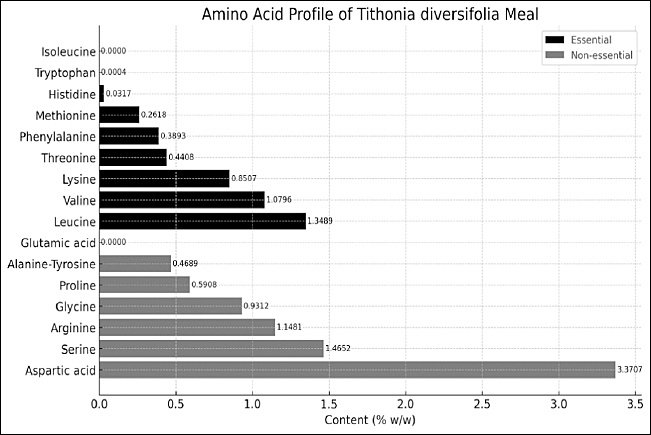
Figure 1. Amino acid profile of
In vitro digestibility and chemical composition of experimental diets
The results of the chemical analysis (Table 5) of experimental diets with different levels of
Table 5. Proximate chemical analysis: dry matter (DM, g/kg as feed); organic matter (OM), crude protein (CP), ether extract (EE), starch (St), neutral detergent fiber (NDF) and acid detergent fiber (ADF) (g/kg DM) of the studied treatments and of the
| Treatments (T) | DM | OM | CP | EE | ST | NDF | ADF | |||||||
|---|---|---|---|---|---|---|---|---|---|---|---|---|---|---|
|
| ||||||||||||||
| x̄ | SD | x̄ | SD | x̄ | SD | x̄ | SD | x̄ | SD | x̄ | SD | x̄ | SD | |
| Control | 894.98 | 3.64 | 917.03 | 3.92 | 173.90ab | 4.02 | 30.75 | 1.53 | 398.78 | 13.91 | 192.45ab | 5.27 | 78.00 | 5.65 |
| T1 (10 %) | 889.63 | 5.62 | 919.78 | 4.80 | 174.38ab | 1.86 | 30.65 | 1.77 | 400.03 | 8.60 | 196.63ab | 6.08 | 78.75 | 4.62 |
| T2 (15 %) | 893.60 | 6.00 | 917.08 | 5.78 | 176.20ab | 3.40 | 31.03 | 2.64 | 401.93 | 13.29 | 188.78a | 1.85 | 74.35 | 3.38 |
| T3 (20 %) | 890.30 | 4.80 | 923.95 | 8.55 | 178.38b | 1.60 | 31.38 | 2.27 | 405.88 | 5.57 | 201.23b | 2.55 | 76.45 | 5.31 |
| T4 (25 %) | 890.85 | 1.66 | 917.65 | 4.91 | 171.68a | 1.26 | 29.98 | 1.92 | 390.83 | 9.66 | 197.13ab | 6.37 | 79.60 | 3.91 |
| p-value | 0.4416 | 0.4284 | 0.03 | 0.9033 | 0.4019 | 0.02 | 0.5461 | |||||||
The values refer only to treatments studied according to analysis of variance (analysis of variance). Values are expressed as mean (X) ± standard deviation (SD). Control: 100 % feed (finishing pig concentrate), T1: 90 % feed + 10 %
Crude protein content showed a progressive increase from the control treatment (173.9 g/kg DM) to treatment T3 (20%), reaching a maximum value of 178.38 g/kg DM, followed by a decrease in T4 (171.68 g/kg DM). Post hoc analysis indicated that T3 differed significantly from the treatment with the highest inclusion level (T4), whereas treatments T1, T2, and the control exhibited intermediate values.
In terms of NDF, treatment T3 (20%) showed the highest value (201.23 g/kg DM), which was significantly higher than T2 (15%) with 188.78 g/kg DM. The remaining treatments did not show significant differences among them.
Starch, proximate stability, and energy trends
Total starch content (ST) ranged from 390.83 g/kg DM (T4) to 405.88 g/kg DM (T3), with no statistical differences (p = 0.4019). EE values remained constant (29.98–31.38 g/kg DM), with no evidence of treatment effects (p = 0.9033). DM and OM also remained stable among treatments (p > 0.4), indicating that the inclusion of
Energy trends derived from the
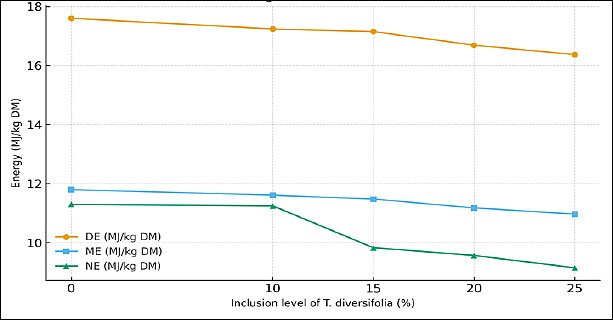
Figure 2.
In vitro digestibility and energy estimation
The
Table 6. Analysis of
| Treatments (T) | dvDM | dvOM | dOM | DE | MEcr | MEfc | NE | |||||||
|---|---|---|---|---|---|---|---|---|---|---|---|---|---|---|
|
| ||||||||||||||
| X | SD | X | SD | X | SD | X | SD | X | SD | X | SD | X | SD | |
| Control | 42.88b | 3.13 | 928.08a | 35.4 | 564.24a | 21.53 | 16.83a | 0.41 | 11.28a | 0.28 | 12.58a | 0.18 | 9.44a | 0.25 |
| T1 (10 %) | 36.88ab | 4.91 | 940.76a | 51.34 | 571.95a | 31.22 | 16.98a | 0.60 | 11.37a | 0.40 | 12.58a | 0.26 | 9.53a | 0.37 |
| T2 (15 %) | 36.39ab | 4.62 | 924.40a | 1.53 | 562.10a | 0.98 | 16.79a | 0.02 | 11.25a | 0.01 | 12.58a | 0.01 | 9.41a | 0.01 |
| T3 (20 %) | 31.68a | 2.72 | 940.16a | 21.64 | 571.59a | 13.16 | 16.97a | 0.25 | 11.37a | 0.17 | 12.58a | 0.11 | 9.53a | 0.16 |
| T4 (25 %) | 36.71ab | 2.52 | 898.44a | 8.65 | 546.22a | 5.26 | 16.49a | 0.10 | 11.05a | 0.07 | 12.58a | 0.04 | 9.23a | 0.06 |
| p-value | 0.0128 | 0.4509 | 0.4512 | 0.4509 | 0.4509 | 0.4509 | 0.4509 | |||||||
The values refer only to treatments studied according to analysis of variance (analysis of variance). Values are expressed as mean (X) ± standard deviation (SD). Control: 100 % feed (finishing pig concentrate), T1: 90 % feed + 10 %
Correspondingly, the estimated energy values (DE, ME, and NE) did not differ statistically (p > 0.05) among treatments, although a mild numerical downward trend was observed with increasing inclusion levels. These findings suggest that
DISCUSION
Nutritional composition of T. diversifolia flour
The crude fiber content was high (366.146 g/kg DM), as were the NDF (534.214 g/kg DM) and ADF (533.013 g/kg DM) values, reflecting a considerable structural fraction. These values suggest limited DM digestibility, especially for monogastric animals, although they could be functional as effective fiber in ruminants [4]. Lignin reached 292.917 (g/kg DM), a value that compromises the digestibility of the fibrous fraction by forming lignocellulosic complexes that are resistant to enzymatic action [22]. It has been observed that lignin levels above 180.100 (g/kg DM) can significantly reduce nutrient degradability in monogastric animals [23], and therefore this value must be carefully considered when formulating diets.
The low EE content (10.444 g/kg DM) is characteristic of shrubby forages, limiting their energy contribution via lipids. However, the energy balance can be maintained by including other energy-rich ingredients in the diet [24]. Ash accounted for 176.471 (g/kg DM), indicating significant mineral richness. This value is often associated with the presence of essential macro- and microminerals, as evidenced by the levels of calcium (32.413 g/kg DM), potassium (39.616 g/kg DM), and phosphorus (7.203 g/kg DM). The calcium content is particularly relevant for the diets of growing and lactating animals [25], while potassium and phosphorus play fundamental roles in osmotic regulation and energy metabolism [26].
The magnesium level (4.682 g/kg DM) and values for trace elements such as iron (0.267 g/kg DM), zinc (0.113 g/kg DM), manganese (0.068 g/kg DM), and copper (0.003 g/kg DM) are adequate and comparable to other tropical forage species [27]. The bioavailability of these elements must be evaluated based on their interaction with other dietary components, especially fiber and phytates [28]. Although the copper content was low, it can be supplemented with external sources according to the requirements of the animal species [29].
Overall, the nutritional profile of
Amino acid profile
Chromatographic analysis of
Among essential amino acids, leucine and valine predominated, with values of 1.35% and 1.08%, respectively. These amino acids are essential for muscle metabolism and protein synthesis, particularly in growing animals [32]. The concentration of lysine (0.85%) is also noteworthy, as it is commonly a limiting amino acid in plant-based diets, highlighting the potential of
However, low concentrations of methionine (0.26%) and an almost negligible presence of tryptophan (0.0004%) were observed, along with the absence of isoleucine and glutamic acid, which represents a nutritional limitation. The deficiency of methionine, an essential sulfur-containing amino acid, can compromise protein utilization efficiency [34]. Therefore, it is advisable to formulate diets that compensate for this deficiency, either through methionine-rich ingredients such as treated soybean meal or through synthetic supplementation [35].
Among non-essential amino acids, aspartic acid (3.37%), serine (1.46%), and glycine (0.93%) were predominant. These compounds play key roles as metabolic precursors and in the synthesis of nucleotides, collagen, and other structural components [36–38].
Overall, the amino acid profile suggests that
In vitro digestibility and nutritional implications
The results of the chemical analysis (Table 5) indicate that the progressive inclusion of
CP content increased up to treatment T3 (20%), reaching 178.38 g/kg DM, followed by a decrease in T4 (25%). This pattern suggests that moderate inclusion levels may enhance protein intake, possibly due to the high concentration of soluble nitrogen in the leaves of this species. The reduction observed in T4 may be attributed to protein dilution associated with increased fiber content, a phenomenon also reported in diets with high inclusion of fibrous forages [41]. Post hoc analysis confirmed a significant difference between T3 and T4, indicating that 20% may represent an optimal inclusion level for maximizing protein content.
NDF content was highest in T3 (201.23 g/kg DM), significantly exceeding that of T2 (188.78 g/kg DM). This increase in effective fiber may contribute to satiety in monogastric animals and stimulate rumination in ruminants [42], although it may also reduce digestibility. Despite variations in CP and NDF, total starch content remained stable (p = 0.40), suggesting that non-structural carbohydrate fractions were not affected by
Despite this trend, treatments T1 (10%) and T2 (15%) maintained moderate energy losses and acceptable digestibility coefficients (>36%) (Table 6), indicating that low to moderate inclusion levels may be viable without significantly compromising nutritional value [46]. This finding is relevant for practical applications, as it supports the use of
CONCLUSION
The present study demonstrated that
From a practical perspective, inclusion levels of 10%–15% appear to represent an optimal balance between nutritional contribution and digestibility, whereas higher inclusion levels (20%–25%) may compromise feed efficiency due to increased structural fiber and lignification. These findings suggest that
A key strength of this study lies in its integrated approach combining chemical composition, amino acid profiling, and
However, the study is limited by its reliance on
Future research should focus on
In conclusion,
DATA AVAILABILITY
The data generated and analyzed during this study are included in this published article. Additional data are available from the corresponding author upon reasonable request.
AUTHORS’ CONTRIBUTIONS
JADLTM: Conceptualization, study design, supervision, data analysis, and writing–original draft preparation, RLO: Study design, data interpretation, and critical revision of the manuscript, VCAY: Experimental design, data collection, and manuscript editing, JEDL: Sample processing, data collection, and manuscript revision, MAML: Laboratory analyses, data collection, and manuscript editing. All authors have read and approved the final manuscript.
COMPETING INTERESTS
The authors declare that they have no competing interests.
PUBLISHER’S NOTE
Veterinary World remains neutral with regard to jurisdictional claims in the published institutional affiliations.
ACKNOWLEDGMENTS
The authors express their sincere gratitude to the Universidad Regional Amazónica Ikiam for providing laboratory facilities and logistical support. Special thanks are extended to the technical staff of the Natural Products Laboratory for their collaboration during sample processing and analysis.
REFERENCES
- Jata N, Swain RK, Raula A, Priyadarshini NP. Alternative feed ingredients for sustainable livestock production. Alternative feed ingredients for sustainable livestock production 2024:194-204. [Google Scholar] | [Crossref]
- Lestingi A. Alternative and sustainable protein sources in pig diet:a review 2023. [Google Scholar] | [Crossref]
- Silva Júnior RA da, Andrade TU de.
Tithonia diversifolia (Hemsl.). A. Gray:uma planta multifuncional na etnobotânica. Flovet 2024;2(13):e2024003. [Google Scholar] | [Crossref] - Román-Miranda ML, Mora-Santacruz A, Avendaño-López AN, Sánchez-Martínez J. Chemical composition of
Tithonia diversifolia (Hemsl.) A. Gray (Asteraceae) and diversity of uses in rural areas. Eur J Entomol 2020:23-33. [Google Scholar] | [Crossref] - Verdecia-Acosta DM, Olmo-González C, Hernández-Montiel LG, Ojeda-Rodríguez A, Ramírez-de la Ribera JL, Martínez Aguilar Y.
Tithonia chemical composition of the foliage meal ofTithonia diversifolia . Enfoque UTE 2022;13(4):1-10. [Google Scholar] | [Crossref] - Conrado-Palma DJ, Meza-Bone GA, Meza Bone CJ, Vivas-Aturo W. Efecto del pasto INIAP 811 y
Tithonia diversifolia en el valor nutricionalin vitro . Ciencia y Tecnología 2022;15(1):41-8. [Google Scholar] | [Crossref] - Son JE, Park N, Kim BG. Energy utilization of corn, oilseed meals, and fibrous ingredients can be predicted by multi-sample simultaneous
in vitro assay for growing pigs. Anim Feed Sci Technol 2024. [Google Scholar] | [Crossref] - Gao Q, Zhang F, Ya W, Zhang H, Zhao J, Gao L. Predicting energetic values of cereal grains and byproducts using a computer-controlled simulated digestion system for growing pigs 2023. [Google Scholar] | [Crossref]
- Guatusmal-Gelpud C, Escobar-Pachajoa LD, Meneses-Buitrago DH, Cardona-Iglesias JL, Castro-Rincón E. Producción y calidad de
Tithonia diversifolia ySambucus nigra en trópico altoandino colombiano. Agron Mesoam 2020;31(1):193-208. [Google Scholar] | [Crossref] - Rodríguez I, Padilla C, Torres V. Evaluación de tres métodos de poda de
Tithonia diversifolia (Hemsl.). Gray bajo condiciones de pastoreo. Livest Res Rural Dev 2020;32:73. [Google Scholar] | [Crossref] - Universidad de Florida. Protocolos para determinar los contenidos de materia seca, materia orgánica, proteína bruta, extracto etéreo, digestibilidad
in vitro de materia seca, materia orgánica 1970. Available:www.iniap.gob.ec/nsite/index.php. Retrieved on 11-04-2026. [Available from] | [Google Scholar] - Universidad de Florida. Protocolos para determinar la energía bruta, energía digestible y energía metabolizable 1974. [Available from] | [Google Scholar]
- Van Soest PJ, Robertson JB, Lewis BA. Methods for dietary fiber, neutral detergent fiber, and non starch polysaccharides in relation to animal nutrition. J Dairy Sci 1991;74(10):3583-9. [Google Scholar] | [Crossref]
- Nutrient requirements of dairy cattle. 2001. Retrieved on 11-04-2026. [Available from] | [Google Scholar]
- Noblet J, Fortune H, Shi XS, Dubois S. Prediction of net energy value of feeds for growing pigs. J Anim Sci 1994;72(2):344-54. [Google Scholar] | [Crossref]
- Miles PH, Wilkinson NS, McDowell LR. Analysis of minerals for animal nutrition research. Department of animal science, University of Florida, Gainesville, USA 2001:117. [Google Scholar] | [Crossref]
- Noblet J, Jaguelin-Peyraud Y. Prediction of organic matter and energy digestibility in the growing pig from an
in vitro method. Anim Feed Sci Technol 2007;134:211-22. [Google Scholar] | [Crossref] - May RW, Bell JM. Digestible and metabolizable energy values of some feeds for the growing pig. Can J Anim Sci 1971;51:271-8. [Google Scholar] | [Crossref]
- Noblet J, Shi XS. Comparative digestibility of energy and nutrients in growing pigs fed ad libitum and adult sows at maintenance. Livest Prod Sci 1993;34:137-52. [Google Scholar] | [Crossref]
- NRC (National Research Council US Nutrient requirements of swine 2012. [cited 2026 Mar 28]. [Available from] | [Google Scholar]
- Scull I, Savón L, Ruíz TE, Rodríguez Y. Componentes químicos y efecto de la harina de forraje de
Tithonia diversifolia (Hemsl) en la calidad de la carne de cerdos en crecimiento-ceba. Livest Res Rural Dev 2022;34:33. [Google Scholar] | [Crossref] - Carranco-Jáuregui M, Barrita-Ramírez V, Ávila-González E, Sanginés-García L. Effect of
Tithonia diversifolia meal on productive variables in laying hens. Abanico Vet 2019;9. [Google Scholar] | [Crossref] - Djajadi DT, Jensen MM, Oliveira M, Jensen A, Thygesen LG, Pinelo M. Lignin from hydrothermally pretreated grass biomass retards enzymatic cellulose degradation by acting as a physical barrier rather than by inducing nonproductive adsorption of enzymes. Biotechnol Biofuels 2018;11(1):85. [Google Scholar] | [Crossref]
- Ngouopo M, Gwladys NK, Emile M, Christiane E, Yanou N, Florence FA. Effect of meal from the leaves of
Manihot esculenta andTithonia diversifolia as a protein substitute to soybean cake in the diet on growth and laying performances, egg quality of local hen (Gallus gallus ) in the Sudano-guinean zone. Int J Agron Agric Res;2021(18):1-12. [Google Scholar] | [Crossref] - Becker L, Gebhardt JT, Tokach MD, Woodworth JC, Goodband RD, DeRouchey JM. A review of calcium and phosphorus requirement estimates for gestating and lactating sows. Transl Anim Sci 2024. [Google Scholar] | [Crossref]
- Oliveira A, Soares SR. A new system of phosphorus and calcium requirements for lactating dairy cows. PLoS One 2024;19(8):e0308889. [Google Scholar] | [Crossref]
- Prasad CS, Gowda NKS. Importance of trace minerals and relevance of their supplementation in tropical animal feeding system:a review. Indian J Anim Sci 2005;75((1)). [Google Scholar] | [Crossref]
- Jack HA, Burke JL, Cranston LM, Morel PCH, Knights M. The mineral content of some tropical forages commonly used in small ruminant production systems in the Caribbean –part 2. Trop Agric 2021;97((1)). [Google Scholar] | [Crossref]
- Scott A, Vadalasetty KP, Chwalibog A, Sawosz E. Copper nanoparticles as an alternative feed additive in poultry diet:a review. Nano Rev 2018;7(1):69-93. [Google Scholar] | [Crossref]
- Zamora L, Avila FAS, Carrrilo JFE, Jimenez JLP, Cedeño EMM, Bone GAM. Valoración nutricional de
Tithonia diversifolia en la alimentación de conejos neozelandés. 2019. [Google Scholar] | [Crossref] - Hernández-Arboleda X, Ortiz Grisales S, Vivas-Arturo WF, Fernández Romay Y, La O-León O, Abdalla AL. Nutritional value and
in vitro dry matter degradability in Mexican sunflower:Tithonia diversifolia Helms (Gray). Trop Subtrop Agroecosyst 2024;27((3)). [Google Scholar] | [Crossref] - Zhang Q, Hou Y, Bazer FW, He W, Posey EA, Wu G. Amino acids in swine nutrition and production. Amino acids in nutrition and health:amino acids in the nutrition of companion, zoo and farm animals 2021:81-107. [Google Scholar] | [Crossref]
- Mendez-Martinez Y, Narvaez-Narvaez RI, Angulo C, Cortes-Jacinto E, Botello-Leon A, Verdecia-Acosta DM. Chemical composition of
Tithonia diversifolia (Hemsl.). and its effect on growth performance, feed efficiency and metabolic biochemistry of juvenile hybrid tilapiaOreochromis mossambicus ×Oreochromis niloticus . Not Bot Horti Agrobot Cluj-Napoca 2023;51(3):13337. [Google Scholar] | [Crossref] - Souza VC, Remus A, Batonon-Alavo DI, Rouffineau F, Mercier Y, Pomar C. Systematic review and meta-analysis of the methionine utilization efficiency in piglets receiving different methionine sources. Animal 2023;17:100894. [Google Scholar] | [Crossref]
- Paredes-Orozco MP, Bravo-Calle OE. Influencia de la suplementación con aminoácidos en la nutrición y rendimiento productivo de los cerdos. Código Científico Rev Investig 2025;6(1):488-506. [Google Scholar] | [Crossref]
- Owens JE. Amino acids:metabolism. Elsevier; 2023. p. 23-35. [Google Scholar]
- Razak MA, Begum PS, Viswanath B, Rajagopal S. Multifarious beneficial effect of nonessential amino acid, glycine:a review. Oxid Med Cell Longev 2017;2017:1716701. [Google Scholar] | [Crossref]
- Ren W, Li Y, Yin Y, Blachier F. Structure, metabolism and functions of amino acids:an overview. Amino acids 2013:91-108. [Google Scholar] | [Crossref]
- Cruz OT, Zambrano JC, Ospina MA, Castañeda Serrano RD. Effects of
Tithonia diversifolia extract as a feed additive on digestibility and performance of hair lambs. Animals 2024;14(24):3648. [Google Scholar] | [Crossref] - Rodríguez-Badilla B, Álvarez Brito R, López-Herrera MaC. Inclusión de
Tithonia diversifolia sobre la calidad de ensilajes de Cuba OM22 con la adición deMusa sp. Nutr Anim Trop 2022;16(2):71-90. [Google Scholar] | [Crossref] - Niepes RA, Bestil L. Nutrient digestibility of fibrous feedstuffs in high-concentrate diet with sodium-bicarbonate (NaHCO₃) addition in rumen-fistulated Brahman bull. Online J Anim Feed Res 2023. [Google Scholar] | [Crossref]
- Adams S, Che D, Qin G, Rui H, Sello CT, Hailong J. Interactions of dietary fiber with nutritional components on gut microbial composition, function and health in monogastrics. Curr Protein Pept Sci 2018;19(10):1011-23. [Google Scholar] | [Crossref]
- Martínez-Vilalta J, Sala A, Asensio D, Galiano L, Hoch G, Palacio S. Dynamics of non-structural carbohydrates in terrestrial plants:a global synthesis. Ecol Monogr 2016;86(4):495-516. [Google Scholar] | [Crossref]
- Mori Ramirez FM, Gonzales Aranibar BJ. Efecto de la fibra dietaría preparto sobre la respuesta conductual y fisiológica en cerdas criollas. 2023. [Google Scholar] | [Crossref]
- Weimer PJ. Degradation of cellulose and hemicellulose by ruminal microorganisms. Microorganisms 2022;10(12):2345. [Google Scholar] | [Crossref]
- Durán ADC, Yucailla VCA. Evaluación de la inclusión de cebadilla de cerveza en la alimentación de pollos de engorde para promover la producción sostenible y el valor agregado en áreas rurales. Rev Científica Arbitrada Multidisciplinaria PENTACIENCIAS 2025;7(1):87-98. [Google Scholar] | [Crossref]
- Churta Valencia JA. Caracterización morfométrica del tracto gastrointestinal de cerdos de engorde alimentados parcialmente con harina de botón de oro (
Tithonia diversifolia ) [Bachelor's thesis. Jipijapa-Unesum 2023. [Google Scholar] | [Crossref] - Rojas OJ, Stein H-H. Concentration of digestible, metabolizable, and net energy and digestibility of energy and nutrients in fermented soybean meal, conventional soybean meal, and fish meal fed to weanling pigs. J Anim Sci 2013;91(9):4397-405. [Google Scholar] | [Crossref]