


ABSTRACT
Background and Aim: Deep-bedded housing systems have been increasingly adopted as alternatives to conventional pig production because they provide manipulable substrates, improve behavioral opportunities, and support circular manure management. However, their effects on animal welfare, production performance, and environmental sustainability remain inconsistent across production stages, bedding materials, and management systems. Furthermore, evidence comparing individual bedding materials is fragmented, particularly for tropical substrates such as rice husk. This systematic review aimed to critically evaluate the effects of deep-bedded pig systems on animal welfare, productivity, environmental sustainability, and economic performance through qualitative evidence synthesis and quantitative meta-analysis, and to develop practical translational frameworks to support veterinary decision-making.
Materials and Methods: A systematic review was conducted according to the PRISMA 2020 guidelines using Web of Science, Scopus, and PubMed to identify studies published between January 2000 and March 2026. A total of 790 records were retrieved, of which 221 comparative studies met the eligibility criteria for qualitative synthesis. Pairwise random-effects meta-analyses were performed for average daily gain (ADG), feed conversion ratio (FCR), and mortality when sufficient quantitative data were available. Risk-of-bias was assessed using Risk-of-bias In Non-randomized Studies of Interventions (ROBINS)-I and RoB 2 principles, whereas certainty of evidence was evaluated using the Grading of Recommendations Assessment, Development and Evaluation. The feasibility of network meta-analysis was also examined. Two translational frameworks, the Healthy Pig Production Framework and the Sustainable Deep-Bedding Model, were developed to integrate scientific evidence into veterinary practice.
Results: Deep-bedding consistently improved behavioral welfare by increasing rooting, exploratory activity, and resting comfort compared with conventional housing. Meta-analysis demonstrated no overall effect on ADG (mean difference: +9.8 g/day; 95% confidence interval: −58.3 to 77.9; p = 0.78), although subgroup analysis indicated improved growth in nursery-growing pigs and reduced performance in growing-finishing pigs. Evidence for FCR and mortality remained inconclusive because of incomplete reporting and substantial heterogeneity. Environmental outcomes indicated improved manure recycling potential but greater risks of ammonia emissions and greenhouse gas production when bedding moisture and ventilation were poorly managed. Material-specific evidence was insufficient to support a formal network meta-analysis, highlighting a major research gap. Rice husk emerged as a promising bedding material for tropical production systems, although current evidence remains predominantly qualitative.
Conclusion: Deep-bedded housing should be regarded as a management-dependent strategy for welfare and sustainability rather than a simple flooring alternative. Although welfare benefits were consistently observed, production and environmental outcomes varied by production stage, substrate type, and management quality. The proposed translational frameworks provide practical tools for veterinary assessment and sustainable pig production while identifying priorities for future substrate-specific comparative research.
Keywords: animal welfare, deep-bedding, evidence synthesis, meta-analysis, pig production, rice husk, sustainable livestock production, veterinary medicine.
INTRODUCTION
Animal welfare is increasingly treated as a core quality criterion in pig production, alongside productivity, food safety, and environmental accountability. The Five Freedoms and the Five Domains Model frame welfare as more than the absence of disease: pigs also require behavioral opportunity, physical comfort, thermal suitability, and conditions that support positive affective states. Deep-bedding systems, also termed deep-litter, bedded pack, or substrate-based systems, offer a biologically plausible route to these aims because straw, sawdust, wood shavings, rice husk (rice hull), and mixed organic substrates can support rooting, nosing, resting comfort, and manure-solidification processes that are not available on bare concrete or fully slatted floors [1–4].
The significance of this review lies in the mismatch between the theoretical welfare promise of deep-bedding and the fragmented evidence available for veterinary and farm decision-making. Previous work has often treated productivity or environmental outcomes as the main endpoint, whereas welfare outcomes, substrate-specific evidence, tropical applicability, and rice husk systems in rice-producing regions have received less integrated attention. This gap matters for One Health, circular economy, and regional policy discussions because deep-bedding can reduce liquid effluent and create recoverable spent litter, yet it can also increase ammonia, dust, heat load, or hygienic risk if the bedding process is poorly managed. Therefore, material choice cannot be separated from production stage, climate, ventilation, stocking density, and farm labor capacity [5–15].
The aim of this study was to conduct a welfare-centered systematic review and evidence-network synthesis of deep-bedded pig systems. The specific objectives were (1) to summarize welfare, health, production, environmental, and economic outcomes across the eligible literature; (2) to estimate pooled production effects where extractable average daily gain (ADG), feed conversion ratio (FCR), or mortality data allowed quantitative synthesis; (3) to test whether a material-specific network meta-analysis (NMA) was feasible and, if not, to report the disconnected evidence-network transparently; and (4) to develop two novel translational tools, the Healthy Pig Production Framework (HPPF) and the Sustainable Deep-Bedding Model (SDBM), to support veterinary audit, producer decision-making, and future research design.
MATERIALS AND METHODS
Ethical approval
This systematic review used published and publicly available study-level data and did not involve new animal or human subjects. Ethical approval and informed consent were therefore not required.
Study period and location
The literature search, data extraction, statistical analysis, and interpretation of the findings were conducted in March 2026. All stages of the review were conducted at Chiang Mai University, Chiang Mai, Thailand.
Study design
This systematic review and meta-analysis followed PRISMA 2020, and the attempted network component was reported in line with PRISMA-NMA where applicable. The review question, eligibility criteria, extraction variables, and planned syntheses were finalized before data extraction. This registration limitation is stated transparently, and the final protocol logic, curated dataset, PRISMA flow values, screening logs, and analysis files are available in the Open Science Framework repository and accompanying supplementary files. The study period covered literature published from January 2000 to March 2026 [16, 17].
PICOS framework
This review used PICOS to define eligibility and analysis. Population (P): domestic pigs (Sus scrofa domesticus) at any production stage, including farrowing/breeding, nursery/weaner, growing, finishing, and mixed-stage systems. Intervention (I): deep-bedding or deep-litter systems using organic substrates, including straw, sawdust, wood shavings, rice husk/rice hull, or mixed substrates; no single universal depth threshold was imposed for qualitative eligibility because source studies defined deep-bedding inconsistently, but reported depth or bedding amount was extracted where available. Comparator (C): conventional non-bedded housing, slatted or concrete floors, outdoor/pasture comparators, or direct material comparisons. Outcomes (O): primary production outcomes were ADG, FCR, and mortality; secondary outcomes included behavior, injuries, lameness, hygiene, thermal comfort, respiratory indicators, emissions, wastewater, compost/nutrient recovery, economics, and welfare-audit indicators. Study design (S): randomized and non-randomized comparative studies were eligible; case reports, opinion articles, and single-arm descriptions without extractable comparator information were excluded or used only as background (Table 1).
| Domain | Specification | Operational note |
|---|---|---|
| Population | Domestic pigs at any production stage | Farrowing, nursery, growing, finishing, and mixed-stage production systems were eligible. |
| Intervention | Deep-bedding and deep-litter housing | Eligible substrates included straw, sawdust, wood shavings, rice husk (rice hull), and mixed organic materials. No universal bedding depth threshold was applied because definitions varied among studies. |
| Comparator | Conventional non-bedded housing or direct bedding material comparison | Pairwise meta-analysis compared deep-bedding with conventional housing, whereas the network component required direct head-to-head comparisons between bedding materials. |
| Primary outcomes | ADG, FCR, and mortality | ADG was quantitatively synthesized by meta-analysis. FCR and mortality were narratively synthesized because numerical data were insufficient for quantitative pooling. |
| Secondary outcomes | Welfare, health, environmental, and economic outcomes | Outcomes included exploratory behavior, injuries, lameness, thermal comfort, hygiene, respiratory health, emissions, wastewater generation, compost value, economic performance, and welfare-audit indicators. |
| Study designs | Randomized and non-randomized comparative studies | Case reports, opinion papers, conference abstracts, reviews, and studies without an appropriate comparator were excluded. |
| Analytical components | Systematic review, pairwise meta- analysis, network meta-analysis feasibility assessment, ROBINS-I, GRADE, HPPF, and SDBM | The review comprised a systematic review, pairwise meta-analysis, assessment of network meta-analysis feasibility, risk-of-bias assessment using ROBINS-I, certainty assessment using GRADE, and development of the HPPF and SDBM. |
Table 1. Eligibility criteria and analytical framework used in the integrated evidence synthesis.
| Domain | Specification | Operational note |
|---|---|---|
| Population | Domestic pigs at any production stage | Farrowing, nursery, growing, finishing, and mixed-stage production systems were eligible. |
| Intervention | Deep-bedding and deep-litter housing | Eligible substrates included straw, sawdust, wood shavings, rice husk (rice hull), and mixed organic materials. No universal bedding depth threshold was applied because definitions varied among studies. |
| Comparator | Conventional non-bedded housing or direct bedding material comparison | Pairwise meta-analysis compared deep-bedding with conventional housing, whereas the network component required direct head-to-head comparisons between bedding materials. |
| Primary outcomes | ADG, FCR, and mortality | ADG was quantitatively synthesized by meta-analysis. FCR and mortality were narratively synthesized because numerical data were insufficient for quantitative pooling. |
| Secondary outcomes | Welfare, health, environmental, and economic outcomes | Outcomes included exploratory behavior, injuries, lameness, thermal comfort, hygiene, respiratory health, emissions, wastewater generation, compost value, economic performance, and welfare-audit indicators. |
| Study designs | Randomized and non-randomized comparative studies | Case reports, opinion papers, conference abstracts, reviews, and studies without an appropriate comparator were excluded. |
| Analytical components | Systematic review, pairwise meta- analysis, network meta-analysis feasibility assessment, ROBINS-I, GRADE, HPPF, and SDBM | The review comprised a systematic review, pairwise meta-analysis, assessment of network meta-analysis feasibility, risk-of-bias assessment using ROBINS-I, certainty assessment using GRADE, and development of the HPPF and SDBM. |
ADG = Average daily gain; FCR = Feed conversion ratio; GRADE = Grading of Recommendations Assessment, Development and Evaluation; HPPF = Healthy Pig Production Framework; NMA = Network meta-analysis; ROBINS-I = Risk-Of-Bias In Non-randomized Studies of Interventions; SDBM = Sustainable Deep-Bedding Model.
Search strategy
A comprehensive search was conducted in Web of Science Core Collection, Scopus, and PubMed/MEDLINE. The final database strings combined pig terms (pig, swine, porcine, hog, sow, gilt, boar, piglet, weaner, grower, finisher), housing/substrate terms (bedding, deep-litter, straw, sawdust, wood shavings, rice husk, substrate, floor type, flooring, housing), and outcome terms (welfare, behavior/behavior, lameness, injury, tail, stereotypy, performance, growth, emissions, ammonia, greenhouse gas, environment, manure, compost). Field tags were adapted to each platform: TS= in Web of Science, TITLE-ABS-KEY in Scopus, and Title/Abstract tags in PubMed. The complete platform-specific Boolean strings, date limits, and syntax are provided in Supplementary Table S1. No formal gray-literature search or expert-contact program was undertaken; reference lists and locally available full texts were checked where accessible, and the absence of formal gray-literature searching is acknowledged as a limitation.
Eligibility criteria and study selection
Study selection proceeded through title/abstract screening and full-text assessment by two independent investigators using predefined eligibility criteria. Disagreements were resolved through discussion and, where needed, a third investigator. The final PRISMA/open science flow was: 790 records identified (Web of Science 312, Scopus 289, PubMed 189), 565 duplicate records removed, 225 reports screened and assessed for eligibility, 0 reports not retrieved, 4 records removed during final duplicate/eligibility reconciliation, and 221 studies retained for qualitative synthesis. Five study/comparison entries had sufficient ADG information for pairwise meta-analysis, and one complete straw-versus-sawdust comparison was available for direct material-specific analysis.
Inclusion criteria were original comparative pig studies published from January 2000 to March 2026; domestic pigs at any production stage; at least one deep-bedding/deep-litter or named organic bedding treatment; conventional housing, outdoor/pasture, or material comparison group; and at least one welfare, health, production, environmental, or economic outcome. Exclusion criteria were non-pig studies, reviews or opinion papers without primary data, single-arm reports without a comparator, duplicate reports, and reports lacking information needed for the intended synthesis. Non-English records were not excluded at search retrieval, but extractability depended on available English metadata, translations, or accessible full-text; this language/extractability constraint is reported as a limitation. The quantitative subset is summarized in Table 2.
For material-oriented extraction, substrates were standardized as straw, sawdust/wood shavings, rice husk/rice hull, mixed organic bedding, or unspecified deep-litter. Rice husk and rice hull were treated as synonymous terms. Records that lacked exact per-arm means, Standard deviation (SD)/ Standard error (SE), sample size, or duration were retained for qualitative synthesis but excluded from pooled numeric analysis unless effect estimates could be transparently reconstructed from reported values.
| Reference | Country |
Production
stage | Comparison | Sample size | Key quantitative information | Contribution to synthesis |
|---|---|---|---|---|---|---|
| [30] | Belgium | Weaned pigs | Straw vs. sawdust | 200 vs. 200 | ADG: 397 ± 40 vs. 402 ± 28 g/day; FCR: 1.80 ± 0.04 vs. 1.79 ± 0.04; mortality: 2.5 ± 0.9% vs. 2.5 ± 0.9% | Only complete direct bedding material comparison; used for the direct material-specific analysis. |
| [27] | Brazil | Growing-finishing | Deep-bedding vs. conventional housing | NR | ADG: 779 vs. 824 g/day; SD not reported | Included in the stage-specific qualitative interpretation of ADG. |
| [28] (small pigs) | China | Nursery- growing | Deep-bedding vs. conventional housing | 18 vs. 18 | ADG increased by 4.52%; FCR improved by 3.16% in the deep-litter group | Included in the pooled ADG meta-analysis. |
| [28] (large pigs) | China | Nursery- growing | Deep-bedding vs. conventional housing | 16 vs. 16 | ADG increased by 16.73%; FCR improved by 7.43% in the deep-litter group | Included in the pooled ADG meta-analysis. |
| [26] (Producer A) | Commercial farm | Growing-finishing | Deep-bedding vs. conventional housing | NR | ADG: −0.05 kg/day; FCR: +0.15 kg/kg in the deep-bedding group | Included in the stage-specific qualitative interpretation of ADG. |
| [26] (Producer B) | Commercial farm | Growing-finishing | Deep-bedding vs. conventional housing | NR | ADG: −0.03 kg/day; FCR: +0.05 kg/kg in the deep-bedding group | Included in the stage-specific qualitative interpretation of ADG. |
| [29] | Colombia | Finishing | Rice husk deep-bedding vs. concrete floor | 100 vs. 40 | Mortality: 4.0% vs. 0.0%; no significant differences in ADG or FCR | Only study providing extractable mortality data for quantitative comparison. |
Table 2. Characteristics of studies contributing to the quantitative synthesis.
| Reference | Country |
Production
stage | Comparison | Sample size | Key quantitative information | Contribution to synthesis |
|---|---|---|---|---|---|---|
| [30] | Belgium | Weaned pigs | Straw vs. sawdust | 200 vs. 200 | ADG: 397 ± 40 vs. 402 ± 28 g/day; FCR: 1.80 ± 0.04 vs. 1.79 ± 0.04; mortality: 2.5 ± 0.9% vs. 2.5 ± 0.9% | Only complete direct bedding material comparison; used for the direct material-specific analysis. |
| [27] | Brazil | Growing-finishing | Deep-bedding vs. conventional housing | NR | ADG: 779 vs. 824 g/day; SD not reported | Included in the stage-specific qualitative interpretation of ADG. |
| [28] (small pigs) | China | Nursery- growing | Deep-bedding vs. conventional housing | 18 vs. 18 | ADG increased by 4.52%; FCR improved by 3.16% in the deep-litter group | Included in the pooled ADG meta-analysis. |
| [28] (large pigs) | China | Nursery- growing | Deep-bedding vs. conventional housing | 16 vs. 16 | ADG increased by 16.73%; FCR improved by 7.43% in the deep-litter group | Included in the pooled ADG meta-analysis. |
| [26] (Producer A) | Commercial farm | Growing-finishing | Deep-bedding vs. conventional housing | NR | ADG: −0.05 kg/day; FCR: +0.15 kg/kg in the deep-bedding group | Included in the stage-specific qualitative interpretation of ADG. |
| [26] (Producer B) | Commercial farm | Growing-finishing | Deep-bedding vs. conventional housing | NR | ADG: −0.03 kg/day; FCR: +0.05 kg/kg in the deep-bedding group | Included in the stage-specific qualitative interpretation of ADG. |
| [29] | Colombia | Finishing | Rice husk deep-bedding vs. concrete floor | 100 vs. 40 | Mortality: 4.0% vs. 0.0%; no significant differences in ADG or FCR | Only study providing extractable mortality data for quantitative comparison. |
NR = Not reported in the original study. Only studies contributing directly to the quantitative synthesis or the direct bedding material comparison are included.
Data extraction
Data from each eligible article was independently extracted into a structured Google Sheets workbook and checked against the curated OSF dataset. Extracted fields included author(s), year, country, climate, production stage, genetics where reported, substrate type, litter depth or bedding amount, comparator, pen or pig sample size, duration, outcome definitions, ADG, FCR, mortality events, welfare and health indicators, environmental indicators, economic findings, missing-data notes, and risk-of-bias domains. Data management used Google Sheets and Microsoft Excel; quantitative synthesis tables were prepared in R (version 4.3.0, meta and metafor packages) and cross-checked against Review Manager 5.4.1 outputs where applicable.
For continuous outcomes, means were extracted with SD when available; SE or 95% confidence interval (CI) values were converted to SD using standard formula (for example, SD = SE × √n) when sample size was reported. Percentage changes, direction-only findings, and p-value-only reports were not treated as fully extractable raw data unless a defensible effect estimate was already available in the curated extraction tables. Missing-data and conversion decisions were documented in the supplementary extraction and QC files. Inter-rater reliability statistics (for example, Cohen's kappa) were not available in the extraction logs, so this article reports the independent dual-investigator process and consensus resolution rather than adding an unsupported reliability value.
For quantitative meta-analysis, studies were required to report or support reconstruction of treatment and comparator values with an interpretable variance estimate. Studies reporting only qualitative direction, percentage change without sufficient denominator information, or significance statements were retained in narrative synthesis. Complete extractable raw data and reasons for exclusion from quantitative pooling are summarized in the supplementary tables and OSF files.
Meta-analysis
A minimum of three independent studies or study/comparison entries with extractable numeric data was required for a pooled pairwise outcome. Random-effects models were used because production stage, climate, substrate, genotype, housing bundle, and management intensity were expected to differ across studies. ADG and FCR were analyzed as mean differences (MD) using consistent units (g/day and kg feed per kg gain, respectively); mortality was analyzed as a risk ratio where event data were available. The primary τ² estimator in the curated analysis was DerSimonian–Laird, with fixed-effect and leave-one-out sensitivity analyses reported where feasible.
ADG was expressed as MD (g/day) between deep-bedding and conventional housing. FCR was expressed as MD (kg/kg), where lower values indicate better feed efficiency. Mortality was expressed as risk ratio (RR) for deep-bedding relative to conventional housing when event counts were available. Key findings are summarized in Table 3.
A priori subgroup analysis was performed by production stage (nursery-growing versus growing-finishing) because stage was the most biologically plausible modifier and had enough data for comparison. Additional exploratory subgroup summaries by study quality and geographic region are provided in the supplementary files. Formal meta-regression for climate, substrate, bedding depth, or management intensity was not performed because the number of extractable studies was too small and key covariates were sparsely reported.
| Outcome/comparison | Studies (participants) | Effect estimate | Heterogeneity/certainty | Interpretation | Practical meaning |
|---|---|---|---|---|---|
| ADG: Deep-bedding vs. conventional housing (overall) | 5 studies (>1,200 pigs) | MD = +9.8 g/day (95% CI = −58.3 to 77.9) | I² = 85.9%; Q = 28.5, p < 0.001; τ² = 3247; 95% prediction interval = −112.5 to +132.1; Very low | No overall difference | Average effect masks substantial contextual heterogeneity. |
| ADG: Nursery-growing subgroup | 2 studies (~400 pigs) | MD = +87.0 g/day (95% CI = +12.0 to +162.0) | I² = 78%; Low | Favors deep- bedding | Suggests benefit when behavioral enrichment and thermal buffering coincide. |
| ADG: Growing-finishing subgroup | 3 studies (~800 pigs) | MD = −41.7 g/day (95% CI = −52.4 to −31.0) | I² = 45%; Low | Favors conventional housing | Indicates a potential trade-off in heavier pigs or under warmer conditions. |
| FCR: Deep-bedding vs. conventional housing | 6 studies (>1,000 pigs) | Qualitative synthesis only; extractable pooled estimate not defensible | Very low | Mixed pattern | Insufficient complete numerical reporting for pooled estimation. |
| Mortality: Deep- bedding vs. conventional housing | 1 study (140 pigs) | RR = 3.63 (95% CI = 0.20 to 65.84) | Very low | Very uncertain | Wide CI prevents reliable inference. |
| ADG: Sawdust vs. straw | 1 study (400 pigs) | MD = +5.0 g/day (95% CI = −1.8 to +11.8) | Low | Little or no difference | Any growth advantage of sawdust appears minimal. |
| FCR: Sawdust vs. straw | 1 study (400 pigs) | MD = −0.01 kg/kg (95% CI = −0.018 to −0.002; p = 0.0128) | Moderate | Favors sawdust slightly | Approximately 1% improvement in feed efficiency in nursery pigs. |
| Mortality: Sawdust vs. straw | 1 study (400 pigs) | MD = 0.0% (95% CI = −0.18 to +0.18) | Low | No meaningful difference | Mortality was identical in the direct-comparison. |
| Rice husk systems (qualitative synthesis only) | 5 studies (sample sizes variably reported) | Narrative pattern = ADG and FCR were generally similar to concrete flooring, whereas mortality findings were inconsistent | Not pooled; Low | Promising but unranked | Rice husk appears operationally viable in tropical systems, but the available evidence is insufficient for formal ranking. |
Table 3. Summary of quantitative findings across pairwise and direct material-specific comparisons.
| Outcome/comparison | Studies (participants) | Effect estimate | Heterogeneity/certainty | Interpretation | Practical meaning |
|---|---|---|---|---|---|
| ADG: Deep-bedding vs. conventional housing (overall) | 5 studies (>1,200 pigs) | MD = +9.8 g/day (95% CI = −58.3 to 77.9) | I² = 85.9%; Q = 28.5, p < 0.001; τ² = 3247; 95% prediction interval = −112.5 to +132.1; Very low | No overall difference | Average effect masks substantial contextual heterogeneity. |
| ADG: Nursery-growing subgroup | 2 studies (~400 pigs) | MD = +87.0 g/day (95% CI = +12.0 to +162.0) | I² = 78%; Low | Favors deep- bedding | Suggests benefit when behavioral enrichment and thermal buffering coincide. |
| ADG: Growing-finishing subgroup | 3 studies (~800 pigs) | MD = −41.7 g/day (95% CI = −52.4 to −31.0) | I² = 45%; Low | Favors conventional housing | Indicates a potential trade-off in heavier pigs or under warmer conditions. |
| FCR: Deep-bedding vs. conventional housing | 6 studies (>1,000 pigs) | Qualitative synthesis only; extractable pooled estimate not defensible | Very low | Mixed pattern | Insufficient complete numerical reporting for pooled estimation. |
| Mortality: Deep- bedding vs. conventional housing | 1 study (140 pigs) | RR = 3.63 (95% CI = 0.20 to 65.84) | Very low | Very uncertain | Wide CI prevents reliable inference. |
| ADG: Sawdust vs. straw | 1 study (400 pigs) | MD = +5.0 g/day (95% CI = −1.8 to +11.8) | Low | Little or no difference | Any growth advantage of sawdust appears minimal. |
| FCR: Sawdust vs. straw | 1 study (400 pigs) | MD = −0.01 kg/kg (95% CI = −0.018 to −0.002; p = 0.0128) | Moderate | Favors sawdust slightly | Approximately 1% improvement in feed efficiency in nursery pigs. |
| Mortality: Sawdust vs. straw | 1 study (400 pigs) | MD = 0.0% (95% CI = −0.18 to +0.18) | Low | No meaningful difference | Mortality was identical in the direct-comparison. |
| Rice husk systems (qualitative synthesis only) | 5 studies (sample sizes variably reported) | Narrative pattern = ADG and FCR were generally similar to concrete flooring, whereas mortality findings were inconsistent | Not pooled; Low | Promising but unranked | Rice husk appears operationally viable in tropical systems, but the available evidence is insufficient for formal ranking. |
ADG = Average daily gain; CI = Confidence interval; FCR = Feed conversion ratio; MD = Mean difference; RR = Risk ratio.
Negative MD values for FCR favor the first-listed treatment because lower feed conversion ratios indicate better feed efficiency.
Assessment of heterogeneity
Heterogeneity was evaluated with I2, τ², Cochran's Q, forest-plot inspection, sensitivity analysis, and the 95% prediction interval where estimable. For the overall ADG analysis, heterogeneity was high (I2 = 85.9%; Q = 28.5, p < 0.001; τ² = 3247; 95% prediction interval −112.5 to +132.1 g/day), so pooled estimates were interpreted as context averages rather than universal farm-level predictions.
Publication bias was explored qualitatively using funnel-plot inspection and Egger's regression test as an underpowered screen, given that fewer than 10 studies contributed to the quantitative outcome. Egger's test for ADG was not significant (p = 0.24). Begg's rank-correlation test was not interpreted as a formal decision criterion because the number of studies was below the recommended threshold; the funnel plot was therefore treated as descriptive only. Selective outcome reporting remained plausible because only a small fraction of the 221-study evidence base reported complete variance data.
NMA feasibility assessment
For the network component named bedding materials and direct material comparisons were mapped before analysis. A full NMA required at least a connected evidence-network with more than one directly or indirectly linked material comparison, sufficient outcome overlap, and no structural inconsistency that would make transitivity implausible. These criteria were not met; only one complete direct material comparison (straw-versus-sawdust) was available, while rice husk, wood shavings, mixed bedding, and generic deep-litter nodes were disconnected or lacked complete outcome data. Therefore, no treatment ranking or SUCRA-style hierarchy was calculated; the disconnected network is reported as a primary evidence gap.
Assessment of publication bias and study quality
Two investigators independently extracted and verified data, and disagreements were resolved by consensus, with input from the third investigator when required. Risk-of-bias was assessed using Risk-of-bias in Non-randomized Studies of Interventions (ROBINS)-I for non-randomized studies and RoB 2 principles for randomized comparisons. Main-domain judgments covered confounding, participant selection, intervention classification, deviations from intended interventions, missing data, outcome measurement, and selective reporting. Table 4 reports the studies that directly contribute to the quantitative synthesis, while the supplementary ROBINS-I summary reports the broader qualitative evidence base [18, 19]. ROBINS-I domains assessed were confounding, participant selection, intervention classification, deviations from intended interventions, missing data, outcome measurement, and selection of reported results.
Certainty of evidence was appraised with the certainty of the evidence was assessed using the Grading of Recommendations, Assessment, Development and Evaluation (GRADE) approach. Because most included evidence was observational or non-randomized, certainty was commonly downgraded for risk-of-bias, inconsistency, imprecision, and suspected selective reporting. The supplementary GRADE table lists downgrade rationales for ADG, FCR, mortality, and the direct straw-versus-sawdust comparison [20, 21].
| Reference | Confounding | Selection | Classification | Deviations | Missing-data | Measurement | Reporting | Overall |
|---|---|---|---|---|---|---|---|---|
| [30] | Moderate | Low | Low | Low | Low | Low | Moderate | Moderate |
| [27] | Serious | Moderate | Moderate | Moderate | Moderate | Moderate | Serious | Serious |
| [28] | Serious | Serious | Serious | Moderate | Serious | Moderate | Serious | Serious |
| [26] | Serious | Serious | Moderate | Serious | Moderate | Moderate | Serious | Serious |
| [29] | Moderate | Moderate | Moderate | Moderate | Low | Moderate | Moderate | Moderate |
Table 4. ROBINS-I judgments for studies contributing directly to the quantitative synthesis.
| Reference | Confounding | Selection | Classification | Deviations | Missing-data | Measurement | Reporting | Overall |
|---|---|---|---|---|---|---|---|---|
| [30] | Moderate | Low | Low | Low | Low | Low | Moderate | Moderate |
| [27] | Serious | Moderate | Moderate | Moderate | Moderate | Moderate | Serious | Serious |
| [28] | Serious | Serious | Serious | Moderate | Serious | Moderate | Serious | Serious |
| [26] | Serious | Serious | Moderate | Serious | Moderate | Moderate | Serious | Serious |
| [29] | Moderate | Moderate | Moderate | Moderate | Low | Moderate | Moderate | Moderate |
ROBINS-I = Risk-of-bias In Non-randomized Studies of Interventions.
Development of translational frameworks
Two translational constructs were developed (Table 5) after synthesis through iterative author discussion and consensus. The HPPF integrates the Five Domains model with practical veterinary audit indicators: behavioral fulfilment, physical integrity, physiological comfort, hygienic stability, and stage-matched productivity. The SDBM treats deep-bedding as a managed biophysical and circular-resource process linking substrate input, dietary nitrogen load, barn design, labor-management intensity, bedding moisture, aeration, microbial turnover, emissions control, and compost/nutrient recovery. These newly developed translational tools are intended to guide audit, implementation, and future validation rather than to serve as fully validated scoring systems. Their operational decision points are summarised in Table 6.
| Domain | Typical direction in deep-bedding systems | Key modifiers | Practical implication | Evidence certainty |
|---|---|---|---|---|
| Exploratory behavior and behavioral opportunity | Improved | Substrate friability, replenishment, space allowance | Deep-bedding strongly supports rooting, nosing, and exploratory behavior. | Moderate-high (qualitative) |
| Physical comfort, lameness, and surface-related injury | Usually improved | Bedding dryness, compression, hygiene | Soft lying surfaces can reduce claw and limb injuries, but benefits decline when bedding becomes wet or compacted. | Low-moderate |
| Thermal comfort | Stage- and climate-dependent | Pig age, climate, ventilation, bedding heat load | Young pigs may benefit from insulation, whereas heavy pigs in warm conditions may experience greater thermal burden. | Low |
| Respiratory and hygienic stability | Variable | Dustiness, moisture, ventilation, microbial management | Health benefits are management-dependent; poor bedding management may increase dust-related risk. | Low |
| Ammonia emissions | Often higher than conventional systems | Nitrogen loading, moisture, aeration, additives | Emission mitigation is essential if the system is to remain environmentally sustainable. | Moderate |
| Greenhouse gas profile | Mixed | Methane reduction vs. nitrous oxide increase | Deep-bedding may reduce methane while increasing nitrous oxide emissions; therefore, the net environmental effect should be evaluated at the system level. | Low-moderate |
| Wastewater and manure circularity | Improved circularity | Substrate quantity, compost handling, crop integration | Reduced liquid effluent and recoverable spent- litter are major strengths of the system. | Moderate |
| Economic viability | Context-dependent | Bedding cost, labor, market premium, compost value | Economic outcomes depend heavily on local resource availability and production stage. | Low |
| Rice husk as a regionally relevant substrate | Potentially favorable but context-dependent | Moisture control, litter depth, regional availability, compost handling | Rice husk may be a practical substrate in rice-producing regions, but it should be managed as a process-sensitive material rather than assumed to be inherently superior. | Low |
Table 5. Integrative synthesis of welfare, environmental, and economic outcomes in deep-bedding systems.
| Domain | Typical direction in deep-bedding systems | Key modifiers | Practical implication | Evidence certainty |
|---|---|---|---|---|
| Exploratory behavior and behavioral opportunity | Improved | Substrate friability, replenishment, space allowance | Deep-bedding strongly supports rooting, nosing, and exploratory behavior. | Moderate-high (qualitative) |
| Physical comfort, lameness, and surface-related injury | Usually improved | Bedding dryness, compression, hygiene | Soft lying surfaces can reduce claw and limb injuries, but benefits decline when bedding becomes wet or compacted. | Low-moderate |
| Thermal comfort | Stage- and climate-dependent | Pig age, climate, ventilation, bedding heat load | Young pigs may benefit from insulation, whereas heavy pigs in warm conditions may experience greater thermal burden. | Low |
| Respiratory and hygienic stability | Variable | Dustiness, moisture, ventilation, microbial management | Health benefits are management-dependent; poor bedding management may increase dust-related risk. | Low |
| Ammonia emissions | Often higher than conventional systems | Nitrogen loading, moisture, aeration, additives | Emission mitigation is essential if the system is to remain environmentally sustainable. | Moderate |
| Greenhouse gas profile | Mixed | Methane reduction vs. nitrous oxide increase | Deep-bedding may reduce methane while increasing nitrous oxide emissions; therefore, the net environmental effect should be evaluated at the system level. | Low-moderate |
| Wastewater and manure circularity | Improved circularity | Substrate quantity, compost handling, crop integration | Reduced liquid effluent and recoverable spent- litter are major strengths of the system. | Moderate |
| Economic viability | Context-dependent | Bedding cost, labor, market premium, compost value | Economic outcomes depend heavily on local resource availability and production stage. | Low |
| Rice husk as a regionally relevant substrate | Potentially favorable but context-dependent | Moisture control, litter depth, regional availability, compost handling | Rice husk may be a practical substrate in rice-producing regions, but it should be managed as a process-sensitive material rather than assumed to be inherently superior. | Low |
| Framework element | Core question | Operational indicator | Action point for practice |
|---|---|---|---|
| HPPF - behavioral fulfilment | Can pigs perform sustained exploratory behavior? | Time spent rooting, nosing, digging; manipulation of substrate | Maintain fresh, friable substrate and adequate space. |
| HPPF - physical integrity | Does the floor protect the pig's body and limbs? | Lameness, bursitis, claw lesions, skin abrasions | Monitor leg and claw condition; prevent wet, compacted bedding. |
| HPPF - physiological comfort | Is the thermal and resting environment stage-appropriate? | Panting, huddling, lying pattern, body cleanliness | Adjust ventilation and bedding depth according to age and climatic conditions. |
| HPPF - hygienic stability | Is microbial and manure load under control? | Moisture, odor, coughing, fly density, pen hygiene | Replenish and aerate bedding; remove local wet patches promptly. |
| HPPF - stage-matched productivity | Is the system supporting the intended production stage? | ADG, FCR, days to market, culling/mortality | Use stage-specific nursery and finishing performance targets rather than assuming one system suits all production stages. |
| SDBM - substrate input | Is the bedding material locally appropriate? | Absorbency, carbon content, dustiness, cost, local availability, rice husk structure, litter depth | Prioritize locally available substrates with acceptable moisture control and handling properties; rice husk may be especially suitable in rice-producing regions when litter depth and replenishment are well managed. |
| SDBM - process-control | Is the composting/manure process stable? | Bedding temperature, moisture, addition frequency, aeration | Treat bedding as a managed biophysical process rather than as a passive floor covering. |
| SDBM - emissions control | Are environmental externalities being minimized? | Ammonia, odor, greenhouse gas indicators | Use additives, dietary nitrogen management, and appropriate ventilation where needed. |
| SDBM - circular output | Does spent-litter become a resource? | Compost maturity, nutrient value, crop utilization pathway | Link housing decisions to manure reuse on cropland or compost markets. |
Table 6. Translation of the Healthy Pig Production Framework and Sustainable Deep-Bedding Model into operational decision points.
| Framework element | Core question | Operational indicator | Action point for practice |
|---|---|---|---|
| HPPF - behavioral fulfilment | Can pigs perform sustained exploratory behavior? | Time spent rooting, nosing, digging; manipulation of substrate | Maintain fresh, friable substrate and adequate space. |
| HPPF - physical integrity | Does the floor protect the pig's body and limbs? | Lameness, bursitis, claw lesions, skin abrasions | Monitor leg and claw condition; prevent wet, compacted bedding. |
| HPPF - physiological comfort | Is the thermal and resting environment stage-appropriate? | Panting, huddling, lying pattern, body cleanliness | Adjust ventilation and bedding depth according to age and climatic conditions. |
| HPPF - hygienic stability | Is microbial and manure load under control? | Moisture, odor, coughing, fly density, pen hygiene | Replenish and aerate bedding; remove local wet patches promptly. |
| HPPF - stage-matched productivity | Is the system supporting the intended production stage? | ADG, FCR, days to market, culling/mortality | Use stage-specific nursery and finishing performance targets rather than assuming one system suits all production stages. |
| SDBM - substrate input | Is the bedding material locally appropriate? | Absorbency, carbon content, dustiness, cost, local availability, rice husk structure, litter depth | Prioritize locally available substrates with acceptable moisture control and handling properties; rice husk may be especially suitable in rice-producing regions when litter depth and replenishment are well managed. |
| SDBM - process-control | Is the composting/manure process stable? | Bedding temperature, moisture, addition frequency, aeration | Treat bedding as a managed biophysical process rather than as a passive floor covering. |
| SDBM - emissions control | Are environmental externalities being minimized? | Ammonia, odor, greenhouse gas indicators | Use additives, dietary nitrogen management, and appropriate ventilation where needed. |
| SDBM - circular output | Does spent-litter become a resource? | Compost maturity, nutrient value, crop utilization pathway | Link housing decisions to manure reuse on cropland or compost markets. |
ADG = Average daily gain; FCR = Feed conversion ratio; HPPF = Healthy Pig Production Framework; SDBM = Sustainable Deep Bedding Model.
RESULTS
Characteristics of the evidence base
The 221 included studies covered farrowing/breeding, nursery/weaner, growing, finishing, and mixed-stage systems. Production stage information was available for 177 studies (80.1%). Finishing, growing, and nursery/weaner systems were the most common extractable stages, whereas evidence for breeding and farrowing was more fragmented. Named bedding information was available for all 221 studies: most records involved generic deep-bedding/deep-litter, while straw, sawdust/wood shavings, and rice husk/rice hull were the most common named materials. Country and climate information was sparse (57/221 studies, 25.8%), which limited formal climate-based synthesis.
Total animal numbers across the qualitative evidence base could not be reliably calculated because per-arm sample sizes were reported in only a small minority of records. This incompleteness is a central result rather than a clerical gap; it explains why the review could include 221 studies qualitatively but only five study/comparison entries in the ADG meta-analysis. The tables therefore separate the broad qualitative evidence base from the smaller quantitative subset and report missingness transparently.
Study selection and evidence-network feasibility
The PRISMA flow diagram is shown in Figure 1. The final flow comprised 790 records identified from Web of Science (n = 312), Scopus (n = 289), and PubMed (n = 189); 565 duplicate records removed; 225 reports screened and assessed for eligibility; no reports not retrieved; 4 records removed during final duplicate/eligibility reconciliation; and 221 studies included in qualitative synthesis. Eleven studies contained production-outcome information relevant to performance interpretation, but only five had data adequate for the pooled ADG synthesis [22–25].
Figure 2 presents the pairwise meta-analysis of production performance. The forest plot comparing average daily gain (ADG) between deep-bedding and conventional housing showed no statistically significant pooled effect, despite substantial between-study heterogeneity (Figure 2A). The funnel plot was visually examined to assess potential publication bias (Figure 2B).

Figure 1. PRISMA 2020 flow diagram of study selection. The diagram summarizes the records identified from Web of Science, Scopus, and PubMed; the deduplicated records screened; the studies included in the qualitative synthesis; and the subsets included in the pairwise meta-analysis and direct material-specific comparison.
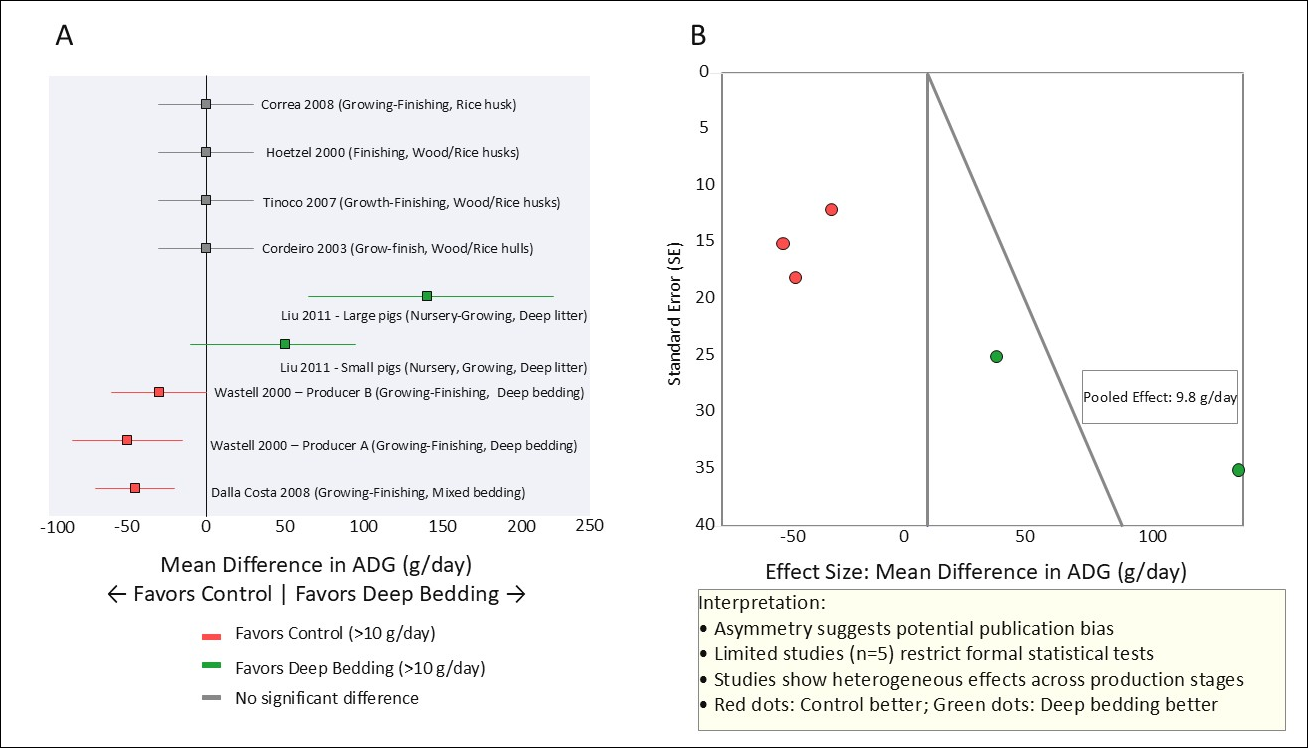
Figure 2. Pairwise meta-analysis of production performance. (A) Forest plot of average daily gain (ADG) comparing deep-bedding with conventional housing. (B) Funnel-plot used to qualitatively assess publication bias. The pooled estimate indicated no significant overall effect despite substantial between-study heterogeneity.
This left the material-specific evidence-network disconnected. Straw and sawdust were linked through a single head-to-head study, but rice husk, wood shavings, mixed bedding, wheat straw, rye straw, peat, bagasse/hay mixtures, concrete floors, slatted floors, and generic deep-litter were either isolated nodes or only partially connected. Figure 3 therefore represents a negative but important finding: the field is not yet structured to support defensible substrate ranking by NMA.
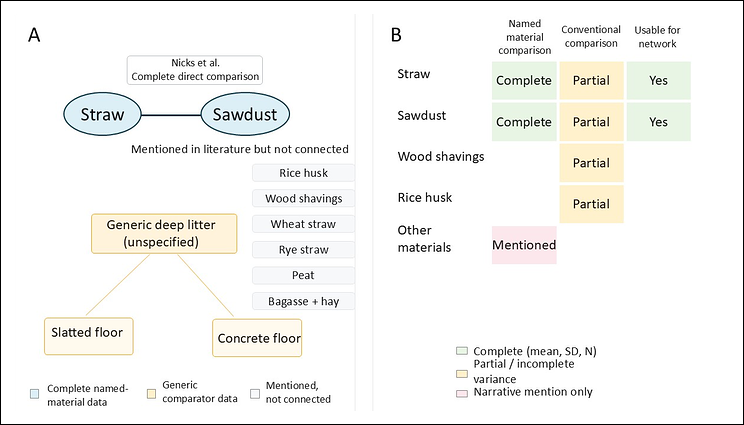
Figure 3. Evidence-network geometry and evidence availability for bedding material comparisons in deep-bedding pig systems. (A) Network geometry showing that only one direct-comparison between named bedding materials (straw vs. sawdust) was available for quantitative analysis. Other materials, including rice husk and wood shavings, were reported but lacked usable head-to-head comparisons. (B) Evidence-availability matrix indicating studies with complete data, partial data, or narrative-only evidence. The disconnected evidence structure prevented network meta-analysis and treatment ranking.
Rice husk illustrates the network limitation and the regional opportunity. It appeared in tropical and subtropical studies as a sole substrate, a depth-manipulated substrate, or a component of mixed bedding, but these studies generally lacked complete head-to-head material comparisons with extractable per-arm means, SD/SE, and sample sizes. Rice husk was therefore synthesized qualitatively in Table 7 rather than ranked quantitatively.
| Refefrence | Country | Production stage | Comparison | Main relevance to rice husk interpretation |
|---|---|---|---|---|
| [31] | Brazil | Grow-finish | Deep-bedding (wood shavings/rice hulls) vs. concrete | No significant differences in ADG or FCR; higher ammonia emissions in deep-bedding systems. |
| [32] | Brazil | Finishing (summer) | Rice husks or wood shavings vs. part-slatted concrete | Growth performance and meat quality were broadly similar; bedded pens provided welfare-related behavioral benefits. |
| [33] | Brazil | Growing-finishing | Deep-bedding (wood shavings/rice husk) vs. concrete | Concrete showed a slight numerical advantage, but overall growth performance was not materially influenced by housing system. |
| [34] | Brazil | Growing-finishing | Rice husk (0.25 m) vs. rice husk (0.5 m) vs. concrete | Rice husk depth had no adverse effect on growth performance, although litter depth altered the thermal profile. |
| [29] | Colombia | Finishing | Rice husk deep-bedding vs. concrete | ADG and FCR were broadly similar; mortality was numerically higher in deep-bedding, whereas compost value slightly improved profitability. |
Table 7. Focused summary of rice husk evidence in deep-bedding pig systems.
| Refefrence | Country | Production stage | Comparison | Main relevance to rice husk interpretation |
|---|---|---|---|---|
| [31] | Brazil | Grow-finish | Deep-bedding (wood shavings/rice hulls) vs. concrete | No significant differences in ADG or FCR; higher ammonia emissions in deep-bedding systems. |
| [32] | Brazil | Finishing (summer) | Rice husks or wood shavings vs. part-slatted concrete | Growth performance and meat quality were broadly similar; bedded pens provided welfare-related behavioral benefits. |
| [33] | Brazil | Growing-finishing | Deep-bedding (wood shavings/rice husk) vs. concrete | Concrete showed a slight numerical advantage, but overall growth performance was not materially influenced by housing system. |
| [34] | Brazil | Growing-finishing | Rice husk (0.25 m) vs. rice husk (0.5 m) vs. concrete | Rice husk depth had no adverse effect on growth performance, although litter depth altered the thermal profile. |
| [29] | Colombia | Finishing | Rice husk deep-bedding vs. concrete | ADG and FCR were broadly similar; mortality was numerically higher in deep-bedding, whereas compost value slightly improved profitability. |
ADG = Average daily gain; FCR = Feed conversion ratio.
Pairwise synthesis of production performance
Five study/comparison entries contributed to the pooled ADG synthesis: Dalla Costa 2008, Liu 2011 small pigs, Liu 2011 large pigs, Wastell 2000 Producer A, and Wastell 2000 Producer B. The overall random-effects estimate was MD +9.8 g/day (95% CI –58.3 to +77.9; p = 0.78), with high heterogeneity (I2 = 85.9%; Q = 28.5, p < 0.001; τ² = 3247) and a wide 95% prediction interval (–112.5 to +132.1 g/day). This result indicates no reliable overall production advantage or disadvantage and substantial uncertainty about farm-level effects [26–28].
Subgroup interpretation by production stage helped explain this heterogeneity. Nursery-growing pigs favored deep-bedding (2 study/comparison entries; MD +87.0 g/day, 95% CI +12.0 to +162.0; p < 0.05; I2 = 78%), whereas growing-finishing pigs favored conventional housing (3 study/comparison entries; MD -41.7 g/day, 95% CI –52.4 to –31.0; p < 0.01; I2 = 45%). The between-stage difference was 128.7 g/day (p < 0.05), supporting a stage-specific biological and management interpretation.
Biologically, this stage effect is plausible. Young pigs may benefit from thermal buffering, exploratory occupation, and softer lying surfaces during weaning and adaptation. Heavier growing-finishing pigs, especially in warm or humid climates, may be more vulnerable to heat load, wet bedding, ammonia, and management-related feed or hygiene penalties. The stage-specific trade-off summary is provided in Table 8.
| Stage/context | Welfare signal | Production signal | Main management risk | Priority evidence gap |
|---|---|---|---|---|
| Nursery- growing | Often favorable: improved exploratory behavior, thermal buffering, and softer lying surfaces. | ADG favored deep-bedding (MD = +87.0 g/day). | Wet bedding, dust, and pathogen load after weaning. | Replicated trials with complete reporting of means, SD/SE, pen-level effects, and standardized welfare outcomes. |
| Growing-finishing | Behavioral benefits are likely, but comfort depends on heat load and litter management. | ADG favored conventional housing in the pooled subgroup (MD = −41.7 g/day). | Heat load, ammonia accumulation, bedding compaction, and feed wastage. | Climate-stratified trials incorporating production, emissions, and standardized welfare outcomes. |
| Rice husk/tropical systems | Promising regional substrate for exploratory behavior, moisture management, and circular-resource use. | Evidence was predominantly qualitative and not suitable for NMA. | Litter depth, aeration, dust, compost maturity, and transport cost. | Direct comparative trials linking rice husk, straw, and sawdust under Southeast Asian production conditions. |
| Breeding/ farrowing | Potential improvements in comfort and nesting behavior, but evidence remains fragmented. | Insufficient extractable production data. | Piglet crushing, hygiene, thermal balance, and labor requirements. | Stage-specific welfare protocols with standardized reporting of sow and piglet outcomes. |
Table 8. Stage-specific welfare-production trade-offs and priority evidence gaps identified in the integrated synthesis.
| Stage/context | Welfare signal | Production signal | Main management risk | Priority evidence gap |
|---|---|---|---|---|
| Nursery- growing | Often favorable: improved exploratory behavior, thermal buffering, and softer lying surfaces. | ADG favored deep-bedding (MD = +87.0 g/day). | Wet bedding, dust, and pathogen load after weaning. | Replicated trials with complete reporting of means, SD/SE, pen-level effects, and standardized welfare outcomes. |
| Growing-finishing | Behavioral benefits are likely, but comfort depends on heat load and litter management. | ADG favored conventional housing in the pooled subgroup (MD = −41.7 g/day). | Heat load, ammonia accumulation, bedding compaction, and feed wastage. | Climate-stratified trials incorporating production, emissions, and standardized welfare outcomes. |
| Rice husk/tropical systems | Promising regional substrate for exploratory behavior, moisture management, and circular-resource use. | Evidence was predominantly qualitative and not suitable for NMA. | Litter depth, aeration, dust, compost maturity, and transport cost. | Direct comparative trials linking rice husk, straw, and sawdust under Southeast Asian production conditions. |
| Breeding/ farrowing | Potential improvements in comfort and nesting behavior, but evidence remains fragmented. | Insufficient extractable production data. | Piglet crushing, hygiene, thermal balance, and labor requirements. | Stage-specific welfare protocols with standardized reporting of sow and piglet outcomes. |
ADG = Average daily gain; MD = Mean difference; NMA = Network meta-analysis.
FCR and mortality
Evidence for FCR was weaker than evidence for ADG. Six studies or comparisons reported FCR-relevant information involving more than 1,000 pigs, but reporting was commonly qualitative, direction-only, or missing complete variance. The GRADE profile therefore treats FCR as a very low certainty qualitative synthesis: results were mixed, with no defensible pooled estimate across the full evidence set [29, 30].
Mortality data were sparse. One extractable comparison (140 pigs) produced an RR of 3.63 for deep-bedding versus conventional housing, but the 95% CI was extremely wide (0.20 to 65.84), so the direction and magnitude of any mortality effect remain very uncertain. Mortality was therefore not interpreted as evidence that deep-bedding is intrinsically safer or riskier; rather, it indicates the need for better event reporting.
Direct material-specific comparison: straw-versus-sawdust
The only complete direct substrate comparison was the nursery pig study by Nicks et al. [30] comparing straw and sawdust. Each group contained 200 pigs, and the duration was approximately 42.6 days. As shown in Figure 4, sawdust had a small, non-significant ADG difference relative to straw (MD +5.0 g/day, 95% CI -1.77 to +11.77; p = 0.148), a statistically small FCR advantage (MD -0.01 kg/kg, 95% CI -0.018 to -0.002; p = 0.0128), and identical mortality (2.5% in both groups; MD 0.0%, 95% CI -0.176 to +0.176).
Evidence concerning rice husk was broader than the direct-comparison evidence presented in Figure 4, but it was less suitable for quantitative synthesis.Brazilian, Colombian, and tropical/subtropical studies using rice husk alone or in mixtures generally reported performance like concrete or other bedding systems, while emphasizing management-sensitive outcomes such as litter depth, moisture, ammonia, fly burden, compost value, and heat stress. These findings support the use of rice husk as a regionally relevant substrate in rice-producing systems, but not as one that can yet be ranked as superior by formal NMA [31–34].
Risk-of-bias and certainty of evidence
The ROBINS-I assessment indicated that serious risk of bias was common, particularly due to confounding, selection, missing variance data, and selective outcome reporting. Quantitative studies were often pragmatic farm comparisons rather than randomized pen-level trials, making them relevant to practice but vulnerable to management-bundle confounding.
GRADE certainty reflected these weaknesses. ADG was rated with very low certainty todue of serious risk of bias, very serious inconsistency, imprecision, and suspected selective reporting. FCR was also very low certainty because results were mixed and variance reporting was incomplete. Mortality was very low certainty because the evidence came from a single comparison with an extremely wide CI. The direct sawdust-versus-straw FCR result was more precise but still limited by its reliance on a single study.
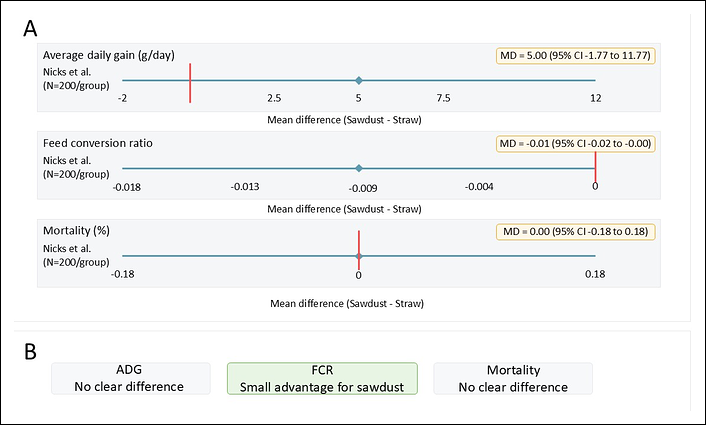
Figure 4. Direct comparison between straw and sawdust in nursery pigs. (A) Effect estimates for average daily gain (ADG), feed conversion ratio, and mortality from the only eligible head-to-head study. (B) Summary of the direct comparison, showing a small advantage of sawdust for feed conversion ratio, with no clear differences in ADG or mortality. As the analysis was based on a single study, the findings should be interpreted with caution and not taken as a treatment ranking.
Animal welfare and health synthesis
Welfare outcomes were the most consistent findings in the review. Deep-bedding generally increased exploratory behavior, rooting, nosing, substrate manipulation, and occupation with manipulable material compared with conventional non-bedded housing. These outcomes correspond directly to the behavioural and mental-state domains incorporated into the Healthy Pig Production Framework shown in Figure 5 and were more consistent across studies than production-related responses.Physical welfare outcomes were generally favorable when bedding was dry, clean, and sufficiently friable. Several studies reported fewer claw lesions, skin abrasions, bursitis-type injuries, or lameness indicators in bedded systems; however, these benefits declined when bedding became wet, compacted, dusty, or poorly ventilated. This conditional pattern is why the analysis frames deep-bedding as a managed welfare process rather than a static intervention.

Figure 5. Healthy Pig Production Framework (HPPF) for deep-bedding systems. The framework integrates five interacting domains: behavioral fulfillment, physical integrity, physiological comfort, hygienic stability, and stage-matched productivity. It provides a translational framework for veterinary and farm-level assessment, emphasizing that healthy pig production depends on the interaction among welfare, hygiene, and production performance.
Recent Thai evidence is especially relevant to tropical interpretation. Studies from Chiang Mai and related tropical settings suggest that deep bedding can increase exploratory behavior and reduce fly burden under certain management conditions, while concrete systems may offer production advantages when bedding moisture, heat load, or hygiene are not optimally controlled. This supports the stage-, climate-, and management-specific interpretation rather than a universal recommendation.
Environmental synthesis
Environmental outcomes revealed the clearest welfare-sustainability trade-off. Deep-bedding can reduce dependence on liquid wastewater and create a recoverable compost or solid manure stream, which is valuable for mixed crop-livestock systems. At the same time, poorly controlled moisture, nitrogen loading, compaction, and ventilation can increase the risks of ammonia, odor, dust, and nitrous oxide [38–44]. These interacting pathways are summarised in the Sustainable Deep-Bedding Model presented in Figure 6.

Figure 6. Sustainable Deep-Bedding Model (SDBM) for management-dependent system outcomes. The model links substrate type, dietary nitrogen load, barn design, and management intensity to bedding process control and three principal outcomes: healthy pigs, reduced emissions, and circular nutrient use. Sustainability depends on effective process control rather than on the substrate alone, and on successful litter stabilization, compost recovery, and nutrient recycling.
Ammonia emissions were often higher in deep-bedding than in conventional housing, especially where dietary nitrogen, bedding moisture, aeration, and replenishment were poorly managed. This does not negate welfare benefits, but it means environmental claims require explicit process-control measures such as dietary protein management, ventilation, dry bedding maintenance, aeration/turning, additives where appropriate, and timely spent-litter removal.
Rice husk carries distinctive environmental implications. Its porosity, silica content, slow decomposition, and regional availability may support moisture control and circular nutrient recovery in rice-producing areas. However, these same properties require attention to litter depth, aeration, dust, compost maturity, and local transport costs.
Greenhouse gas patterns were mixed. Deep-bedding may reduce methane relative to slurry systems by retaining manure in a more aerated matrix, but nitrous oxide can increase when aerobic and anaerobic microsites coexist. Net climate performance therefore depends on bedding moisture, carbon-to-nitrogen balance, stocking density, turning frequency, and manure-use pathway.
Economic and operational interpretation
Economic results were mixed and strongly context-dependent. Deep-bedding may reduce liquid-manure infrastructure needs and produce a compostable output, but it also requires bedding purchase or collection, labor, storage space, and management skill. Profitability is most plausible when welfare premiums, local substrate availability, reduced wastewater costs, or crop-nutrient value offset these inputs. Stage-specific welfare-production trade-offs are summarized in Table 8. The main evidence gaps are also visualized in Figure 7, which highlights the need for complete material comparison trials, tropical rice husk experiments, standardized welfare indicators, and complete variance reporting.
DISCUSSION
Principal interpretation
The evidence does not support a simple judgment that deep-bedding is uniformly superior or inferior to conventional housing. Instead, the integrated synthesis supports three linked conclusions: welfare responses are more consistently favorable than production responses; production effects differ by production stage and management context; and material-specific substrate ranking is not yet possible because the evidence network is disconnected.
From a production perspective, the pooled ADG result should be interpreted as a context average. The high heterogeneity, wide prediction interval, and divergent stage-specific estimates mean that deep-bedding may be beneficial in nursery-growing settings yet less favorable for heavier pigs under warm, wet, or poorly ventilated conditions. This interpretation is more useful for veterinary advice than alone pooled estimate alone.

Figure 7. Evidence gap map and future research priorities for deep-bedded pig systems. The map highlights the lack of direct comparisons of bedding materials, limited evidence from tropical production systems and rice husk bedding, incomplete reporting of variance measures, insufficient integration of environmental and welfare outcomes, and the need for validation of the Healthy Pig Production Framework and Sustainable Deep-Bedding Model.
Novelty and originality
This review makes four original contributions. First, it organizes deep-bedding evidence around animal welfare rather than treating welfare as secondary to productivity. Second, it identifies stage-specific heterogeneity, with nursery-growing and growing-finishing pigs showing different ADG signals. Third, it transparently reports the failed NMA as a methodological finding that exposes the absence of connected, material-specific evidence. Fourth, it introduces the HPPF and SDBM as newly developed translational tools for veterinary audit, farm management, and sustainable production planning.
These contributions are especially relevant to tropical and rice-producing regions because rice husk is locally available, potentially circular, and underrepresented in complete comparative trials. To our knowledge, no previous deep-bedding pig review has combined a welfare-centered synthesis, a pairwise production meta-analysis, an explicit material-network feasibility assessment, and two practice-facing frameworks in a single manuscript.
The HPPF
The HPPF treats welfare-supportive housing as a multidimensional veterinary audit problem rather than a single productivity endpoint. It links behavioral fulfilment, physical integrity, physiological comfort, hygienic stability, and stage-matched productivity to observable indicators such as rooting time, lying behavior, claw lesions, lameness, panting, huddling, body cleanliness, cough, odor, fly density, ADG, FCR, and mortality.
This framework explains why apparently conflicting studies can both be credible. A pen may improve exploratory behavior and resting comfort while simultaneously creating hygienic or environmental risk if moisture and manure load are not controlled. The framework is therefore proposed as a checklist for structured veterinary assessment, not as a claim that any one bedding material automatically improves all domains.
The SDBM
The SDBM reframes deep-bedding as a managed, biophysical, circular-resource process. Substrate input, dietary nitrogen, barn design, and labor-management intensity influence bedding moisture, aeration, microbial turnover, replenishment frequency, thermal load, emissions, and compost maturity. This framing links animal welfare to manure management and nutrient recovery rather than treating bedding only as enrichment.
This process-based view is central to sustainability claims. Deep-bedding can reduce liquid effluent and support nutrient recovery in crop-livestock systems, but only when spent litter is composted or reused responsibly and when risks of ammonia, odor, dust, and greenhouse gases are actively monitored. The SDBM therefore provides a practical structure for farm audits and for future validation studies.
Implications for practice, veterinary audit and research design
For producers and veterinarians, deep-bedding is most defensible where welfare improvement, reduced liquid effluent, or manure circularity are explicit priorities, and where daily management can maintain stable bedding conditions. Veterinary audits should assess substrate quality, moisture, compaction, ventilation, nitrogen load, fly density, respiratory signs, lameness, claw lesions, body cleanliness, and stage-specific productivity targets [35–37, 48].
In terms of research design, the review highlights a persistent weakness: studies often compare entire housing bundles rather than isolate substrate effects. Future trials should report per-arm means, SD/SE, sample sizes, pen replication, study duration, bedding depth, replenishment frequency, moisture, ventilation, climate, genotype, diet, welfare scores, emissions, and manure-output metrics. Material comparison trials should be designed to connect straw, sawdust, wood shavings, rice husk, mixed bedding, and conventional comparators in a network suitable for NMA.
Comparison with recent tropical evidence
Recent Thai and broader tropical evidence are especially informative because it tests deep-bedding under warm, humid conditions where wet litter, heat stress, fly pressure, and feed losses may be harder to control. These studies support the idea that welfare benefits and production trade-offs can coexist. Rice husk deserves particular attention in Southeast Asian rice-producing regions because it links local by-product use, bedding availability, and compost return to crop land [49, 53].
This tropical evidence does not invalidate the case for deep-bedding; it defines the management boundary conditions for success. In warm climates, ventilation, stocking density, bedding depth, turning, replenishment, and moisture control are likely to determine whether behavioral and comfort benefits are achieved without unacceptable heat, ammonia, or hygiene penalties.
Material selection guidance
Material choice is often where farms want a simple ranking, but the present evidence base does not yet support one. The only complete direct comparison suggests a very small FCR advantage for sawdust over straw in nursery pigs, while evidence for rice husk is promising but mostly qualitative. Therefore, a defensible material decision should match substrate properties to farm goals, climate, stage, bedding supply, manure-use plan, and labor capacity.
Recent material-oriented studies reinforce this caution. Bedding materials differ in water-binding capacity, dust, thermal behavior, microbial turnover, pesticide or contaminant risk, pen cleanliness, and fly burden. These differences can affect welfare, product safety, and environmental outcomes, so material selection should be treated as a risk-managed decision rather than a fixed hierarchy [45–47, 50–52].
A practical approach is to use straw where exploratory enrichment and fiber availability are priorities, sawdust or wood shavings where absorbency and feed efficiency are priorities, and rice husk where regional availability, cost, moisture management, and nutrient cycling make it attractive. In all cases, bedding should be managed to remain dry, friable, and compatible with the pigs' production stage and thermal environment.
Implications for policy and implementation
At the policy level, the findings support welfare-oriented housing reform while cautioning that welfare improvements do not automatically deliver environmental gains. Programs aligned with WOAH guidance and national welfare codes, including updated New Zealand pig welfare discussions on manipulable materials and housing standards [48, 54], should pair substrate provision with monitoring of emissions, hygiene, thermal comfort, and manure management.
The same caution applies to circular-livestock narratives. Deep-bedding can contribute to nutrient reuse and reduced wastewater generation, especially in integrated rice-pig or crop-livestock settings, but these benefits materialize only when spent-litter is composted or applied responsibly and when externalities such as ammonia, odor, and greenhouse gases are controlled.
Strengths and limitations
This review has several strengths. It uses a welfare-centered structure, integrates production and environmental outcomes, reports quantitative pooling only where data allow, treats failed NMA as informative, identifies rice husk as a regional evidence gap, and develops two practice-facing frameworks that can be tested in future veterinary audit and farm implementation studies.
The limitations are equally important. The quantitative dataset was small; many studies lacked per-arm means, SD/SE, sample size, or duration; risk of bias was often serious; and heterogeneity was high. Formal gray-literature searching, expert contact, meta-regression, and inter-rater reliability statistics could not be fully documented from the available review files. Language and extractability constraints, the March 2026 search cutoff, possible post-search publications, management-bundle confounding, and the unvalidated status of the HPPF and SDBM should be considered when interpreting the findings.
CONCLUSION
This systematic review demonstrated that deep-bedded pig systems consistently improve behavioral welfare indicators such as rooting, exploratory activity, and resting comfort compared with conventional housing. However, production outcomes were stage-dependent: nursery-growing pigs showed improved ADG with deep-bedding, whereas growing-finishing pigs exhibited reduced performance under certain conditions. Environmental benefits included reduced liquid effluent and potential for nutrient recovery, but risks of increased ammonia and greenhouse gas emissions were evident when bedding moisture, aeration, and management were suboptimal. Material-specific comparisons were limited; rice husk appeared promising for tropical systems but lacked sufficient quantitative data for ranking.
Deep-bedding should be implemented as a managed welfare and sustainability strategy rather than a simple flooring replacement. Veterinary practitioners can use the proposed frameworks to assess suitability for specific farms, balancing behavioral enrichment, thermal comfort, hygiene, stage-specific productivity, and circular manure management. In rice-producing regions, rice husk offers a locally available, potentially sustainable option when litter depth, moisture control, and ventilation are optimized.
Future research should prioritize connected material comparison trials (including rice husk), complete reporting of means, SD/SE, sample sizes, and welfare indicators, climate-stratified studies, longitudinal designs, and validation of the HPPF and SDBM in real-world veterinary audits. Integration of microbiome, emissions, and economic analyses will further strengthen evidence for sustainable pig production.
Deep-bedding offers clear welfare benefits through enhanced behavioral opportunities and comfort, but production and environmental outcomes are highly management-dependent. The HPPF and SDBM provide practical tools for veterinarians and producers to implement and evaluate these systems effectively. By addressing current evidence gaps and adopting context-specific management, deep-bedded systems can contribute meaningfully to sustainable, welfare-oriented pig production worldwide.
DATA AVAILABILITY
The curated extraction tables, PRISMA flow data, meta-analysis files, GRADE profiles, NMA feasibility files, and screening logs are publicly available through the Open Science Framework repository and the accompanying supplementary materials. The supplementary dataset includes the raw search results, deduplicated records, screening decisions, lists of included and excluded studies with reasons for exclusion, meta-analysis datasets, GRADE assessments, and NMA feasibility files. Because complete raw numerical data were not consistently reported in the original publications, data extraction limitations, missing values, and conversion procedures are fully documented in the supplementary tables for extraction and quality control.
Supplementary Table S1 contains the complete database search strategies. Supplementary Table S2 provides the PRISMA 2020 checklist. Supplementary Table S3 summarizes the characteristics of the included studies. Supplementary Table S4 compares the properties of the evaluated bedding materials. Supplementary Table S5 presents the animal welfare assessment framework. Supplementary Table S6 summarizes the ROBINS-I risk-of-bias assessments. Supplementary Table S7 synthesizes the available evidence for rice husk as a bedding material. Additional supplementary files include the meta-analysis datasets, GRADE evidence profiles, NMA feasibility tables, screening decisions, excluded studies with reasons for exclusion, and detailed framework implementation materials.
GENERATIVE AI DECLARATION
Artificial intelligence tools were used solely to assist with language editing and manuscript organization. All generated content was carefully reviewed, verified, and revised by the authors, who accept full responsibility for the accuracy, integrity, and originality of the manuscript.
AUTHORS’ CONTRIBUTIONS
KM and NC: Conceived and designed the systematic review, developed the integrated evidence synthesis framework, interpreted the evidence, drafted the manuscript, and critically revised the manuscript. KM: Supervised data curation. WW, KS, and CA: Interpreted the evidence and critically revised the manuscript. All authors have read and approved the final manuscript.
COMPETING INTERESTS
The authors declare that they have no competing interests.
PUBLISHER’S NOTE
Veterinary World remains neutral with regard to jurisdictional claims in the published institutional affiliations.
ACKNOWLEDGMENTS
The authors gratefully acknowledge partial financial support from the Agricultural Research Development Agency (Public Organization), Thailand (ARDA), under Grant No. PRP6807030990.
REFERENCES
- Mellor DJ. Updating animal welfare thinking: Moving beyond the “Five Freedoms” towards “A Life Worth Living”. Animals (Basel) 2016;6(3):21. [Google Scholar]
- Johnson AK, Rault JL, Marchant JN, Baxter EM, O'Driscoll K. Improving young pig welfare on-farm: The Five Domains Model. J Anim Sci 2022;100(6):skac164. [Google Scholar]
- Kells NJ. Review: The Five Domains Model and promoting positive welfare in pigs. Animal 2022;16(Suppl 2):100378. [Google Scholar]
- EFSA Panel on Animal Health and Welfare (AHAW). Welfare of pigs on farm. EFSA J 2022;20(8):e07421. [Google Scholar]
- Van de Weerd HA, Day JEL. A review of environmental enrichment for pigs housed in intensive housing systems. Appl Anim Behav Sci 2009;116(1):1-20. [Google Scholar]
- Studnitz M, Jensen MB, Pedersen LJ. Why do pigs root and in what will they root? A review on the exploratory behavior of pigs in relation to environmental enrichment. Appl Anim Behav Sci 2007;107(3-4):183-197. [Google Scholar]
- Beattie VE, O'Connell NE, Moss BW. Influence of environmental enrichment on the behavior, performance and meat quality of domestic pigs. Livest Prod Sci 2000;65(1-2):71-79. [Google Scholar]
- Taylor PS, Schrobback P, Verdon M, Lee C. An effective environmental enrichment framework for the continual improvement of production animal welfare. Anim Welf 2023;32:e14. [Google Scholar]
- Vargas LB, Caldara FR, Lippi ICC, Oliveira GF, Odakura AM, Burbarelli MFC, Garcia RG, Paz ICLA, Santos LS. Environmental enrichment strategies for weaned pigs: Welfare and behavior. J Appl Anim Welf Sci 2023;26(2):205-217. [Google Scholar]
- Rosvold EM, Ocepek M, Andersen IL. Effects of different rooting materials on behavior and welfare of finishing pigs. Appl Anim Behav Sci 2024;277:106344. [Google Scholar]
- Ocepek M, Newberry RC, Andersen IL. Enriching the environment with multiple rooting materials and bedded rest areas improves welfare of finishing pigs. Appl Anim Behav Sci 2025;292:106773. [Google Scholar]
- Ramirez BC, Hayes MD, Condotta ICFS, Leonard SM. Impact of housing environment and management on pre-/post-weaning piglet productivity. J Anim Sci 2022;100(6):skac142. [Google Scholar]
- de Bruijn BGC, van Dixhoorn IDE, Bolhuis JE, Cornelissen JBWJ, Stockhofe-Zurwieden N, Kluivers-Poodt M, Rebel JMJ. Environmental enrichment affects immunity and reduces disease severity in pigs after co-infection, with stronger effects when applied from birth than from weaning. Front Vet Sci 2024;11:1511209. [Google Scholar]
- Collarini E, Capponcelli L, Pierdomenico A, Cordoni G, Norscia I. Balancing welfare and habitat damage in pigs (Sus scrofa) under extensive farming: An ethological approach for determining the effects of group composition and environmental enrichment. Front Ethol 2024;3:1450585. [Google Scholar]
- Hemsworth PH, Tilbrook AJ, Galea RY, Lucas ME, Chidgey KL, Hemsworth LM. Review of the influence of farrowing and lactation housing and positive human contact on sow and piglet welfare. Front Anim Sci 2023;4:1230830. [Google Scholar]
- Page MJ, McKenzie JE, Bossuyt PM, Boutron I, Hoffmann TC, Mulrow CD. The PRISMA 2020 statement: An updated guideline for reporting systematic reviews. BMJ 2021;372:n71. [Google Scholar]
- Hutton B, Salanti G, Caldwell DM, Chaimani A, Schmid CH, Cameron C. The PRISMA extension statement for reporting of systematic reviews incorporating network meta-analyses of health care interventions: Checklist and explanations. Ann Intern Med 2015;162(11):777-784. [Google Scholar]
- Sterne JA, Hernan MA, Reeves BC, Savovic J, Berkman ND, Viswanathan M. ROBINS-I: A tool for assessing risk-of-bias in non-randomized studies of interventions. BMJ 2016;355:i4919. [Google Scholar]
- Sterne JAC, Savovic J, Page MJ, Elbers RG, Blencowe NS, Boutron I. RoB 2: A revised tool for assessing risk-of-bias in randomized trials. BMJ 2019;366:l4898. [Google Scholar]
- Guyatt GH, Oxman AD, Vist GE, Kunz R, Falck-Ytter Y, Alonso-Coello P. GRADE: An emerging consensus on rating quality of evidence and strength of recommendations. BMJ 2008;336(7650):924-926. [Google Scholar]
- Puhan MA, Schunemann HJ, Murad MH, Li T, Brignardello-Petersen R, Singh JA. A GRADE Working Group approach for rating the quality of treatment effect estimates from network meta-analysis. BMJ 2014;349:g5630. [Google Scholar]
- Krutthai N, Chaiwang N, Sringarm K, Arjin C, Mekchay S, Marupanthorn K, Wattanakul W. Influence of deep-bedding and fermented feed supplementation on the behavioral patterns, adult fly (Musca domestica) density and performance of crossbred pigs. Vet Integr Sci 2025;23(1):e2025021. [Google Scholar]
- Chaiwang N, Bunmee T, Arjin C, Wattanakul W, Krutthai N, Mekchay S, Sringarm K. Effect of deep-bedding floor and fermented feed supplement on productive performance, carcase, meat quality and fatty acid profile of crossbred pigs. Ital J Anim Sci 2021;20(1):479-488. [Google Scholar]
- Perez P, Solis-Tejeda MA, Lango-Reynoso F, Diaz-Rivera P, Aguilar-Avila J, Asiain-Hoyos A. Deep-litter pig production system as a sustainable alternative for small farmers. Agrociencia 2022;56(6):51-60. [Google Scholar]
- Honeyman MS, Harmon JD, Kliebenstein JB, Richard TL. Feasibility of hoop structures for market swine in Iowa: Pig performance, pig environment, and budget analysis. Appl Eng Agric 2001;17(6):869-874. [Google Scholar]
- Wastell ME, Lubischer PR, Penner AJ. Deep-bedding - an alternative system for raising pork. Swine Housing Conference. American Society of Agricultural Engineers. 2000 2000. [Google Scholar]
- Dalla Costa OA, Amaral AL, Ludke JV, Coldebella A, Figueiredo EAP. Desempenho, caracteristicas de carcaca, qualidade da carne e condicao sanitaria de suinos criados nas fases de crescimento e terminacao nos sistemas confinado convencional e de cama sobreposta. Cienc Rural 2008;38(8):2307-2313. [Google Scholar]
- Liu R, Cui YX, Li HJ, Liu GH, Xu YN, Pan XL. Comparison of feeding effect of pigs with deep-litter and conventional system. China Anim Husb Vet Med 2011;38(6):106-109. [Google Scholar]
- Faber Arango EC, Alvarez HE, Hurtado Nery VL. Analisis comparativo de la ceba de cerdos en un sistema de cama profunda y piso de concreto en una granja comercial de Villavicencio, Colombia. Rev Sist Prod Agroecol 2012;3(1):36-56. [Google Scholar]
- Nicks B, Laitat M, Vandenheede M, Desiron A, Verhaeghe C, Canart B. Emissions of ammonia, nitrous oxide, methane, carbon dioxide and water vapor in the raising of weaned pigs on straw-based and sawdust-based deep litters. Anim Res 2003;52(3):299-308. [Google Scholar]
- Cordeiro MB, Tinoco IFF, Oliveira PAV, Xin H, Gates RS, Silva JN, Baeta FC, Vigoderis RB. Environmental and production performance of deep-bedded and concrete floor housing systems for grow-finish swine in Brazil. Swine Housings II Proceedings. 2003; 016-024 2003. [Google Scholar]
- Hotzel MJ, Lopes EJC, Oliveira PAV, Guidoni AL. Behavior and performance of pigs finished on deep-bedding with wood shavings or rice husks in summer. Anim Welf 2009;18(1):65-71. [Google Scholar]
- Cordeiro MB, Tinoco IFF, Oliveira PAV, Menegali I, Guimaraes MCC, Baeta FC, Silva JN. Effect of different raising systems on the thermal environment comfort and swine productive performance under spring conditions. Rev Bras Zootec 2007;36(5 Suppl):1597-1602. [Google Scholar]
- Correa EK, Bianchi I, Ulguim RR, Correa MN, Gil-Turnes C, Lucia T Jr. Effects of different litter depths on environmental parameters and growth performance of growing-finishing pigs. Cienc Rural 2009;39(3):838-843. [Google Scholar]
- Council Directive 2008/120/EC of 18 December 2008 laying down minimum standards for the protection of pigs (codified version). Off J Eur Union. 2009;L47:5-13. [Google Scholar]
- Ede T, Parsons TD. Cognitive tasks as measures of pig welfare: A systematic review. Front Vet Sci 2023;10:1251070. [Google Scholar]
- Andersen IL, Ocepek M, Thingnes SL, Newberry RC. Welfare and performance of finishing pigs on commercial farms: Associations with group size, floor space per pig and feed type. Appl Anim Behav Sci 2023;265:105979. [Google Scholar]
- Pereira JL, Perdigao A, Marques F, Wessel DF, Trindade H, Fangueiro D. Mitigating ammonia and greenhouse gas emissions from stored pig slurry using chemical additives and biochars. Agronomy 2022;12(11):2744. [Google Scholar]
- Cattaneo M, Taya C, Burgos L, Morey L, Noguerol J, Provolo G, Cerrillo M, Bonmati A. Assessing ammonia and greenhouse gas emissions from livestock manure storage: Comparison of measurements with dynamic and static chambers. Sustainability 2023;15(22):15987. [Google Scholar]
- Varga ZI, Shahzad S, Ramay MW, Damak M, Gulyas M, Beres A, Gyuricza C, Szekacs A, Aleksza L. Ammonia and greenhouse gas emissions from organic manure composting: The effect of membrane cover. Agronomy 2024;14(7):1471. [Google Scholar]
- El bied O, Terrero Turbi MA, Gomez Garrido M, Faz Cano A, Acosta JA. Reducing methane, carbon dioxide, and ammonia emissions from stored pig slurry using Bacillus-biological additives and aeration. Environments 2024;11(8):171. [Google Scholar]
- Canh TT, Aarnink AJA, Schutte JB, Sutton A, Langhout DJ, Verstegen MWA. Dietary protein affects nitrogen excretion and ammonia emission from slurry of growing-finishing pigs. Livest Prod Sci 1998;56(3):181-191. [Google Scholar]
- Philippe FX, Laitat M, Canart B, Vandenheede M, Nicks B. Comparison of ammonia and greenhouse gas emissions during the fattening of pigs, kept either on fully slatted floor or on deep-litter. Livest Sci 2007;111(1-2):144-152. [Google Scholar]
- Guingand N, Rugani A. Impact of the reduction of straw on ammonia, greenhouse gas and odor emissions from fattening pigs housed in a deep-litter system. Proceedings of the 9th International Livestock Environment Symposium. 2012 2012. [Google Scholar]
- Riedel A, Pieper L, Lautner M, Leiding C, Jung M, Schulze M. Comparison of deep-litter bedding materials and analysis of semen traits in Pietrain boars: A randomized controlled field study. Anim Reprod Sci 2023;259:107379. [Google Scholar]
- Riedel A, Pieper L, Lautner M, Leiding C, Jung M, Schulze M. Influence of deep-litter bedding materials on environmental and welfare-related factors in boar studs. Appl Anim Behav Sci 2024;273:106215. [Google Scholar]
- Kropiwiec-Domanska K, Babicz M, Szyndler-Nedza M, Tyra M, Skrzypczak E. Analysis of physical parameters and chemical composition of offal from Pulawska fattening pigs raised in deep-litter and slatted floor housing systems. Ann Anim Sci 2024;24(1):269-276. [Google Scholar]
- Terrestrial Animal Health Code. 2024. [Google Scholar]
- Foppa L, Pierozan CR, Simonelli SM, Dias CP, Silva CA. Evolution of welfare indicators of pigs housed in deep-bedding systems during growing and finishing phases: Assessment of good health principles and housing conditions. Trop Anim Health Prod 2021;53(5):483. [Google Scholar]
- Wallgren T, Lundeheim N, Gunnarsson S. Impact of amount of straw on pig and pen hygiene in partly slatted flooring systems. BMC Vet Res 2020;16:377. [Google Scholar]
- Ludwiczak A, Skrzypczak E, Skladanowska-Baryza J, Stanisz M, Slosarz P, Racewicz P. How housing conditions determine the welfare of pigs. Animals (Basel) 2021;11(12):3484. [Google Scholar]
- Koch F, Kowalczyk J, Wagner B, Klevenhusen F, Schenkel H, Lahrssen-Wiederholt M, Pieper R. Chemical analysis of materials used in pig housing with respect to the safety of products of animal origin. Animal 2021;15(9):100319. [Google Scholar]
- Lee J, Song H, Biswas S, Kang KW, Yun J. Effects of housing and environmental enrichment on performance, welfare, and air quality in fattening pigs. Animals (Basel) 2026;16(4):580. [Google Scholar]
- Ministry for Primary Industries. Code of Welfare: Pigs. Ministry for Primary Industries, Wellington, New Zealand; 2025. [Google Scholar]