


ABSTRACT
Background and Aim: Imerslund–Gräsbeck syndrome (IGS) is a rare autosomal recessive disorder characterized by selective intestinal cobalamin malabsorption in humans and several canine breeds. In Border Collies, IGS is caused by a single cytosine deletion in exon 53 of the CUBN gene (c.8392delC), resulting in a frameshift mutation and loss of Cubam receptor function. Although carrier frequencies have been reported in European and East Asian populations, region-specific genetic epidemiology data from Southeast Asia are lacking. This study aimed to determine the genotypic distribution and allele frequency of the CUBN c.8392delC mutation in Thai Border Collies and to validate a cost-effective molecular diagnostic approach combining double-mismatch allele-specific primers with multiplex polymerase chain reaction (PCR).
Materials and Methods: A total of 107 clinically healthy Border Collies from private owners and breeding kennels in Thailand were enrolled. Genomic DNA extracted from peripheral blood was genotyped using a newly optimized double-mismatch allele-specific multiplex PCR assay designed to discriminate wild-type and mutant CUBN alleles, with an internal control amplicon included in each reaction. Synthetic mutant DNA fragments were used as positive controls for homozygous mutant detection. All PCR-based genotyping results were independently validated by Sanger sequencing. Genotype and allele frequencies were calculated, and 95% confidence interval (CI) values were estimated using the Wilson score method.
Results: Of the 107 dogs examined, 106 were homozygous wild-type (WT; CUBN +/+) (99.1%; 95% CI: 94.8%–99.8%), one dog was a heterozygous carrier (CUBN +/−) (0.9%; 95% CI: 0.16–5.0%), and no homozygous mutant individuals (CUBN −/−) were identified (0%; 95% CI: 0%–4.3%). The estimated wild-type and mutant allele frequencies were 99.6% (95% CI: 98.2%–99.9%) and 0.4% (95% CI: 0.07%–1.8%), respectively. The double-mismatch allele-specific multiplex PCR assay demonstrated 100% concordance with Sanger sequencing, with no false-positive or false-negative results.
Conclusion: This study provides the first population-level screening data for the CUBN c.8392delC mutation associated with IGS in Thai Border Collies and indicates a very low carrier and mutant allele frequency in this genetically diverse population. The validated double-mismatch allele-specific multiplex PCR assay offers a rapid, reliable, and cost-effective tool for routine genetic screening, supporting evidence-based breeding strategies and future large-scale genetic surveillance of hereditary disorders in dogs.
Keywords: Border Collies, cubilin gene, double-mismatch allele-specific PCR, genetic screening, Imerslund–Gräsbeck syndrome, multiplex PCR, Thailand, veterinary genetics.
INTRODUCTION
Cobalamin (B12) is an essential water-soluble vitamin involved in multiple physiological processes, including hematopoiesis, neural transmission [1], nucleic acid synthesis, mitochondrial metabolism, intestinal microbial regulation [2], and antioxidant defense [3]. It functions as a cofactor for enzymes responsible for methylmalonic acid degradation and methionine synthesis [4]. In most carnivores, cobalamin is obtained predominantly from animal-derived dietary sources [5]. During digestion, dietary cobalamin initially binds to haptocorrin and is subsequently released by pancreatic enzymes in the intestine, enabling its interaction with the Cubam receptor located on the apical surface of ileal enterocytes. Following cellular uptake, cobalamin binds to transcobalamin, which mediates its transport throughout the systemic circulation [6, 7].
Cubam is a membrane-bound endocytic receptor expressed primarily in the terminal ileum, where it plays a central role in intestinal cobalamin absorption [6]. It is also expressed in the renal proximal tubule and participates in the reabsorption of filtered proteins, particularly albumin [8]. Cubam is a multimeric receptor complex composed of two subunits, amnionless (AMN) and cubilin (CUBN), encoded by the AMN and CUBN genes, respectively [6, 7]. Mutations in either gene have been associated with IGS in humans, following an autosomal recessive mode of inheritance [9, 10]. A comparable hereditary disorder has also been reported in several dog breeds, including Australian Shepherds [11, 12], Giant Schnauzers [13], Beagles [14–17], and Border Collies [18–21]. He et al. [11] identified two independent AMN gene mutations underlying IGS in Australian Shepherds and Giant Schnauzers. In contrast, IGS in Beagles and Border Collies has been linked to two distinct mutations in the CUBN gene [19, 20, 22].
In 2013, Fyfe et al. [19] and Owczarek-Lipska et al. [20] independently employed genomic sequencing to identify the causative mutation of IGS in Border Collies. Both studies reported a single cytosine deletion (CUBN:c.8392delC) in exon 53 of the CUBN gene on chromosome 2. This deletion induces a frameshift mutation, generating a premature stop codon in CUBN and leading to the production of a non-functional Cubam receptor. Consequently, intestinal cobalamin absorption is impaired, resulting in cobalamin deficiency and associated clinical manifestations, including lethargy, poor weight gain, anemia, hypocobalaminemia, hypoproteinemia, elevated liver enzyme activities, and hyperammonemia [16, 19–21]. Previous genetic surveys conducted in Switzerland [20] and Japan [23] reported IGS carrier frequencies of 6.2% and 3%, respectively.
Despite the established association between CUBN and AMN mutations and IGS in several canine populations, region-specific genetic epidemiology data for IGS in Thai Border Collies remain unavailable. Existing prevalence estimates are largely derived from European and East Asian cohorts, which differ substantially in population structure, breeding practices, and founder effects. Moreover, routine screening in Thailand is constrained by limited access to high-throughput or sequencing-based diagnostics, underscoring the need for a reliable, cost-effective, and scalable genotyping approach that can be implemented in clinical and breeding settings. Consequently, the distribution of CUBN variants and the true carrier frequency of IGS in Thai Border Collies have not yet been systematically characterized.
The aim of this study was to determine the genotypic distribution and allele frequency of the CUBN c.8392delC mutation associated with IGS in a cohort of Thai Border Collies using a double-mismatch allele-specific multiplex polymerase chain reaction (PCR) assay. In addition, this study sought to validate the accuracy and reliability of this assay against Sanger sequencing and to provide foundational data to support evidence-based genetic counseling, preventive breeding strategies, and future large-scale surveillance of hereditary disorders in Thai Border Collies.
MATERIALS AND METHODS
Ethical approval
The study was conducted in full compliance with national and institutional guidelines for the care and use of research animals. All procedures involving animals were reviewed and approved by the Institutional Animal Care and Use Committee (IACUC), Faculty of Veterinary Medicine, Kasetsart University, Thailand (Approval No. ACKU67-VET-064). The protocol adhered to the ethical principles outlined in the Guide for the Care and Use of Laboratory Animals, the Animal Welfare Act of Thailand, and the Animal Research: Reporting of In vivo Experiments 2.0 guidelines for reporting animal research.
Blood sampling was minimally invasive and performed exclusively by licensed veterinarians. No sedation or anesthesia was required for routine venipuncture; however, appropriate gentle manual restraint was used to minimize stress and ensure animal safety. Each owner (private and kennel owners) provided written informed consent for the collection of blood samples and the use of the animals’ genetic information strictly for research purposes. All samples were handled according to standard biosafety and biosecurity practices. Owner details and kennel identifiers were kept confidential, and no person or identifying information is disclosed in the publication. The IACUC verified that the study posed minimal risk, involved non-terminal and non-invasive sampling, and met all ethical requirements for genetic screening in companion animals.
Study period and location
The research project was conducted from June 2024 to March 2025. All experiments were performed in the molecular research laboratory of the Department of Physiology, Faculty of Veterinary Medicine, Kasetsart University, Thailand (13.8446° N, 100.5773° E). Throughout all laboratory procedures, the room temperature was maintained at 22–25°C, and to ensure consistency, standard laboratory equipment was calibrated regularly. To minimize variability, the timing of each experimental step was strictly followed according to the validated protocol.
Animals and sample collection
Border Collies were selected based on phenotypic characteristics defined in the Fédération Cynologique Internationale breed standard No. 297 to ensure breed authenticity. All dogs had an unknown CUBN genotype before genetic testing. The dogs included in this study were clinically healthy, aged between 3 months and 10 years, and had no history of inherited metabolic or hematological disorders. Both male and female dogs were included in this study.
A total of 107 dogs, comprising 33 privately owned dogs and 74 dogs from seven breeding kennels, representing both pedigree and non-pedigree backgrounds, were enrolled. Participation was voluntary, and owners and kennel managers provided informed consent for sample collection (Table 1). Pedigree information for dogs originating from registered breeding kennels was verified using breeder- and kennel-provided records, while pedigree data for privately owned dogs were obtained from owner-provided documentation when available.
| Source of dogs | Total (n) | Male, n (%) | Female, n (%) | Age range (months to years) |
|---|---|---|---|---|
| Privately owned dogs | 33 | 18 (54.55) | 15 (45.45) | 3 months to 10 years |
| Kennel A | 49 | 30 (61.22) | 19 (38.78) | 3 months to 7 years |
| Kennel B | 5 | 3 (60) | 2 (40) | 3–7 months |
| Kennel C | 8 | 3 (37.5) | 5 (62.5) | 6 months to 5 years |
| Kennel D | 4 | 0 (0) | 4 (100) | 10 months to 2 years |
| Kennel E | 2 | 2 (100) | 0 (0) | 4–5 years |
| Kennel F | 2 | 0 (0) | 2 (100) | 5–6 months |
| Kennel G | 4 | 1 (25) | 3 (75) | 4 months to 3 years |
| Total | 107 | 57 (53.27) | 50 (46.73) | – |
Table 1. Distribution of dogs by source, sex, and age in the study population.
| Source of dogs | Total (n) | Male, n (%) | Female, n (%) | Age range (months to years) |
|---|---|---|---|---|
| Privately owned dogs | 33 | 18 (54.55) | 15 (45.45) | 3 months to 10 years |
| Kennel A | 49 | 30 (61.22) | 19 (38.78) | 3 months to 7 years |
| Kennel B | 5 | 3 (60) | 2 (40) | 3–7 months |
| Kennel C | 8 | 3 (37.5) | 5 (62.5) | 6 months to 5 years |
| Kennel D | 4 | 0 (0) | 4 (100) | 10 months to 2 years |
| Kennel E | 2 | 2 (100) | 0 (0) | 4–5 years |
| Kennel F | 2 | 0 (0) | 2 (100) | 5–6 months |
| Kennel G | 4 | 1 (25) | 3 (75) | 4 months to 3 years |
| Total | 107 | 57 (53.27) | 50 (46.73) | – |
Peripheral blood samples (1.5 mL per dog) were collected using minimally invasive venipuncture with gentle manual restraint. Samples were collected in tubes containing ethylenediaminetetraacetic acid and stored at 4°C until genomic DNA extraction.
DNA extraction
Genomic DNA extraction was performed under controlled environment conditions (22–25°C) using the QIAamp DNA Blood Mini Kit (Qiagen GmbH, Hilden, Germany) according to the manufacturer’s instructions. The concentration and purity of DNA were evaluated using a NanoDrop™ 2000 spectrophotometer (Thermo Fisher Scientific, Waltham, MA, USA), with a typical concentration of 50–80 ng/µL and acceptable A260/A280 ratios between 1.8 and 2.0.
Samples with concentrations below the minimum concentration threshold and a low A260/A280 ratio were re-extracted and subsequently evaluated by agarose gel electrophoresis to confirm DNA integrity. High-quality DNA samples were aliquoted and stored at −20°C for long-term preservation, and stability was maintained for up to 12–18 months without detectable degradation.
Primer design
This study developed a new set of primers using the integration of double-mismatch allele-specific primers with a multiplex PCR assay. Targeted sequences were identified using the Primer-BLAST tool (NCBI). All primers were designed using sequences deposited in GenBank under accession No. NC_006584.3.
In silico analysis of primer secondary structures, BLAST alignment results, and potential intermolecular interactions, including hairpin loops, self-dimers, and primer-dimer formation, were performed using the OligoAnalyzer™ Tool (Integrated DNA Technologies, Coralville, IA, USA). To ensure adequate purity for downstream PCR applications, oligonucleotides were synthesized and purified using the high-affinity purification method (Biobasic Inc., Markham, ON, Canada) (Table 2).
| Primer name | Nucleotide sequence (5′–3′) | Tm (°C) | GC (%) | Product |
|---|---|---|---|---|
| Forward-Internal | AGCTCACTTACAACTCGGAGC | 60.07 | 52.38 | Internal control amplicon (611–612 bp) |
| Reverse-Common | TATGCCATGCCCTTTTGCCTA | 60.06 | 47.62 | — |
| Forward-WT | GGATTTTATGCTACATGGAACACGC | 61.01 | 44 | Wild-type allele amplicon (371 bp) |
| Reverse-Common | TATGCCATGCCCTTTTGCCTA | 60.06 | 47.62 | — |
| Forward-MUT | GGATTTTATGCTACATGGAACACGA | 59.70 | 40 | Mutant allele amplicon (370 bp) |
| Reverse-Common | TATGCCATGCCCTTTTGCCTA | 60.06 | 47.62 | — |
Table 2. Primer sequences used for CUBN genotype identification.
| Primer name | Nucleotide sequence (5′–3′) | Tm (°C) | GC (%) | Product |
|---|---|---|---|---|
| Forward-Internal | AGCTCACTTACAACTCGGAGC | 60.07 | 52.38 | Internal control amplicon (611–612 bp) |
| Reverse-Common | TATGCCATGCCCTTTTGCCTA | 60.06 | 47.62 | — |
| Forward-WT | GGATTTTATGCTACATGGAACACGC | 61.01 | 44 | Wild-type allele amplicon (371 bp) |
| Reverse-Common | TATGCCATGCCCTTTTGCCTA | 60.06 | 47.62 | — |
| Forward-MUT | GGATTTTATGCTACATGGAACACGA | 59.70 | 40 | Mutant allele amplicon (370 bp) |
| Reverse-Common | TATGCCATGCCCTTTTGCCTA | 60.06 | 47.62 | — |
The mismatched bases at the 3′ terminus and penultimate site of allele-specific primers (Forward-WT and Forward-MUT) are shown in bold. WT = wild-type, MUT = mutant, bp = base pair.
A specific primer set consisting of forward wild-type allele-specific (Forward-WT), forward mutant allele-specific (Forward-MUT), and common reverse (Reverse-Common) primers was designed to distinguish target alleles based on a single-nucleotide polymorphism (SNP) region in the CUBN gene. The specificity of this assay was further enhanced by introducing wild-type and mutant residues at the 3′ terminus of the corresponding allele-specific primers.
The penultimate position of each allele-specific primer incorporated a second mismatch, where adenine was substituted with guanine. This mismatch reduces heteroduplex stability between the primer and the non-target allele, thereby reducing non-specific amplification [24]. This modification exploits the destabilizing properties of mismatched nucleotides to enhance allele discrimination [25]. The destabilization of primer–template pairs is nucleotide-pair specific, and optimal specificity requires a balance between mismatches at the 3′ terminus and the penultimate site [24].
To achieve high reaction specificity, allele-specific primers were designed based on established CUBN mutation profiles. The Forward-WT primer included a 3′-C base for wild-type amplification, whereas the Forward-MUT primer included a 3′-A base for mutant amplification. When paired with non-target templates, Forward-MUT generated an A/G mismatch and Forward-WT generated a C/T mismatch at the 3′ terminus, producing maximal destabilization. Accordingly, a “G” base was introduced at the penultimate position to generate a weak destabilizing interaction with a “T” base in non-target templates [24]. This design ensured one mismatch against target alleles and two consecutive mismatches against non-target alleles (Figure 1b).
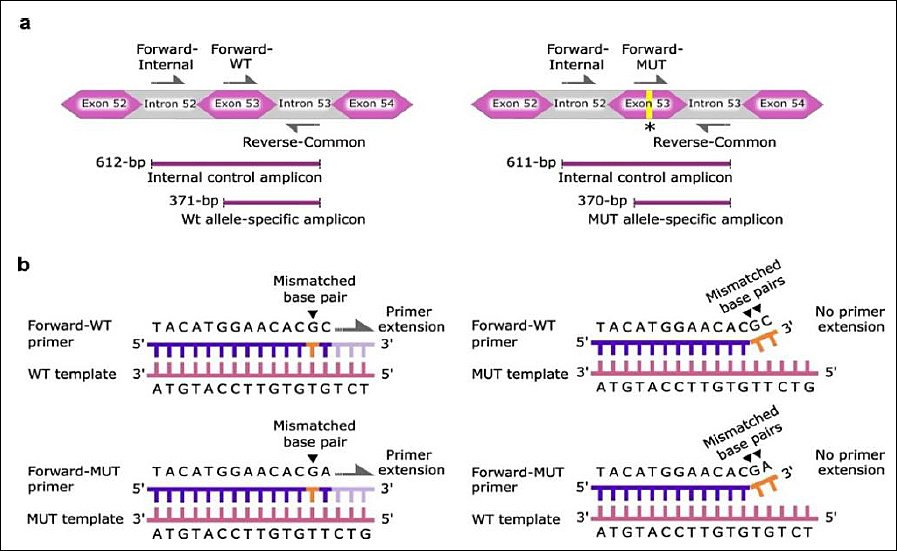
Figure 1. Schematic representation of primer design for single nucleotide polymorphism (SNP) genotyping of the CUBN gene. (a) The left panel illustrates a primer set that amplifies a 371-bp wild-type allele-specific amplicon (Forward-WT and Reverse-Common) and a 612-bp internal control amplicon (Forward-Internal and Reverse-Common). The right panel illustrates a primer set that amplifies a 370-bp mutant allele-specific amplicon (Forward-MUT and Reverse-Common) and a 611-bp internal control amplicon (Forward-Internal and Reverse-Common). The asterisk (*) denotes the position of a single cytosine deletion at the single nucleotide polymorphism site. The gray half-arrows represent the orientation of primers designed to amplify the SNP region and the conserved region distinct from the SNP. (b) The left panel illustrates forward allele-specific primers, which are perfectly aligned to their target SNP at the 3′ terminus and incorporate a single mismatched base pair at the penultimate site. This design enables efficient target allele extension and amplification. The right panel illustrates forward allele-specific primers incorporating two consecutive mismatches against their non-target alleles, one at the penultimate site and one at the 3′ terminus. These mismatches provide a stronger destabilizing effect and reduce the primer extension of non-target alleles. Black arrowheads denote mismatched base pairs. The gray half-arrows indicate the primer extension direction.
Schematic representation of primer design for single nucleotide polymorphism (SNP) genotyping of the CUBN gene. (a) The left panel illustrates a primer set that amplifies a 371-bp wild-type allele-specific amplicon (Forward-WT and Reverse-Common) and a 612-bp internal control amplicon (Forward-Internal and Reverse-Common). The right panel illustrates a primer set that amplifies a 370-bp mutant allele-specific amplicon (Forward-MUT and Reverse-Common) and a 611-bp internal control amplicon (Forward-Internal and Reverse-Common). The asterisk (*) denotes the position of a single cytosine deletion at the single nucleotide polymorphism site. The gray half-arrows represent the orientation of primers designed to amplify the SNP region and the conserved region distinct from the SNP. (b) The left panel illustrates forward allele-specific primers, which are perfectly aligned to their target SNP at the 3′ terminus and incorporate a single mismatched base pair at the penultimate site. This design enables efficient target allele extension and amplification. The right panel illustrates forward allele-specific primers incorporating two consecutive mismatches against their non-target alleles, one at the penultimate site and one at the 3′ terminus. These mismatches provide a stronger destabilizing effect and reduce the primer extension of non-target alleles. Black arrowheads denote mismatched base pairs. The gray half-arrows indicate the primer extension direction.
To further improve assay reliability, a forward-internal control primer (Forward-Internal) was integrated with the common reverse primer to ensure consistent amplification of an internal control fragment across all samples. Following optimization, the assay enabled co-amplification of a 371-bp wild-type allele fragment, a 370-bp mutant allele fragment, and a 611–612-bp internal control fragment (Figure 1a).
The CUBN locus of each sample was genotyped simultaneously in two separate reaction tubes. The first tube detected the wild-type allele and contained Platinum® Taq PCR buffer (Invitrogen, Carlsbad, CA, USA), dNTPs (Biotechrabbit, Berlin, Germany), MgCl2 (Invitrogen), Forward-Internal, Forward-WT, and Reverse-Common primers (Biobasic Inc.), Platinum® Taq DNA Polymerase (Invitrogen), and 50–80 ng genomic DNA in a 25 µL reaction volume.
The second reaction selectively amplified the mutant allele and contained identical reagents, except Forward-WT was replaced with Forward-MUT (Table 3). Amplification was performed using a MiniAmp Plus Thermal Cycler (Thermo Fisher Scientific, Waltham, MA, USA) with standardized cycling conditions, consisting of an initial denaturation at 95C for 5 min, followed by 35 cycles of denaturation at 95°C for 30 s, primer annealing at 59°C for 2 min, and extension at 72°C for 1 min, with a final extension step at 72°C for 10 min.
| Reagent | Stock concentration | Volume added (µL) | Final concentration in 25 µL |
|---|---|---|---|
| Platinum® Taq PCR buffer | 10 × | 2.5 | 1× |
| dNTP mixture | 2 mM | 2.5 | 0.2 mM each |
| MgCl2 | 50 mM | 0.75 | 1.5 mM |
| Forward-Internal primer | 10 µM | 0.75 | 0.3 µM |
| Forward-WT primer | 10 µM | 0.75 | 0.3 µM |
| Forward-MUT primer | 10 µM | 0.75 | 0.3 µM |
| Reverse-Common primer | 10 µM | 0.75 | 0.3 µM |
| Platinum® Taq DNA polymerase | 5 U/µL | 0.1 | 0.5 U |
| Template DNA | 50–80 ng/µL | 1.0 | 50–80 ng |
| Nuclease-free water | – | 15.9 | – |
| Total | 25.0 |
Table 3. Composition of a 25 L PCR reaction mixture for CUBN genotyping.
| Reagent | Stock concentration | Volume added (µL) | Final concentration in 25 µL |
|---|---|---|---|
| Platinum® Taq PCR buffer | 10 × | 2.5 | 1× |
| dNTP mixture | 2 mM | 2.5 | 0.2 mM each |
| MgCl2 | 50 mM | 0.75 | 1.5 mM |
| Forward-Internal primer | 10 µM | 0.75 | 0.3 µM |
| Forward-WT primer | 10 µM | 0.75 | 0.3 µM |
| Forward-MUT primer | 10 µM | 0.75 | 0.3 µM |
| Reverse-Common primer | 10 µM | 0.75 | 0.3 µM |
| Platinum® Taq DNA polymerase | 5 U/µL | 0.1 | 0.5 U |
| Template DNA | 50–80 ng/µL | 1.0 | 50–80 ng |
| Nuclease-free water | – | 15.9 | – |
| Total | 25.0 |
* Forward-WT and Forward-MUT primers were added to a separate reaction tube.
PCR products were resolved on 1.5% agarose gels prepared in 1× TBE buffer and pre-stained with ethidium bromide (0.5 µg/mL). Electrophoresis was conducted at 100 V for approximately 30 min, and fragments were visualized under UV illumination using a Gel Doc™ EZ Documentation System (Bio-Rad Laboratories, Hercules, CA, USA).
Synthetic mutated DNA fragments of CUBN
Due to the absence of naturally occurring homozygous mutant individuals, a synthetic 924-bp DNA fragment containing the CUBN mutation locus was used as a positive control (Figure 2). The fragment was designed using GenBank accession No. NC_006584.3 and synthesized by Invitrogen Custom Gene Synthesis (GeneArt® Strings™ DNA fragments, Thermo Fisher Scientific, Waltham, MA, USA).
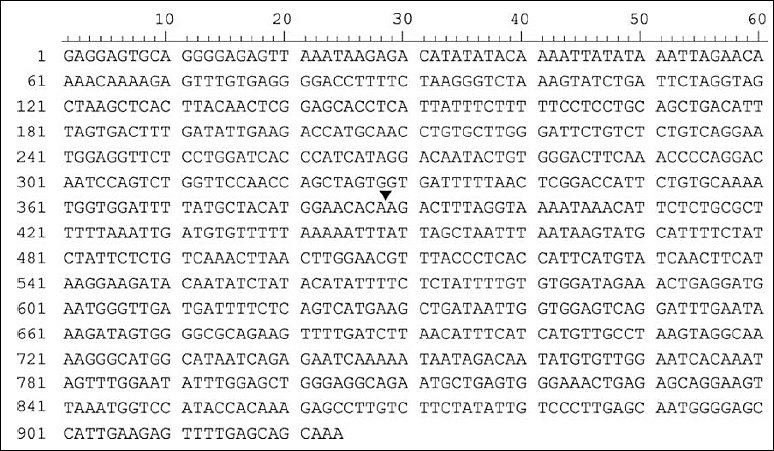
Figure 2. Schematic of the synthetic 924-bp DNA fragment containing the CUBN gene mutation locus (CUBN:c.8392delC). Arrowhead indicates a single cytosine deletion mutation in the target region.
Schematic of the synthetic 924-bp DNA fragment containing the CUBN gene mutation locus (CUBN:c.8392delC). Arrowhead indicates a single cytosine deletion mutation in the target region.
Sequencing
Following PCR-based CUBN genotyping, all 107 samples were further analyzed by Sanger sequencing. Target sequences were amplified using Forward-Internal and Reverse-Common primers. PCR products were purified using the NucleoSpin® Gel and PCR Clean-up Kit (Macherey-Nagel, Düren, Germany) and sequenced by Macrogen Inc. (Seoul, Republic of Korea).
Consensus sequences were generated using SnapGene® Viewer (GSL Biotech LLC, San Diego, CA, USA) and aligned with the reference CUBN sequence in the NCBI database. Sequencing chromatograms were evaluated using Phred quality scores, retaining regions with scores ≥ 20 and validating variants with scores ≥ 30.
Statistical analysis
Prevalence and allele frequencies were calculated as proportions, and 95% confidence intervals (CI) were estimated using the Wilson score method to improve accuracy for rare events in moderate sample sizes.
RESULTS
Technical validation of combined double-mismatch allele-specific and multiplex PCR assays
All 107 samples were successfully and reliably genotyped for the CUBN gene using multiplex PCR integrated with double-mismatch allele-specific primers. This approach enabled discrimination of CUBN genotypes based on three distinct DNA fragment patterns: homozygous wild-type (WT; CUBN (+/+)), heterozygous carrier (CUBN (+/−)), and homozygous mutant (CUBN (−/−)). Samples with the CUBN (+/+) genotype produced a 371-bp wild-type allele-specific amplicon together with a 612-bp internal control amplicon. In contrast, the CUBN (+/−) genotype yielded three fragments, consisting of a 370-bp mutant allele-specific amplicon, a 371-bp wild-type allele-specific amplicon, and an internal control amplicon measuring either 611 or 612 bp.
The assay performance was further validated using synthetic mutated DNA fragments. As expected, this positive control generated a CUBN (−/−) genotype pattern characterized by a 370-bp mutant allele-specific amplicon and a 611-bp internal control amplicon (Figure 3a). PCR amplification of both allele-specific and internal control fragments produced distinct, sharp bands of the expected sizes on agarose gels. All amplicons showed clear resolution with minimal background or nonspecific amplification, allowing unambiguous discrimination between wild-type and mutant alleles.
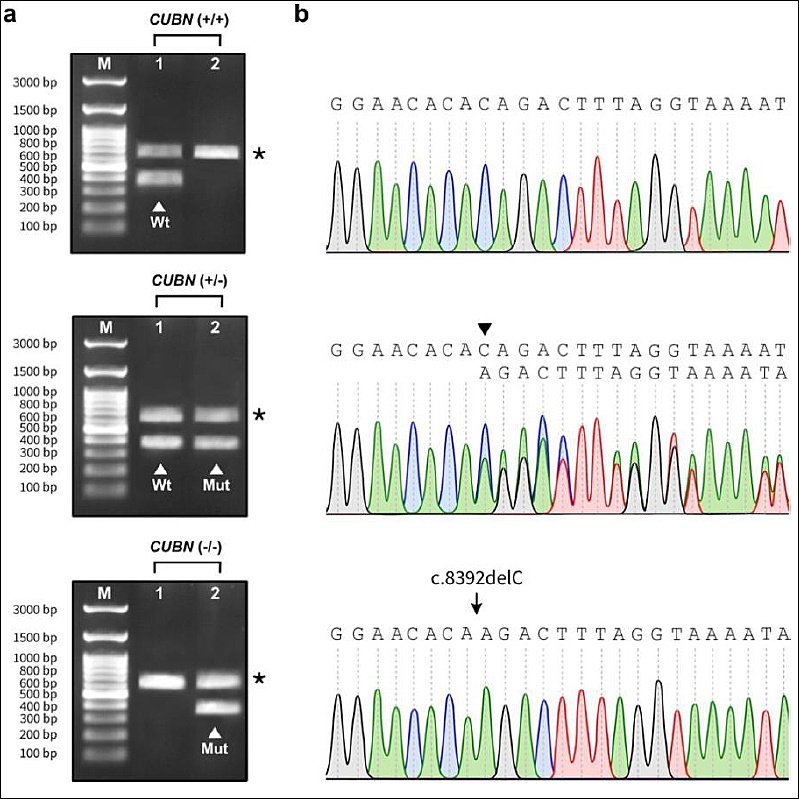
Figure 3. Validation of CUBN genotypes using integrated double-mismatch allele-specific primers with multiplex polymerase chain reaction assays, confirmed by DNA sequencing. (a) Representative agarose gel images show the amplicon patterncorresponding to the CUBN (+/+) (upper), CUBN (+/−) (middle), and CUBN (−/−) (lower) genotypes. The white arrowheads indicate 371-bp wild-type allele-specific (Wt) amplicons in Lane 1 and 370-bp mutant allele-specific amplicons (Mut) in Lane 2. The asterisks (*) denote the 611- or 612-bp internal control amplicons present in both lanes. M, 100-bp DNA marker; Lane 1, wild-type allele-specific amplicon and internal control amplicon; Lane 2, mutant allele-specific amplicon and internal control amplicon. (b) Sanger sequencing chromatograms illustrating the three CUBN genotypes. M, 100-bp DNA marker. The CUBN (+/+) individual (upper panel) exhibited continuous and uniform peaks, confirming the absence of mutation. In the CUBN (+/−) individual (middle panel), the black arrowhead indicates the overlapping sequence traces at the mutation site, indicating the presence of both alleles. The arrow in the synthetic 924-bp mutated DNA fragment (lower panel) denotes a single cytosine deletion mutation locus (c.8392delC).
Validation of CUBN genotypes using integrated double-mismatch allele-specific primers with multiplex polymerase chain reaction assays, confirmed by DNA sequencing. (a) Representative agarose gel images show the amplicon pattern
The multiplex double-mismatch allele-specific PCR assay demonstrated high reproducibility across all replicates, with 100% concordance observed. Genotyping results for all 107 samples were fully consistent with those obtained by Sanger sequencing, with no false-positive or false-negative findings detected (Figure 3b). Collectively, these results confirm that the proposed assay is highly efficient, sensitive, and specific, providing a reliable detection platform for the targeted CUBN mutation.
CUBN genotype profiles associated with IGS
The genotypic distribution and allele frequencies of the CUBN gene among the 107 Border Collies analyzed are summarized in Table 4. Of these, 106 dogs were identified as homozygous WT (CUBN (+/+)), corresponding to 99.1% of the population (95% CI: 94.8%–99.8%). Only one individual carried the heterozygous genotype (CUBN (+/−)), representing 0.9% (95% CI: 0.16%–5.0%). No dogs were found to harbor the homozygous mutant genotype (CUBN (−/−)) (0%; 95% CI: 0%–4.3%).
| Category | Genotype/Allele | Frequency (%) | Wilson 95% CI |
|---|---|---|---|
| Genotype frequencies | CUBN (+/+) (n = 106) | 99.1 | 94.8–99.8 |
| CUBN (+/−) (n = 1) | 0.9 | 0.16–5.0 | |
| CUBN (−/−) (n = 0) | 0 | 0–4.3 | |
| Allelic frequencies | Wild-type allele | 99.6 | 98.2–99.9 |
| Mutant allele | 0.4 | 0.07–1.8 |
Table 4. Distribution of CUBN genotype and allele frequencies in 107 Border Collies.
| Category | Genotype/Allele | Frequency (%) | Wilson 95% CI |
|---|---|---|---|
| Genotype frequencies | CUBN (+/+) (n = 106) | 99.1 | 94.8–99.8 |
| CUBN (+/−) (n = 1) | 0.9 | 0.16–5.0 | |
| CUBN (−/−) (n = 0) | 0 | 0–4.3 | |
| Allelic frequencies | Wild-type allele | 99.6 | 98.2–99.9 |
| Mutant allele | 0.4 | 0.07–1.8 |
The calculated allele frequencies indicated a predominance of the wild-type allele at 99.6% (95% CI: 98.2%–99.9%), whereas the mutant allele frequency was estimated at 0.4% (95% CI: 0.07%–1.8%). Taken together, the absence of homozygous mutant individuals and the very low mutant allele frequency suggest that the estimated prevalence of IGS is relatively low in this Border Collie population.
DISCUSSION
Development and validation of the genotyping approach
This study aimed to investigate CUBN variants associated with IGS in Thai Border Collies by integrating double-mismatch allele-specific primers with a multiplex PCR assay. Allele-specific primers were deliberately designed with an artificial nucleotide mismatch at the penultimate position to enhance discrimination among closely related SNP variants. The incorporation of double-mismatch allele-specific primers into a multiplex PCR format further improved assay specificity and reduced the likelihood of false-negative results.
A forward-internal control primer was designed to target a conserved region within intron 52 without nucleotide mismatches. The inclusion of parallel internal control amplification provided an additional reliability feature that is not commonly incorporated in previously published allele-specific PCR designs for IGS. When paired with the common reverse primer, this internal control primer consistently amplified a fragment of 611- or 612-bp across the SNP region in all samples. The internal control fragment was clearly visualized and readily distinguished from the smaller allele-specific products (370-bp for the mutant allele and 371-bp for the WT allele) by agarose gel electrophoresis (Figure 3a).
To further validate assay performance, a custom-designed 924-bp synthetic DNA fragment representing the mutant allele was included to confirm the detection of homozygous mutant genotypes. This strategy represents a novel control approach that enables reliable interpretation of results in populations in which homozygous mutants are extremely rare. This is the first study to adapt and validate a double-mismatch allele-specific PCR assay for the rapid and cost-efficient detection of CUBN mutations in Thai clinical and breeding settings. Compared with Sanger sequencing or real-time PCR, the proposed assay offers an economical and scalable workflow suitable for resource-limited veterinary laboratories in Thailand.
Practical implications for genetic screening and disease control
The findings of this study have important practical implications for genetic counselors, breeders, and clinicians. Integration of these results into genetic counseling frameworks allows collaboration with breeders to develop long-term preventive breeding strategies that maintain disease-free populations while preserving genetic diversity. Routine genetic screening before breeding can help avoid carrier-to-carrier matings and prevent the production of affected offspring. In addition, this diagnostic approach provides clinicians with a practical tool for incorporating genetic testing into routine diagnostic protocols for dogs presenting compatible clinical signs or originating from high-risk lineages.
Population structure and CUBN genotype distribution
A genetic survey was conducted on 107 Border Collies in Thailand, comprising 33 privately owned dogs with unrelated parental origins and 74 dogs from seven breeding kennels. Kennel A contributed the largest proportion of dogs (n = 49), with approximately one-third sharing common parentage, whereas kennels B (n = 5), C (n = 8), D (n = 4), E (n = 2), F (n = 2), and G (n = 4) contributed smaller numbers. Pedigree verification demonstrated that the study population represented a heterogeneous genetic pool. Nearly half of the dogs were direct descendants of Border Collies originating from the United States, while the remaining dogs traced ancestry to Australia, Russia, Austria, France, Hungary, Italy, and the United Kingdom.
Genotypic analysis revealed a predominance of the WT CUBN genotype. Only one dog was identified as a heterozygous carrier, and no dogs were homozygous for the targeted CUBN mutation. The estimated WT and mutant allele frequencies were 99.6% and 0.4%, respectively. The carrier dog was a privately owned, neutered female that was clinically healthy based on physical examination and owner-reported history. No signs suggestive of cobalamin deficiency or IGS-like disease were observed, although hematological and biochemical testing was not performed. Complete pedigree information was unavailable for this adopted dog, limiting the ability to trace its ancestral origin.
Comparison with international studies and population genetics considerations
A cohort study from Switzerland involving 203 Border Collies reported a substantially higher carrier frequency of 6.2% for the CUBN mutation [20], whereas a large-scale study in Japan involving 500 dogs identified a carrier frequency of 3% and a mutant allele frequency of 1.5% [23]. Despite differences in sample size and population structure, these findings highlight marked geographic variation in CUBN mutation distribution among Border Collie populations. The higher carrier frequency in Switzerland [20] may reflect a relatively closed gene pool with restricted gene flow, promoting the accumulation of deleterious alleles over generations. In contrast, the intermediate frequency reported in Japan [23] likely reflects differences in breeding practices and population structure, where moderate genetic diversity and founder expansion may partially dilute deleterious allele accumulation.
Analysis of imported and locally bred Border Collies in Thailand underscores the influence of international breeding lines on the distribution of hereditary disorders in emerging populations. The relatively low carrier frequency observed in this cohort is likely attributable to a geographically diverse population structure composed of dogs imported from multiple countries and their descendants. Such diversity establishes a heterogeneous founder population, mitigating founder effects and reducing CUBN mutation risk.
Study limitations and future perspectives
Despite the predominance of the WT CUBN genotype, several limitations should be considered. First, the relatively small sample size (n = 107) limits the power to detect rare genotypes, particularly heterozygous and homozygous mutant states. This constraint is largely due to the absence of a centralized registry for Thai Border Collies, restricting access to a well-documented population. Limited awareness of breed-predisposing diseases, particularly IGS, may also have reduced owner and breeder participation.
Second, the use of convenience sampling rather than randomized selection may have resulted in uneven representation of specific kennels, introducing potential selection bias and limiting generalizability to the broader Thai Border Collie population. Third, pedigree analysis was not performed because comprehensive multigenerational lineage records were unavailable for many dogs, particularly privately owned and adopted individuals. Consequently, future studies incorporating larger sample sizes, well-documented pedigrees, and stratified random sampling are required to refine prevalence estimates and better characterize transgenerational inheritance patterns of IGS.
Integration with existing genetic screening data
This study complements recent genetic screening efforts targeting multidrug resistance 1 (MDR1) [26], non-homologous end-joining factor 1 (NHEJ1) [27], and vacuolar protein sorting 13 homolog B (VPS13B) [28] in Thai Border Collies conducted between 2021 and 2023. These studies reported a complete absence of MDR1 mutations, a 15.6% carrier frequency, and 7.8% mutant allele frequency for NHEJ1 associated with Collie eye anomaly (n = 45), and carrier and mutant allele frequencies of 4% and 2% for VPS13B associated with trapped neutrophil syndrome (n = 100). Although detection of NHEJ1, VPS13B, and CUBN mutations indicates potential hereditary disease transmission, the very low prevalence of CUBN carrier and homozygous mutant genotypes suggests a generally favorable genetic health profile for Thai Border Collies at these loci.
CONCLUSION
This study successfully identified CUBN variants associated with IGS in Thai Border Collies using a double-mismatch allele-specific multiplex PCR assay. Among 107 dogs analyzed, 106 individuals (99.1%) were homozygous WT, one dog (0.9%) was a heterozygous carrier, and no homozygous mutant individuals were detected. The estimated WT and mutant allele frequencies were 99.6% and 0.4%, respectively, indicating a very low prevalence of the CUBN mutation in this population. All PCR-based genotyping results showed complete concordance with Sanger sequencing, confirming the robustness and accuracy of the assay.
The validated assay provides a rapid, reliable, and cost-efficient diagnostic tool for routine CUBN genotyping in clinical and breeding settings. Its scalability and low resource requirement make it particularly suitable for veterinary laboratories with limited access to sequencing platforms. Integration of this assay into genetic counseling programs can assist breeders in implementing preventive mating strategies, avoiding carrier-to-carrier pairings, and maintaining disease-free populations while preserving genetic diversity. Clinicians may also apply this method as part of diagnostic workflows for dogs presenting compatible clinical signs or originating from high-risk lineages.Major strengths include the use of a novel double-mismatch allele-specific multiplex PCR design with an internal control amplicon, ensuring high specificity and minimizing false-negative results. The inclusion of a synthetic mutant control enabled validation of homozygous mutant detection despite the rarity of such genotypes. In addition, complete agreement with Sanger sequencing supports the analytical validity of the assay.
Several limitations should be acknowledged. The moderate sample size may limit the detection of rare genotypes and reduce statistical power. Convenience sampling and uneven representation among kennels may introduce selection bias, restricting extrapolation to the entire Thai Border Collie population. Furthermore, incomplete pedigree information for many dogs prevented detailed transgenerational inheritance analysis.
Future studies should incorporate larger, randomly sampled cohorts with comprehensive pedigree data to refine prevalence estimates and better characterize population-level inheritance patterns of IGS. Integration of this PCR-based approach with high-throughput genotyping platforms may further enhance large-scale surveillance. Longitudinal studies combining genetic data with clinical and biochemical assessments would also improve understanding of genotype–phenotype relationships.
Overall, this study provides the first population-level insight into CUBN-associated IGS in Thai Border Collies and demonstrates that the mutation occurs at a very low frequency in this genetically diverse population. The validated assay offers a practical foundation for routine genetic screening and supports evidence-based breeding and disease prevention strategies, contributing to improved genetic health management of Border Collies in Thailand.
DATA AVAILABILITY
Additional data supporting the findings of this study are available from the corresponding author upon reasonable request.
AUTHORS’ CONTRIBUTIONS
CL: Examined the clinical condition of the animals, collected blood samples, designed the study, performed the experiments, analyzed data, drafted, reviewed, and edited the manuscript. NA: designed the study, analyzed data, reviewed and edited the manuscript. NP: Provided technical laboratory support, reviewed and edited the manuscript.
COMPETING INTERESTS
The authors declare that they have no competing interests.
PUBLISHER’S NOTE
Veterinary World remains neutral with regard to jurisdictional claims in the published institutional affiliations.
ACKNOWLEDGMENTS
The authors would like to thank all dog owners and breeders involved in the study. This research was financially supported by the Faculty of Veterinary Medicine, Kasetsart University, Thailand (Grant no. VET.KU2024-RPDF03).
REFERENCES
- Wolffenbuttel BH, McCaddon A, Ahmadi KR, Green R. A brief overview of the diagnosis and treatment of cobalamin (B12) deficiency. Food Nutr Bull 2024;45((1 Suppl)):S40-S59. [Google Scholar] | [Crossref]
- Hossain KS, Amarasena S, Mayengbam S. B vitamins and their roles in gut health. Microorganisms 2022;10(6):1168. [Google Scholar] | [Crossref]
- Offringa AK, Bourgonje AR, Schrier MS, Deth RC, van Goor H. Clinical implications of vitamin B12 as redox-active cofactor. Trends Mol Med 2021;27((10)):931-934. [Google Scholar] | [Crossref]
- Nexo E, Parkner T. Vitamin B12-related biomarkers. Food Nutr Bull 2024;45((1 Suppl)):S28-S33. [Google Scholar] | [Crossref]
- Moravcová M, Siatka T, Krčmová LK, Matoušová K, Mladěnka P. Biological properties of vitamin B12. Nutr Res Rev 2025;38(1):338-370. [Google Scholar] | [Crossref]
- Kather S, Grützner N, Kook PH, Dengler F, Heilmann RM. Review of cobalamin status and disorders of cobalamin metabolism in dogs. J Vet Intern Med 2020;34((1)):13-28. [Google Scholar] | [Crossref]
- Kozyraki R, Verroust P, Cases O. Cubilin, the intrinsic factor-vitamin B12 receptor. Vitam Horm 2022;119:65-119. [Google Scholar] | [Crossref]
- Gburek J, Konopska B, Gołąb K. Renal handling of albumin—from early findings to current concepts. Int J Mol Sci 2021;22(11):5809. [Google Scholar] | [Crossref]
- Aminoff M, Carter JE, Chadwick RB, Johnson C, Gräsbeck R, Abdelaal MA, Broch H, Jenner LB, Verroust PJ, Moestrup SK, de la Chapelle A, Krahe R. Mutations in CUBN, encoding the intrinsic factor-vitamin B12 receptor, cubilin, cause hereditary megaloblastic anaemia 1. Nat Genet 1999;21(3):309-313. [Google Scholar] | [Crossref]
- Tanner SM, Aminoff M, Wright FA, Liyanarachchi S, Kuronen M, Saarinen A, Massika O, Mandel H, Broch H, de la Chapelle A. Amnionless, essential for mouse gastrulation, is mutated in recessive hereditary megaloblastic anemia. Nat Genet 2003;33(3):426-429. [Google Scholar] | [Crossref]
- He Q, Madsen M, Kilkenney A, Gregory B, Christensen EI, Vorum H, Højrup P, Schäffer AA, Kirkness EF, Tanner SM, de la Chapelle A, Giger U, Moestrup SK, Fyfe JC. Amnionless function is required for cubilin brush-border expression and intrinsic factor-cobalamin (vitamin B12) absorption in vivo. Blood 2005;106(4):1447-1453. [Google Scholar] | [Crossref]
- Gold AJ, Scott MA, Fyfe JC. Failure to thrive and life-threatening complications due to inherited selective cobalamin malabsorption effectively managed in a juvenile Australian shepherd dog. Can Vet J 2015;56(10):1029-1034. [Google Scholar] | [Crossref]
- Fyfe JC, Giger U, Hall CA, Jezyk PF, Klumpp SA, Levine JS, Patterson DF. Inherited selective intestinal cobalamin malabsorption and cobalamin deficiency in dogs. Pediatr Res 1991;29((1)):24-31. [Google Scholar] | [Crossref]
- Fordyce HH, Callan MB, Giger U. Persistent cobalamin deficiency causing failure to thrive in a juvenile beagle. J Small Anim Pract 2000;41(9):407-410. [Google Scholar] | [Crossref]
- Kook PH, Drögemüller M, Leeb T, Howard J, Ruetten M. Degenerative liver disease in young beagles with hereditary cobalamin malabsorption because of a mutation in the cubilin gene. J Vet Intern Med 2014;28((2)):666-671. [Google Scholar] | [Crossref]
- Fyfe JC, Hemker SL, Venta PJ, Stebbing B, Giger U. Selective intestinal cobalamin malabsorption with proteinuria (Imerslund-Gräsbeck syndrome) in juvenile beagles. J Vet Intern Med 2014;28((2)):356-362. [Google Scholar] | [Crossref]
- Murtagh K, Batchelor D, German A, Piviani M, Silvestrini P. Congenital cobalamin malabsorption (Imerslund-Gräsbeck syndrome) in two beagles in the UK. Vet Rec Case Rep 2015;3(1):e000201. [Google Scholar] | [Crossref]
- Battersby IA, Giger U, Hall EJ. Hyperammonaemic encephalopathy secondary to selective cobalamin deficiency in a juvenile Border collie. J Small Anim Pract 2005;46(7):339-344. [Google Scholar] | [Crossref]
- Fyfe JC, Hemker SL, Venta PJ, Fitzgerald CA, Outerbridge CA, Myers SL, Giger U. An exon 53 frameshift mutation in CUBN abrogates cubam function and causes Imerslund-Gräsbeck syndrome in dogs. Mol Genet Metab 2013;109(4):390-396. [Google Scholar] | [Crossref]
- Owczarek-Lipska M, Jagannathan V, Drögemüller C, Lutz S, Glanemann B, Leeb T, Kook PH. A frameshift mutation in the cubilin gene (CUBN) in Border collies with Imerslund-Gräsbeck syndrome (selective cobalamin malabsorption). PLoS One 2013;8(4):e61144. [Google Scholar] | [Crossref]
- Lutz S, Sewell AC, Reusch CE, Kook PH. Clinical and laboratory findings in Border collies with presumed hereditary juvenile cobalamin deficiency. J Am Anim Hosp Assoc 2013;49(3):197-203. [Google Scholar] | [Crossref]
- Drögemüller M, Jagannathan V, Howard J, Bruggmann R, Drögemüller C, Ruetten M, Leeb T, Kook PH. A frameshift mutation in the cubilin gene (CUBN) in beagles with Imerslund-Gräsbeck syndrome (selective cobalamin malabsorption). Anim Genet 2014;45(1):148-150. [Google Scholar] | [Crossref]
- Mizukami K, Yabuki A, Kohyama M, Kushida K, Rahman MM, Uddin MM, Sawa M, Yamato O. Molecular prevalence of multiple genetic disorders in Border collies in Japan and recommendations for genetic counselling. Vet J 2016;214:21-23. [Google Scholar] | [Crossref]
- Bui M, Liu Z. Simple allele-discriminating PCR for cost-effective and rapid genotyping and mapping. Plant Methods 2009;5:1. [Google Scholar] | [Crossref]
- Huang K, Zhang J, Li J, Qiu H, Wei L, Yan Y, Wang C. Exploring the impact of primer-template mismatches on PCR performance of DNA polymerase varying in proofreading activity. Genes 2024;15((2)):215. [Google Scholar] | [Crossref]
- Lerdkrai C, Phungphosop N. Prevalence of the MDR1 gene mutation in herding dog breeds and Thai Ridgebacks in Thailand. Vet World 2021;14(11):3015-3020. [Google Scholar] | [Crossref]
- Lerdkrai C, Phungphosop N. A novel multiplex polymerase chain reaction assay for the genotypic survey of the non-homologous end-joining factor 1 associated with Collie eye anomaly in Thailand. Vet World 2022;15(1):132-139. [Google Scholar] | [Crossref]
- Lerdkrai C, Phungphosop N. Multiplex allele-specific polymerase chain reaction-based prevalence study of canine trapped neutrophil syndrome in Thailand. Vet World 2023;16(11):2271-2276. [Google Scholar] | [Crossref]