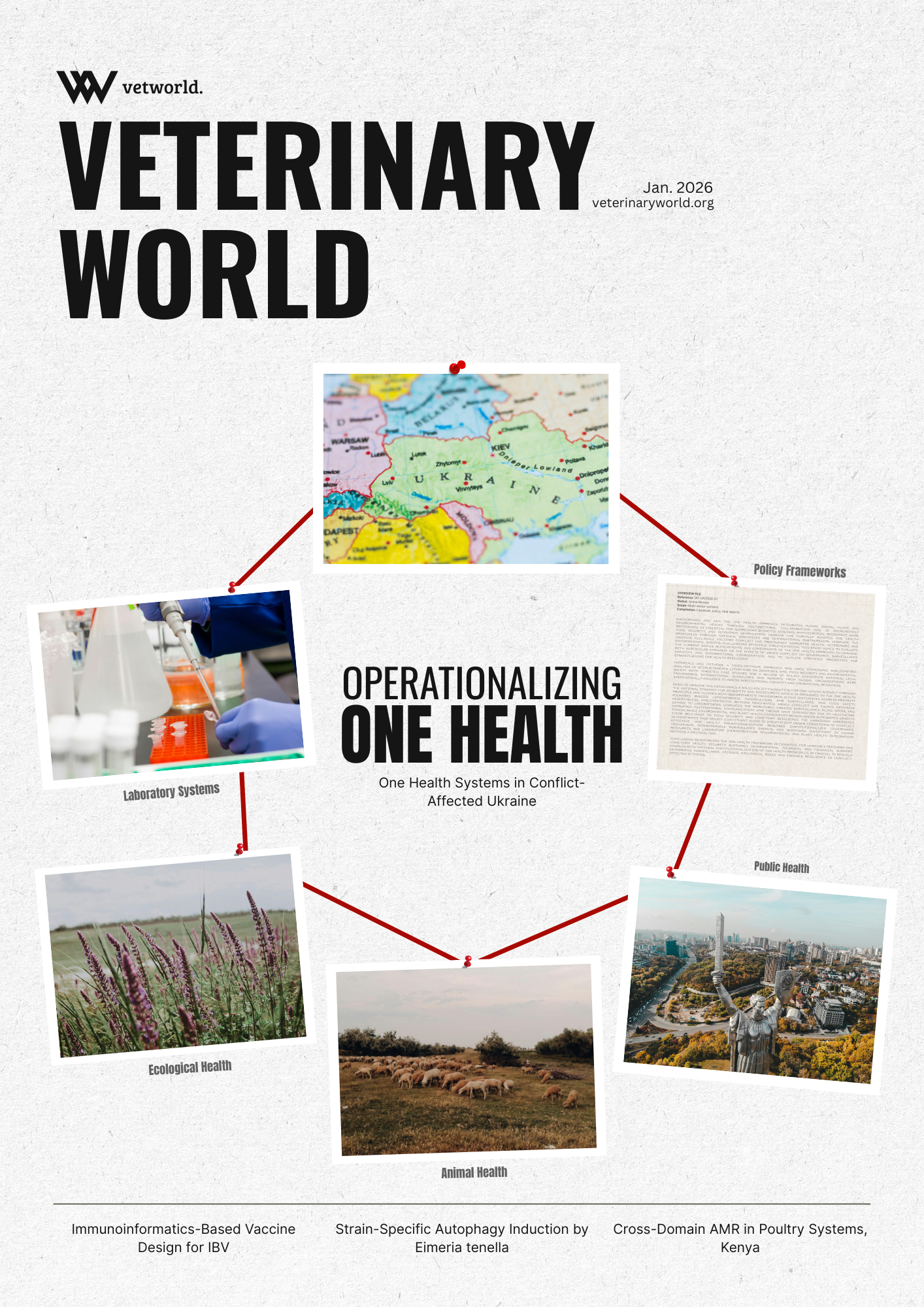
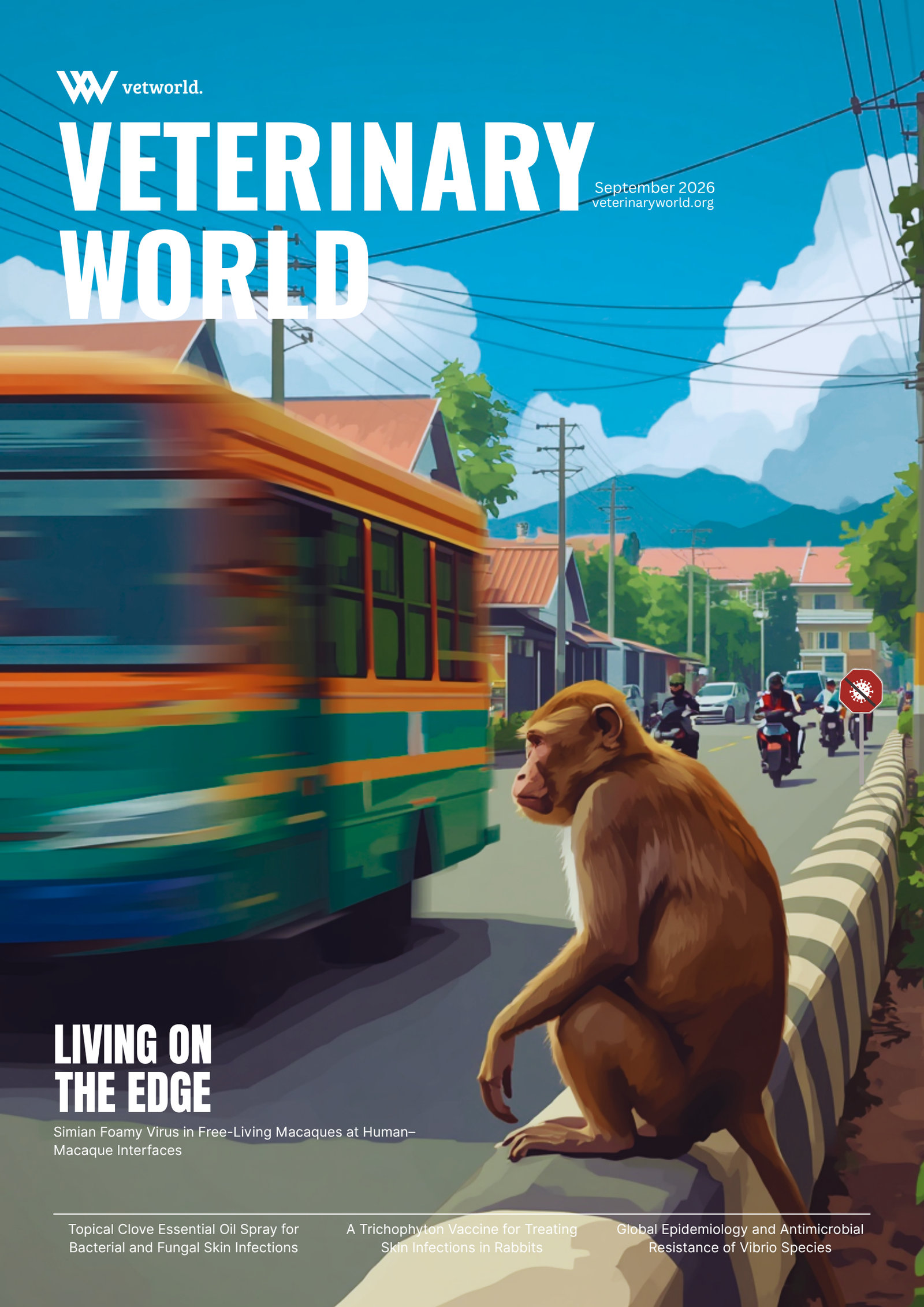
Issue Cover
Volume 19 | January
Research Article | 06 Jan 2026
Cross-domain antimicrobial resistance in poultry farming: A One Health assessment of antimicrobial use and multidrug resistance in Kiambu County, Kenya
Ann Kangai Munene, Peter Muiruri Mwangi, Lilly Caroline Bebora, Christine Minoo Mbindyo, and John Muthini Maingi

Volume-19 | Issue-1 | Article-1 | https://doi.org/10.14202/vetworld.2026.1-14

Preview Abstract
Antimicrobial resistance (AMR) has emerged as a major One Health threat driven by inappropriate antimicrobial use (AMU) in humans, animals, and the environment. Poultry production is recognized as a key reservoir of antimicrobial-resistant bacteria, yet few studies in Kenya examine AMU and AMR across interconnected human–animal–environment domains. This study assessed AMU patterns among poultry farmers in Kiambu County and characterized phenotypic resistance in Escherichia coli and Enterococcus spp. isolated from humans, chickens, and chicken environments.  A cross-sectional study was conducted from June to September 2024, involving 102 poultry farms. Farm demographics and AMU data were collected using a semi-structured questionnaire. Archived E. coli (n = 92) and Enterococcus spp. (n = 101) isolates from chicken handlers’ hands, chickens, and environmental samples were subjected to antimicrobial susceptibility testing using the Kirby–Bauer method per Clinical and Laboratory Standards Institute (CLSI) 2024 guidelines. Descriptive and inferential statistics, including logistic regression with false discovery rate correction, were used to assess associations between AMU and phenotypic resistance.  Macrolides (69%), tetracyclines (48%), and sulfonamides (21%) were the most commonly used antimicrobials; 7% of farms reported colistin use. Among E. coli isolates, resistance was highest to ampicillin (77%), tetracycline (72%), and trimethoprim–sulfamethoxazole (49%), with 35% exhibiting multidrug resistance (MDR). No carbapenem resistance was detected. Enterococcus isolates showed high erythromycin resistance (61%) and moderate ciprofloxacin resistance (26%), with 6.9% exhibiting MDR; no vancomycin-resistant enterococci (VRE) were observed. Penicillin use strongly predicted ampicillin resistance in both organisms, whereas sulfonamide use was associated with reduced trimethoprim–sulfamethoxazole resistance. Macrolide use did not correlate with erythromycin resistance.  High AMU in poultry farming, particularly of macrolides, tetracyclines, and sulfonamides, has created significant selection pressure, contributing to MDR emergence across One Health interfaces. Detection of resistance in humans, poultry, and shared environments underscores the bidirectional risk of AMR transmission. Strengthened antimicrobial stewardship, regulation of critically important antimicrobials, and enhanced farm hygiene are essential to mitigate AMR. These findings directly support Kenya’s Vision 2030 and SDGs targeting health, responsible production, and environmental protection. 
Research Article | 06 Jan 2026
First validated liquid chromatography–tandem mass spectrometry method for simultaneous quantification of propranolol and 4-hydroxypropranolol in pig plasma and dried blood spots and its application to a pharmacokinetic study
Anisa Bardhi, Domenico Ventrella, Alberto Elmi, Ronette Gehring, Davide Martelli, Ilaria Troisio, Maria Laura Bacci, and Andrea Barbarossa

Volume-19 | Issue-1 | Article-2 | https://doi.org/10.14202/vetworld.2026.15-28

Preview Abstract
Propranolol is a widely used non-selective beta-adrenergic blocker in human medicine, with well-characterized pharmacokinetics (PK) in humans but virtually no data available for pigs, a species of growing biomedical relevance. Furthermore, no validated bioanalytical methods exist for propranolol or its primary metabolite, 4-hydroxypropranolol, in porcine matrices. This study aimed to develop and validate a rapid, sensitive, and reliable liquid chromatography–tandem mass spectrometry (LC–MS/MS) method for the simultaneous quantification of propranolol and 4-hydroxypropranolol in pig plasma and dried blood spots (DBS), and to apply it in a preliminary PK investigation in pigs.  Sample preparation involved simple protein precipitation (plasma) or solvent extraction (DBS) using acetonitrile–water mixtures, followed by chromatographic separation on a Bridged ethyl hybrid C18 column (50 × 2.1 mm, 1.7 μm; 4-min run). Detection was performed in Multiple reaction monitoring mode with propranolol-d7 as the internal standard. Validation followed EMA ICH M10 guidelines, assessing linearity, accuracy, precision, matrix effects, recovery, and stability. The method was then applied to plasma samples from five juvenile female pigs receiving oral propranolol (3 mg/kg, q8 h).  The method demonstrated excellent linearity (r2 > 0.99) and acceptable accuracy and precision (±15%) across 2–500 ng/mL (propranolol) and 1–400 ng/mL (4-hydroxypropranolol). Recoveries ranged from 83% to 116% (plasma) and 81%–113% (DBS), with no matrix interference or carry-over. In vivo PK data revealed rapid absorption (Tmax 1.14 ± 0.63 h), moderate elimination (t½ 2.19 ± 0.86 h), and a mean Cmax of 112.02 ± 81.87 ng/mL. Notably, 4-hydroxypropranolol was undetectable in all plasma samples, suggesting species-specific metabolic differences.  This study reports the first validated LC–MS/MS assay for propranolol and 4-hydroxypropranolol in pigs and demonstrates its successful application in a PK study. The method’s simplicity, short runtime, and compatibility with DBS microsampling make it ideal for preclinical and veterinary research, minimizing animal stress and sampling volume. Absence of 4-hydroxypropranolol highlights interspecies metabolic variability and warrants further investigation into propranolol biotransformation pathways in swine and other translational models. 

Volume-19 | Issue-1 | Article-3 | https://doi.org/10.14202/vetworld.2026.29-38

Preview Abstract
Heat stress (HS) substantially impairs dairy goat productivity in Mediterranean climates by disrupting metabolic, endocrine, and cellular homeostasis. High-yielding Saanen goats are particularly vulnerable because of elevated metabolic heat production, yet age-specific physiological responses to prolonged natural HS remain unclear. This study aimed to characterize age-dependent adaptations to progressive summer HS by evaluating changes in triiodothyronine (T3), thyroxine (T4), cortisol (CORT), and heat shock protein 70 (HSP70), and their relationship to daily average milk yield (DAMY). We hypothesized that increasing temperature–humidity index (THI) would suppress T3 and T4, moderately elevate CORT, and stimulate HSP70 expression, particularly in young goats.  Thirty clinically healthy, lactating Saanen does were grouped into young, middle-aged, and old age groups (n = 10 per group). The study was conducted from May to August under natural Mediterranean field conditions. Ambient temperature, relative humidity, and THI were recorded daily. DAMY was measured automatically using a radio-frequency identification-linked milking system. Blood samples were collected twice monthly to quantify serum T3, T4, CORT, and HSP70 using commercial enzyme-linked immunosorbent assay kits. A repeated-measures general linear model evaluated the effects of age, month, and their interaction; significance was set at p < 0.05.  THI increased from “no HS” in May to “severe HS” in July and August, confirming sustained heat-load. DAMY declined from 2.59 ± 0.43 kg in May to 1.88 ± 0.40 kg in August. T4 decreased significantly in young and middle-aged goats, with the sharpest decline in middle-aged goats (92.96 to 61.82 nmol/L; p < 0.01). T3 also decreased significantly in young and middle-aged groups (p < 0.01), whereas older goats showed modest, nonsignificant reductions. CORT showed a mild, nonsignificant upward trend. HSP70 increased across all groups, with a significant rise in young goats (13.32 to 17.85 ng/mL; p < 0.05). T4 showed a strong positive correlation with DAMY (r = 0.78, p = 0.0027), whereas CORT showed a moderate negative correlation with DAMY (r = −0.58, p = 0.047).  Lactating Saanen goats exhibit age-dependent dual adaptations to summer HS: endocrine suppression of thyroid activity, stronger in middle-aged goats, and cellular upregulation of HSP70, most evident in young goats. Monitoring T3, T4, CORT, HSP70, and DAMY can help identify thermally vulnerable life-stage groups and guide targeted cooling, nutritional, and breeding interventions in heat-stressed dairy systems. 
Research Article | 06 Jan 2026
Black soldier fly protein–based microencapsulation of lemongrass oil improves rumen fermentation efficiency and mitigates methane production in vitro
Maharach Matra, Chaichana Suriyapha, Gamonmas Dagaew, Rittikeard Prachumchai, Srisan Phupaboon, Sukruthai Sommai, Theerachai Haitook, Sajee Kunhareang, and Metha Wanapat

Volume-19 | Issue-1 | Article-4 | https://doi.org/10.14202/vetworld.2026.39-51

Preview Abstract
Essential oils (EOs) are promising natural modifiers of rumen fermentation and methane production; however, their volatility and rapid degradation limit their effectiveness. Microencapsulation can shield bioactive compounds and allow controlled release. Insect-derived proteins, especially from black soldier fly (BSF; Hermetia illucens L.), offer a sustainable and functional wall material, yet their use for rumen-targeted delivery remains unexplored. This study aimed to assess the effects of microencapsulated-lemongrass oil (M-LEO) using BSF protein as a biopolymer wall on gas kinetics, nutrient degradability, rumen fermentation parameters, microbial populations, and methane output in vitro.  A completely randomized design was used with five dietary treatments containing M-LEO at 0, 2, 4, 6, and 8% of total dry matter (DM) substrate. In vitro rumen fermentation was performed using rumen fluid from Holstein-crossbred dairy cattle. Fermentation was measured at 12, 24, and 48 h for gas kinetics, in vitro dry matter degradability (IVDMD) and in vitro organic matter degradability (IVOMD), pH, ammonia-nitrogen (NH₃-N), volatile fatty acids (VFAs), methane production, and microbial populations quantified by real-time polymerase chain reaction.  M-LEO showed high encapsulation efficiency (85.2%) and significant bioactive content. Supplementing with M-LEO notably improved gas production kinetics and nutrient degradability, with optimal effects at 6% of total DM. At this level, IVDMD and IVOMD increased by up to 11.5% and 10.5%, respectively. Total VFA and propionate concentrations rose significantly (p < 0.05), while acetate proportion and the acetate-to-propionate ratio decreased. Rumen pH and NH₃-N levels stayed within optimal ranges and were unaffected by treatment. Methane production was substantially reduced, with decreases of up to 48.8% at 48 h compared to the control. Additionally, M-LEO boosted populations of key cellulolytic bacteria (Fibrobacter succinogenes, Ruminococcus albus, and Ruminococcus flavefaciens) and Megasphaera elsdenii, while significantly suppressing methanogenic archaea (Methanobacteriales).  Microencapsulation of lemongrass oil with BSF protein effectively enhances rumen fermentation efficiency and significantly decreases methane emissions in vitro. This innovative insect-protein delivery system provides a sustainable and climate-friendly feed additive approach, deserving further validation in vivo. 
Research Article | 08 Jan 2026
Antimicrobial resistance, extended-spectrum β-lactamase determinants, and virulence gene profiles of Escherichia coli along the pork production chain in central Thailand
Watsawan Prapasawat, Achiraya Siriphap, Sirikarn Wiriyasirivaj, Apiradee Intarapuk, Ruttana Pachanon, Chie Nakajima, Yasuhiko Suzuki, and Orasa Suthienkul

Volume-19 | Issue-1 | Article-5 | https://doi.org/10.14202/vetworld.2026.52-64

Preview Abstract
Antimicrobial resistance (AMR) in foodborne bacteria presents a significant threat to public health, especially in countries with intensive livestock production systems. Pig farming is a major source of animal protein in Thailand and is recognized as an important reservoir of antimicrobial-resistant bacteria. Escherichia coli is commonly used as an indicator organism for monitoring AMR, including extended-spectrum β-lactamase (ESBL) production and pathogenic potential. This study aimed to assess the frequency of AMR, multidrug-resistant (MDR), ESBL determinants, and virulence genes in E. coli isolates collected from slaughterhouses and fresh markets in central Thailand.  A total of 498 archived E. coli isolates were analyzed, including 236 isolates from slaughterhouses (feces and carcasses) and 262 isolates from fresh markets (pork and cutting boards). Antimicrobial susceptibility testing was performed against 18 antimicrobial agents using the disk diffusion method. MDR was defined as resistance to three or more antimicrobial classes. ESBL production was identified through phenotypic confirmatory tests, and ESBL-producing isolates were screened for blaTEM, blaCTX-M, and blaSHV genes by multiplex polymerase chain reaction. All isolates were further examined for select virulence genes linked to major E. coli pathotypes.  Overall, 97.4% of E. coli isolates showed resistance to at least one antimicrobial agent, and 87.3% were classified as MDR. ESBL-producing E. coli made up 23.5% of all isolates, with a significantly higher prevalence in slaughterhouses compared to fresh markets (p < 0.05). Among ESBL producers, 97.4% exhibited MDR phenotypes. Most (89.7%) of the ESBL-producing isolates carried at least one bla gene, with blaTEM being the most common, followed by blaCTX-M. Virulence genes were detected at a low frequency (3.2%), mainly involving eaeA, lt, and stp.  The high prevalence of AMR, MDR, and ESBL-producing E. coli throughout the pork production chain highlights slaughterhouses and fresh markets as key points for the spread of resistant bacteria. These findings emphasize the need for stronger antimicrobial stewardship, better hygiene practices, and ongoing AMR surveillance within the One Health approach to reduce public health risks linked to pork consumption. 
Research Article | 08 Jan 2026
Trimodal cytological integration of micronuclei assay, argyrophilic nucleolar organizer region staining, and cytomorphometry enhances diagnostic discrimination of canine gingival masses
Poppapak Hoonpo, Tawewan Issarankura Na Ayudhaya, Kridsada Chaichoun, Panpanga Sangsuriya, Thanongsak Mamom, and Parin Suwannaprapha

Volume-19 | Issue-1 | Article-6 | https://doi.org/10.14202/vetworld.2026.65-80

Preview Abstract
Canine gingival masses are common oral lesions with variable biological behavior, ranging from reactive hyperplasia to malignant neoplasia. Although routine cytology is widely used for initial evaluation, diagnostic overlap between benign and malignant lesions may limit accuracy when relying solely on morphology. This study aimed to develop and validate a trimodal cytological framework that integrates cytomorphometric analysis, argyrophilic nucleolar organizer region (AgNOR) staining, and micronuclei assay to enhance cytological differentiation and objectively characterize proliferative and genotoxic alterations in canine gingival masses.  Cytological specimens were obtained through fine-needle aspiration from gingival masses of 46 dogs and classified as epithelial hyperplasia (n = 11), benign neoplasms (n = 14), and malignant neoplasms (n = 21), with histopathology serving as the reference standard. Cytomorphometric parameters (nuclear diameter, nuclear area, cytoplasmic area, cellular diameter (CD), and nuclear-to-cytoplasmic [N:C] ratio) were measured using digital image-analysis. Cellular proliferation was evaluated by AgNOR silver staining, while genomic instability was assessed with acridine orange-based micronuclei assay. Group comparisons were conducted using one-way analysis of variance, and relationships among parameters were examined using Pearson’s correlation coefficient.  Significant differences were observed among lesion categories for AgNOR count, micronuclei frequency, and most cytomorphometric parameters (p < 0.01), except for CD. Malignant neoplasms showed the highest AgNOR count (4.04 ± 2.81) and micronuclei frequency (7.76 ± 2.10), indicating increased proliferative activity and genotoxic damage. Epithelial hyperplasia presented larger nuclear and cytoplasmic dimensions, while the N:C ratio was highest in benign neoplasms (0.44 ± 0.23). The N:C ratio showed significant correlations with AgNOR (r = 0.319, p = 0.030) and micronuclei counts (r = 0.317, p = 0.032). A strong positive correlation was found between AgNOR and micronuclei counts (r = 0.631, p < 0.01).  The integration of cytomorphometry, AgNOR staining, and the micronuclei assay creates a strong, quantitative cytological framework that improves diagnostic accuracy for canine gingival masses. This three-part approach decreases subjective interpretation, enhances detection of malignant changes, and can easily be adapted to digital and AI-supported cytopathology systems in veterinary clinical practice. 
Research Article | 08 Jan 2026
Whole-genome characterization and zoonotic insights of feline rotavirus A genotypes G3P[9] and novel G6P[9] circulating in domestic cats in Thailand
Yu Nandi Thaw, Kamonpan Charoenkul, Chanakarn Nasamran, Ekkapat Chamsai, Waleemas Jairak, Eaint Min Phyu, Hnin Wai Phyu, Supassama Chaiyawong, Somsak Pakpinyo, and Alongkorn Amonsin

Volume-19 | Issue-1 | Article-7 | https://doi.org/10.14202/vetworld.2026.81-96

Preview Abstract
Rotavirus A (RVA) is an enteric pathogen affecting both humans and animals, known for its zoonotic potential. Feline RVA (FeRVA) infections are increasingly reported worldwide; however, data remain limited in Thailand. This study aimed to determine the prevalence, genotype distribution, and whole-genome features of FeRVA found in domestic cats in Thailand, as well as to assess the potential for cross-species transmission.  A cross-sectional survey was conducted from January 2022 to December 2023 in Bangkok and nearby provinces. Rectal swab samples (n = 636) were collected from both symptomatic and asymptomatic cats and screened for RVA using reverse-transcription polymerase chain reaction (RT-PCR) targeting the nonstructural protein 5 (NSP5) gene. Samples positive for FeRVA were subjected to whole-genome sequencing (WGS) using Oxford Nanopore technology. Genotypes were assigned based on all 11 gene segments, and phylogenetic analyses were performed using the neighbor-joining method to compare Thai strains with global RVA reference strains.  The FeRVA positivity rate was 1.41% (9/636). Three FeRVA-positive samples were successfully sequenced. Whole-genome analysis identified one strain as genotype G3P[9] and two strains as genotype G6P[9]. The G6P[9] strains showed the genetic constellation G6-P[9]-I2-R2-C2-M2-A3-N2-T3-E3-H3, identical to feline and human RVA G6P[9] strains previously reported in Japan. The G3P[9] strain displayed high nucleotide identity with Thai and East Asian human RVAs. Most FeRVA-positive cats were asymptomatic, and no significant association was found between infection status and age, season, or clinical signs. Analysis of the viral protein 7 antigenic regions revealed conserved amino acids, apart from a single substitution (S90P) in G6P[9].  This study reports the first detection of the novel FeRVA genotype G6P[9] in Thailand and provides comprehensive genomic evidence of FeRVA diversity in domestic cats. The close genetic relationship between Thai-FeRVA strains and human RVA strains highlights the potential for interspecies transmission. Enhanced surveillance and One Health–based monitoring are recommended to improve early detection and prevent zoonotic spread. 
Research Article | 08 Jan 2026
Knowledge, attitudes, and practices toward avian influenza among free-grazing duck farmers in Central Thailand: An analytical cross-sectional study
Supanat Boonyapisitsopa, Kamonpan Charoenkul, Napawan Bunpapong, Supassama Chaiyawong, Chanakarn Nasamran, Kannika Thammasutti, Chutarat Saengkul, Somsak Pakpinyo, Kanokwan Suwannarong, and Alongkorn Amonsin

Volume-19 | Issue-1 | Article-8 | https://doi.org/10.14202/vetworld.2026.97-110

Preview Abstract
Free-grazing duck (FGD) production systems play a vital economic role in Thailand but are also recognized as potential sources and amplifiers of avian influenza (AI) viruses at the human–animal–environment interface. Understanding the knowledge, attitudes, and practices (KAP) of individuals involved in FGD production is crucial for effective prevention and control of AI. This study aimed to assess AI-related KAP levels among FGD farmers and related workers in central Thailand and to identify demographic, occupational, and behavioral factors linked to these KAP outcomes.  An analytical cross-sectional survey was conducted from January to May 2023, involving 101 participants working in FGD production systems across Ayutthaya, Suphan Buri, and Nakhon Sawan provinces. Data were obtained through face-to-face interviews using a structured, expert-validated questionnaire that covered socio-demographic details, animal exposure, vaccination history, and AI-related knowledge, attitudes, and practices. KAP scores were determined using standardized scoring criteria. The relationships between KAP scores and explanatory variables were analyzed using simple and multiple linear regression.  The average knowledge score was 8.65 ± 2.39 (out of 12), the average attitude score was 3.63 ± 0.36 (out of 5), and the average practice score was 3.17 ± 0.38 (out of 5). Overall, 58.4% of participants demonstrated good knowledge, 66.3% exhibited positive attitudes, and 38.6% reported good preventive practices against AI. Knowledge scores were significantly linked to daily working hours with FGDs, contact with other animals, and influenza vaccination history. Positive attitudes were significantly influenced by educational level and occupation, while good practices were associated with higher education, type of FGD production system, animal contact, and vaccination during poultry work. Moderate positive correlations were observed between knowledge and attitude scores and between attitude and practice scores.  This study offers the first comprehensive assessment of KAP regarding AI among FGD farmers in Thailand. Although knowledge and attitudes about AI were generally adequate, preventive measures were relatively inadequate. Improving targeted public health education, increasing vaccination awareness, and implementing One Health–based biosecurity measures are recommended to boost AI prevention and readiness in FGD production systems. 
Research Article | 14 Jan 2026
Maternal antioxidant supplementation enhances oxidative balance, milk bioactivity, and neonatal performance in Beetal goats during the transition period
Gul Zaib, Kong Zhiwei, Anjaleena Yaseen, Amjad Hameed, Shakeel Ahmed Tunio, Muhammad Ismail Chughtai, and Tarique Hussain

Volume-19 | Issue-1 | Article-9 | https://doi.org/10.14202/vetworld.2026.111-124

Preview Abstract
Pregnancy and early lactation in small ruminants are characterized by heightened metabolic activity and increased production of reactive oxygen species, predisposing animals to oxidative stress and reduced productivity. Despite extensive research in dairy cattle, evidence is limited for subtropical small-ruminant systems. This study evaluated whether dietary antioxidant supplementation during mid- and late-gestation improves oxidative status, milk quality, and neonatal growth in crossbred Beetal goats.  Forty healthy multiparous Beetal goats were allocated to mid- (n = 20) and late-gestation groups (n = 20), each further divided into control and antioxidant-supplemented subgroups (120 mg/kg BW/day of a tocopherol–rosemary extract blend). The 90-day trial included serial blood sampling (gestation days 60–165) and milk/colostrum collection (0, 15, and 30 days postpartum). Enzymatic (Catalase [CAT], Superoxide dismutase [SOD], and Glutathione peroxidase [GPx]) and non-enzymatic antioxidants (phenolics, flavonoids, lycopene, carotenoids), total protein, Total Antioxidant Capacity (TAC), total oxidant status (TOS), and malondialdehyde (MDA) were quantified. Kid birth weight, growth, litter size, and survival were recorded. Data were analyzed using repeated-measures analysis of variance.  Antioxidant supplementation significantly increased CAT, SOD, and GPx activities during both gestational phases (p < 0.05), with parallel improvements in colostrum and milk enzymatic antioxidant profiles. Non-enzymatic antioxidant concentrations, including phenolics, flavonoids, lycopene, and carotenoids, were markedly elevated in treated animals across all sampling points (p < 0.05). Maternal TAC and total protein increased, while TOS and MDA were significantly reduced (p < 0.05), demonstrating enhanced redox homeostasis. Milk from supplemented goats exhibited higher antioxidant capacity and lower oxidative damage markers. Neonatal outcomes showed increased birth weight in male kids (p < 0.05), although litter size, growth rates, and survival remained unchanged (p > 0.05).  Maternal antioxidant supplementation effectively strengthened oxidative defense mechanisms, improved colostrum and milk biochemical quality, and enhanced neonatal birth weight in Beetal goats. These findings support the strategic use of natural antioxidant blends as a nutritional intervention to mitigate periparturient oxidative stress and improve productivity under subtropical management conditions. 
Research Article | 14 Jan 2026
Long-term biochemical stability of fresh-frozen plasma from Asian elephants (Elephas maximus) stored at −20°C: Implications for emergency transfusion protocols for elephant endotheliotropic herpesvirus hemorrhagic disease
Chatchote Thitaram, Pakkanut Bansiddhi, Araya Pakamma, Kontawan Arintasai, Siripat Khammesri, Chonticha Sirikul, Worapong Kosaruk, Janine L. Brown, and Preeyanat Vongchan

Volume-19 | Issue-1 | Article-10 | https://doi.org/10.14202/vetworld.2026.125-134

Preview Abstract
Elephant endotheliotropic herpesvirus hemorrhagic disease (EEHV-HD) is a leading cause of fatal hemorrhagic illness in juvenile Asian elephants (Elephas maximus), often requiring urgent plasma transfusion. However, the biochemical stability of fresh-frozen plasma (FFP) during long-term storage has not been systematically evaluated in this species. This study assessed the stability of key plasma proteins, fibrinogen, clotting factor VIII, immunoglobulin G (IgG), and albumin, in FFP stored at −20°C for 4, 8, and 12 months, and compared them with fresh plasma to determine suitability for emergency clinical use.  Plasma samples were collected from 20 healthy elephants and processed into fresh and frozen aliquots. Fibrinogen concentrations were quantified using the Clauss assay, factor VIII activity via a one-stage clotting assay, and IgG and albumin concentrations using colorimetric methods. A repeated-measures generalized linear model evaluated the effects of storage duration on protein stability, with post hoc Tukey adjustments.  Fibrinogen concentrations remained stable during storage, with no significant differences at 8 or 12 months compared with fresh plasma. Factor VIII activity declined progressively, with a significant 16% reduction after 12 months (p < 0.001), though values remained within clinically acceptable ranges. Conversely, IgG and albumin concentrations increased significantly during frozen storage, with 37% and 21% higher values, respectively, at 12 months, likely reflecting cryoconcentration. Neither sex nor other covariates significantly influenced protein stability.  This study provides the first evidence that elephant FFP stored at −20°C retains acceptable biochemical stability for up to 12 months. Although factor VIII activity decreases over time, fibrinogen remains stable, and immunoproteins increase, supporting the clinical utility of stored plasma in EEHV-HD emergencies. These findings provide foundational guidance for establishing elephant plasma banking protocols, improving readiness for rapid intervention, and advancing One Health–aligned conservation strategies for endangered megafauna. 
Research Article | 14 Jan 2026
Proteomic signatures of cervical mucus associated with fertility in Bali heifers (Bos javanicus): Implications for biomarker-based selection in artificial insemination programs
Muhammad Yusuf, Abdul Latief Toleng, Hasrin Hasrin, Abdullah Baharun, Athhar Manabi Diansyah, Santoso Santoso, Rahmat Rahmat, Andi Muhammad Alfian, Masturi Masturi, Sahiruddin Sahiruddin, Muhammad Fajar Amrullah, Ahmad Alfaruqi Syahrandi Adam, and Miftahul Jannah

Volume-19 | Issue-1 | Article-11 | https://doi.org/10.14202/vetworld.2026.135-148

Preview Abstract
Despite strong adaptive traits, the reproductive efficiency of Bali cattle (Bos javanicus) remains suboptimal, with low conception rates following artificial insemination (AI). Cervical mucus (CM) is a critical factor in sperm transport and fertilization; however, its molecular basis in relation to fertility has not been elucidated in this indigenous breed. This study aimed to characterize the proteomic profile of CM in Bali heifers and to identify protein biomarkers associated with fertility-related mucus quality.  The study was conducted between February and August 2024 in South Sulawesi, Indonesia. Forty clinically healthy Bali heifers (2–3 years old) were sampled during natural oestrus and divided into good CM (GCM; n = 20) and poor CM (PCM; n = 20) groups using a validated five-parameter biophysical scoring system. CM proteins were extracted and analyzed using one-dimensional sodium dodecyl sulfate–polyacrylamide gel electrophoresis followed by liquid chromatography–tandem mass spectrometry. High-confidence protein identification was achieved at <1% false discovery rate, and differential abundance was evaluated using Benjamini–Hochberg correction (p < 0.05). Functional enrichment, correlation analysis with mucus traits, and receiver-operating-characteristic (ROC) analyses with cross-validation were performed.  Significant differences (p < 0.05) were observed between GCM and PCM groups for appearance, viscosity, spinnbarkeit, and ferning pattern, while pH did not differ. A total of 52 proteins were identified after quality control, of which 13 showed significant differential abundance. GCM was characterized by higher levels of NT5E, lactoferrin, SCGB1D, and lactotransferrin, whereas PCM showed enrichment of complement factor I (CFI), haptoglobin (HP), MUC5AC, FAIM2, TIMP2, PEBP4, SAA3, GRP, and IGL. Functional enrichment analysis indicated anti-inflammatory and epithelial-protective pathways in GCM, in contrast to complement activation, proteolysis, and oxidative remodeling in PCM. ROC analysis demonstrated excellent discriminative performance for NT5E (GCM) and CFI and haptoglobin (PCM), each achieving an area under the curve of 1.00 in this cohort.  This study offers the first proteomic evidence connecting CM composition to fertility-related traits in Bali heifers. NT5E, CFI, and HP stand out as promising biomarkers for fertility screening, providing a molecular framework to improve AI efficiency and selection strategies in indigenous cattle. 
Research Article | 14 Jan 2026
Dose-dependent effects of dietary quercetin on performance, egg quality, metabolic health, and antioxidant defense in laying hens: A systematic review and meta-analysis
Slamet Hartanto, Heru Ponco Wardono, Heri Kurnianto, Franciscus Rudi Prasetyo Hantoro, Amrih Prasetyo, Bambang Haryanto, Rini Nur Hayati, Dini Dwi Ludfiani, Rita Purwasih, Aan Andri Yano, Joko Sujiwo, Aera Jang, and Sugiharto Sugiharto

Volume-19 | Issue-1 | Article-12 | https://doi.org/10.14202/vetworld.2026.149-164

Preview Abstract
Quercetin is a plant-derived flavonoid known for its antioxidant and metabolic regulatory properties. Many studies have assessed its effects on laying hen performance, egg quality, blood metabolites, and oxidative status; however, the results have been inconsistent, mainly due to differences in dosage, duration, hen age, and quercetin form. This meta-analysis aims to quantitatively synthesize the available evidence and examine the dose–response relationships of dietary quercetin supplementation on productive performance, egg quality traits, blood metabolites, and antioxidant defenses in laying hens.  A systematic literature search of Scopus and Web of Science identified 27 eligible studies published in English. Effect sizes were calculated as mean differences (MDs) using a restricted maximum likelihood random-effects model. Subgroup and meta-regression analyses were conducted to evaluate how quercetin dose, treatment duration, initial hen age, and quercetin form (extract vs. plant powder) influenced the outcomes. Heterogeneity was assessed with the I² statistic, and publication bias was examined using funnel plots and Egger’s regression test.  Dietary quercetin significantly improved laying rate (LR) (MD = 2.82%), egg weight (MD = 1.21 g), Haugh unit (MD = 1.84%), shell thickness (MD = 0.014 mm), and yolk color (MD = 0.53), while reducing the feed-to-egg ratio (FER) (MD = −0.15) (p < 0.05). Quercetin supplementation also decreased serum glutamate pyruvate transaminase (SGPT), glucose, total cholesterol, and malondialdehyde levels, while increasing high-density lipoprotein and superoxide dismutase (SOD) concentrations (p < 0.05). Meta-regression revealed linear dose-dependent reductions in SGPT, glucose, and total cholesterol, whereas LR, FER, and SOD activity showed quadratic responses. Optimal responses occurred at quercetin doses of approximately 400–600 mg/kg. Treatment duration, hen age, and quercetin form further influenced several outcomes.  Dietary quercetin effectively boosts productivity, egg quality, metabolic health, and antioxidant defense in laying hens in a dose-dependent way. Supplementing at 400–600 mg/kg seems optimal for maximizing laying performance and antioxidant levels, supporting quercetin as a promising phytogenic feed additive for sustainable poultry farming. 
Reviewer Acknowledgement | 14 Jan 2026
Veterinary World reviewer acknowledgment 2025
A. V. Sherasiya and Riyaz

Volume-19 | Issue-1 | Article-13 | https://doi.org/10.14202/vetworld.2026.165-168

Preview Abstract
Veterinary World editorial team sincerely like to thank all of our reviewers who contributed to peer review for the journal in 2025.
Research Article | 14 Jan 2026
Field evaluation of visual endoscope-assisted transcervical artificial insemination in goats: Effects on insemination time and pregnancy outcomes under tropical conditions
Sarawut Sringam, Pongthorn Suwannathada, Panisara Kunkitti, Peerapat Deesuk, Awirut Wichaiwong, and Patchanee Sringam

Volume-19 | Issue-1 | Article-14 | https://doi.org/10.14202/vetworld.2026.169-179

Preview Abstract
Artificial insemination (AI) in goats is constrained by the complex cervical anatomy, which limits the efficiency of conventional transcervical AI (C-TCAI), particularly under field conditions. Although laparoscopic AI (LAI) achieves higher fertility rates, its invasive nature, need for anesthesia, and high operational costs limit its routine application. Visual endoscope-assisted transcervical AI (VE-TCAI) offers a minimally invasive alternative that enables real-time cervical visualization and potentially improves procedural efficiency. This study evaluated the field performance of VE-TCAI compared with C-TCAI in native–Boer crossbred goats by assessing insemination time and pregnancy outcomes.  A total of 37 multiparous native–Boer crossbred does maintained on two commercial farms in northeastern Thailand were enrolled in a completely randomized field trial. Estrus was synchronized using intravaginal progesterone-releasing devices in combination with equine chorionic gonadotropin and cloprostenol sodium. Fixed-time AI was performed 48 h after device removal using frozen–thawed semen (200 million spermatozoa per doe). Does were inseminated either by C-TCAI using a vaginal speculum or by VE-TCAI using a portable visual endoscopic insemination system. Insemination time was recorded and categorized as ≤1 min or >1 min. Pregnancy was diagnosed by transabdominal ultrasonography at 45 days postinsemination. Data were analyzed using Fisher’s exact test.  VE-TCAI significantly improved procedural efficiency, with a greater proportion of does inseminated within 1 min compared with C-TCAI (78% vs 39%; p = 0.020). Pregnancy rates were numerically higher in the VE-TCAI group than in the C-TCAI group (45.5% vs 33.3%), although the difference was not statistically significant (p = 0.737). Overall conception rate across both methods was 37.8%, yielding an average litter size of 1.36 kids per pregnant doe. No major procedure-related complications were observed.  Visual endoscope-assisted transcervical AI markedly reduced insemination time and facilitated easier cervical navigation under field conditions. Although pregnancy rates did not differ significantly, the consistent numerical improvement suggests potential biological relevance. VE-TCAI represents a practical, minimally invasive alternative to C-TCAI and LAI for field-based goat breeding programs, particularly in tropical production systems, warranting validation in larger multi-farm studies. 
Research Article | 20 Jan 2026
Differential induction of host cell autophagy by virulent and precocious strains of Eimeria tenella in vitro and in vivo
Li Zhang, Ying-ying Chen, Hong-hui Zhang, Xiao-zhen Cui, Ming-xue Zheng, and Long-long Zheng

Volume-19 | Issue-1 | Article-15 | https://doi.org/10.14202/vetworld.2026.180-190

Preview Abstract
Eimeria tenella is the most pathogenic species affecting chickens and a leading cause of economic loss due to coccidiosis. While live vaccines using virulent or attenuated strains are effective, they can still cause intestinal damage and reduce weight gain. Autophagy, a crucial host cell response during intracellular parasitic infections, shows variations in induction between virulent and precocious E. tenella strains that are not yet well understood. This study compares how host cell autophagy is triggered by the virulent E. tenella Shanxi strain (Tsx) and precocious Tsx (PTsx) strains, both in vitro and live animal experiments.  Primary chick embryo cecal epithelial cells and specific pathogen-free chickens were infected with either low or high doses of Tsx or PTsx. Infection rates were determined through hematoxylin and eosin (H&E) staining. Autophagy levels were assessed by quantifying Beclin-1 mRNA expression via reverse transcription quantitative real-time polymerase chain reaction, evaluating LC3II puncta accumulation through immunofluorescence (IF), and calculating LC3II/I ratios using Western blot. In vitro experiments were carried out from 4 to 120 h post-infection, whereas in vivo evaluations took place on day 5 after inoculation.  In vitro, infection rates did not differ significantly between Tsx and PTsx groups during early stages (4–72 h), but Tsx showed significantly higher infection rates at 120 h. Both strains induced autophagy in a dose-dependent manner, as evidenced by increased Beclin-1 mRNA expression, LC3II puncta, and LC3II/I ratios compared with controls. These autophagy markers were consistently higher in Tsx-infected cells than in PTsx-infected cells at equivalent doses. In vivo findings mirrored in vitro trends, with stronger autophagy activation observed in Tsx-infected chickens, particularly at high doses. Autophagy activation was markedly amplified in vivo compared with in vitro, indicating the influence of the intestinal microenvironment.  The highly virulent E. tenella strain Tsx causes intense and prolonged autophagy in host cells, while the less aggressive PTsx strain triggers a milder autophagic response. The level of autophagy activation is directly related to the parasite's virulence and infection dose. These results show that excessive autophagy plays a significant role in intestinal damage during E. tenella infection and highlight that reducing host autophagy activation is crucial for developing more effective live attenuated coccidiosis vaccines. 
Research Article | 20 Jan 2026
Infestation patterns and ecological distribution of fleas and sucking lice on Rattus tanezumi in southwest China: Evidence from a long-term multi-provincial study (2000–2024)
Xue-Jiao Zhu, Ya-Nan Li, Xian-Guo Guo, Tian-Guang Ren, Yong-Guang Jing, Lei Zhang, and Ti-Jun Qian

Volume-19 | Issue-1 | Article-16 | https://doi.org/10.14202/vetworld.2026.191-209

Preview Abstract
The oriental house rat (Rattus tanezumi) is a dominant commensal rodent in southwest China and an important reservoir host for multiple zoonotic pathogens. Fleas and sucking lice that parasitize this species play a critical role in the maintenance and transmission of flea-borne and louse-associated diseases. However, long-term, large-scale evidence on the infestation patterns, ecological distribution, and host–parasite relationships of these ectoparasites remains limited. This study aimed to comprehensively characterize the infestation status, community structure, and ecological determinants of fleas and sucking lice on R. tanezumi across southwest China.  A retrospective analysis was conducted using data from systematic field investigations conducted at 116 survey sites across five provincial regions of southwest China between 2000 and 2024. Rodents were captured using standardized trapping protocols in indoor and outdoor habitats. Fleas and sucking lice were collected, mounted, and taxonomically identified under a microscope. Infestation indices, including prevalence, mean abundance, and mean intensity, were calculated. Community diversity indices, host-related factors (sex, age, and relative fatness), environmental gradients (latitude, longitude, and altitude), and habitat types were analyzed. Association coefficients and Spearman’s rank correlation were used to assess interspecific and intergroup relationships.  A total of 3,069 R. tanezumi were examined, of which 40.40% were infested with ectoparasitic insects. Overall, 12,539 insects belonging to 34 species were identified, comprising 30 flea species and four sucking louse species. Fleas exhibited markedly higher species diversity but lower individual abundance than sucking lice. Ten flea species are known or potential vectors of zoonotic pathogens. Sucking lice showed significantly higher infestation prevalence and intensity than fleas (p < 0.05). Male, adult, and low-fatness hosts harbored significantly heavier louse infestations, whereas flea infestation showed no clear sex or age bias. Infestation indices varied significantly across environmental gradients and habitats. The association coefficient between fleas and lice was close to zero, indicating mutual independence.  R. tanezumi harbors a diverse assemblage of ectoparasitic insects, including multiple zoonotic flea species. Fleas and sucking lice exhibit contrasting community structures, host associations, and ecological patterns. These findings provide long-term, multi-regional evidence supporting targeted surveillance and control strategies for rodent-associated ectoparasites and related zoonoses in southwest China. 
Research Article | 20 Jan 2026
District-level joint risk assessment of highly pathogenic avian influenza H5N1 at the human–animal–environment interface in live bird markets of Bogor, Indonesia
Etih Sudarnika, Herwin Pisestyani, Syafrison Idris, Gunawan Setiaji, Dinda Iryawati, Nurul Hardianti, Ni Luh Putu Ika Mayasari, Okti Nadia Poetri, Chaerul Basri, Yusuf Ridwan, and Srihadi Agungpriyono

Volume-19 | Issue-1 | Article-17 | https://doi.org/10.14202/vetworld.2026.210-223

Preview Abstract
Highly pathogenic avian influenza (HPAI) A(H5N1) continues to be endemic in Indonesia, with live bird markets (LBMs) serving as key points for zoonotic transmission. While national assessments exist, there is a lack of local joint risk assessments (JRAs) specifically focused on LBMs. This study conducted the first district-level, multisectoral JRA of HPAI H5N1 at the human–animal–environment interface in LBMs of Bogor District and Municipality, Indonesia, utilizing the FAO–WHO–WOAH JRA Operational Tool adapted for subnational use.  A qualitative, participatory JRA was carried out through a structured five-stage process, including governance formation, risk pathway development, stakeholder validation, technical risk analysis, and final consultation. In total, fifty stakeholders from sectors such as human health, animal health, environmental, trade, market, academic, and local government took part. Evidence was triangulated from poultry movement logs, animal and human surveillance data (Integrated Animal Health Information System [iSIKHNAS] and Early Warning and Response System [Sistem Kewaspadaan Dini dan Respons; SKDR), environmental sampling at 15 LBMs, trader interviews, and prior market studies. The risk analysis concentrated on the likelihood, impact, and uncertainty of human H5N1 infection over a 12-month period.  More than 90% of approximately 25 million poultry supplied annually to LBMs originated locally, with marked seasonal surges during religious festivals. Risk pathways highlighted poultry trade networks, market handling practices, slaughtering activities, and inadequate sanitation as key transmission nodes. Two environmental samples tested positive for influenza A, but no H5 subtype or human cases were detected locally since 2017. Consensus-based risk estimation classified the likelihood of at least one human H5N1 infection as low, with minor potential population-level impact. Uncertainty was rated moderate due to limited wild bird surveillance, incomplete environmental sampling, and variable data quality across sectors.  This district-level JRA identified LBMs as persistent but manageable risk nodes for HPAI H5N1 transmission in Bogor. While the current risk to human health was assessed as low, structural and behavioral vulnerabilities justify proactive mitigation. Priority actions include strengthening LBM biosecurity, improving waste management, enhancing environmental surveillance, and reinforcing integrated One Health coordination. The study demonstrates the feasibility and policy relevance of locally implemented JRAs and provides an operational model for decentralized zoonotic risk assessment in endemic settings. 

Volume-19 | Issue-1 | Article-18 | https://doi.org/10.14202/vetworld.2026.224-263

Preview Abstract
The global restriction and withdrawal of antibiotic growth promoters (AGPs) in poultry production have accelerated the search for natural, safe, and sustainable feed additives that maintain bird health and productivity. Alginate oligosaccharides (AOS), derived from the depolymerization of alginate present in brown seaweeds, have gained increasing attention due to their multifunctional biological properties, including prebiotic, immunomodulatory, antioxidant, and antimicrobial activities. Although most available research has focused on alginate sources from temperate seaweeds, tropical brown seaweeds such as Sargassum and Turbinaria are abundant, renewable, and rich in alginate, particularly in Southeast Asia, making them attractive and underutilized resources for the development of functional feed additives. This review summarizes current knowledge on the biodiversity of tropical brown seaweeds, alginate extraction and depolymerization techniques suitable for feed-grade AOS production, and the physicochemical properties that influence their functionality in poultry nutrition. Emphasis is placed on AOS behavior in the poultry gastrointestinal tract, including resistance to enzymatic digestion, fermentation by beneficial microbiota, and stimulation of short-chain fatty acid production. Evidence from experimental studies indicates that dietary AOS supplementation improves gut morphology, enhances microbial balance, strengthens intestinal barrier function, and modulates immune responses. These effects are consistently associated with improved growth performance, feed efficiency, egg production, and antioxidant status, with outcomes comparable to or exceeding those achieved using AGPs. The review also highlights emerging processing strategies, such as low-energy extraction and encapsulation technologies, that enhance AOS stability and bioavailability during feed manufacturing. Overall, tropical seaweed-derived AOS represent a promising, sustainable alternative to AGPs in poultry systems, supporting productivity while addressing antimicrobial resistance and environmental sustainability concerns. Further large-scale field studies and optimization of dosage and formulation strategies are recommended to facilitate commercial adoption. 
Research Article | 25 Jan 2026
Dose-dependent effects of dietary quercetin on cecal microbiota, hematological responses, and production efficiency in Arbor Acres broiler chickens
Shamil Rakhmatullin, Marina Kurilkina, Dianna Kosyan, Dmitry Deryabin, and Galimzhan Duskaev

Volume-19 | Issue-1 | Article-19 | https://doi.org/10.14202/vetworld.2026.264-281

Preview Abstract
The gastrointestinal microbiome plays a key role in nutrient absorption, immune regulation, and growth performance in broiler chickens. As restrictions on antibiotic growth promoters increase, phytogenic compounds like quercetin (QC) have gained attention as potential alternatives. Although QC is recognized for its antioxidant and immunomodulatory effects, its dose-dependent influence on gut microbiota composition and systemic immune parameters remains not fully understood. This study aimed to assess the effects of graded dietary QC supplementation on cecal microbiome structure, hematological profiles, and production performance in Arbor Acres (AA) broiler chickens to identify an optimal and safe inclusion level.  A total of 180 seven-day-old AA broiler chickens were randomly divided into four groups (n = 45 per group; three replicates). Birds received either a basal diet (BD, control) and the BD supplemented with QC at 5 mg/kg (QC1), 10 mg/kg (QC2), or 15 mg/kg (QC3) of feed daily for 35 days. Growth performance indicators, including body weight gain, feed conversion ratio, livability, and the European Production Efficiency Factor (EPEF), were recorded. Hematological parameters were analyzed using an automated veterinary hematology analyzer. Cecal microbiota composition was examined through high-throughput 16S Ribosomal ribonucleic acid (rRNA) gene sequencing, followed by alpha- and beta-diversity analyses and differential abundance testing.  Dietary QC significantly affected broiler performance, immune status, and gut microbiota composition in a dose-dependent way. The QC1 group achieved the highest final body weight, average daily gain, and EPEF, with an 11.6% increase in production efficiency compared to the control. Hematological analysis showed increased total leukocyte and lymphocyte counts, along with decreased neutrophil, monocyte, eosinophil, and basophil levels, reflecting immunomodulatory and anti-inflammatory effects. Microbiome analysis indicated that Bacillota and Bacteroidota were dominant across all groups. QC at 5 mg/kg boosted beneficial, butyrate-producing genera, especially Faecalibacterium, while preserving microbial balance. Conversely, higher doses (10–15 mg/kg) led to a notable rise in Campylobacterota, suggesting a possible shift toward dysbiosis. Alpha-diversity measures were not significantly affected, but beta-diversity analysis confirmed distinct changes in microbial communities among the treatment groups.  Dietary QC has a clear dose-dependent effect on the gut microbiota–immune–performance axis in broiler chickens. Supplementation at 5 mg/kg of feed is the optimal level, improving growth performance, feed efficiency, immune balance, and beneficial microbial populations without increasing pathogenic taxa. Higher supplementation levels may disturb microbial balance and raise the levels of potentially harmful bacteria. These findings support QC as a promising phytogenic alternative to antibiotic growth promoters and provide a scientific basis for its rational use in sustainable, antibiotic-free poultry production systems. 
Research Article | 25 Jan 2026
Growth performance and muscle histological characteristics of IPB-D3 chickens reared under intensive and free-range systems
Andhika Yudha Prawira, Rizki Fitrawan Yuneldi, Isyana Khaerunnisa, Ahmad Furqon, Dwi Lestari, Ni Luh Putu Rischa Phadmacanty, Cahyo Budiman, and Cece Sumantri

Volume-19 | Issue-1 | Article-20 | https://doi.org/10.14202/vetworld.2026.282-294

Preview Abstract
IPB-D3 chicken is a locally developed fast-growing composite line derived from Pelung, Sentul, Kampung, and Broiler strains. Despite its potential as a dual-purpose Indonesian breed, detailed information on its muscle histology, especially type IIX myofiber composition under different rearing systems, is lacking. This study aimed to evaluate the growth performance and muscle histological characteristics of IPB-D3 chickens reared under intensive and free-range systems.  Ninety 12-week-old IPB-D3 chickens were reared for 12 weeks under two systems: intensive (n = 45) and free-range (n = 45). Samples of pectoralis major and quadratus femoris (Fem) muscles from 10 birds (five per group) were examined using hematoxylin-eosin, picrosirius red, and immunohistochemical staining for type IIX myofibers. Parameters such as fasciculus area, myofiber cross-sectional area, myofiber number per mm2, collagen percentage, and type IIX fiber intensity were analyzed using an independent t-test at a 95% confidence level (Statistical Package for the Social Sciences v.29.0).  No significant difference (p > 0.05) was observed in body weight or carcass yield between rearing systems. However, free-range chickens exhibited a significantly larger myofiber cross-sectional area and a higher proportion of high-intensity type IIX myofibers in the Fem muscle (p < 0.05), while the intensive system showed a higher percentage of intramuscular collagen (p < 0.05). The overall muscle morphology was similar between systems, with polygonal myofibers organized within collagen-bound fasciculi.  This study provides the first histological characterization of IPB-D3 chickens, demonstrating that both rearing systems support comparable growth performance. Free-range rearing enhances thigh muscle hypertrophy and type IIX fiber development, whereas intensive rearing increases collagen deposition. These findings suggest that IPB-D3 chickens are adaptable to diverse production environments. Further studies should explore Myosin heavy chain gene expression, longitudinal muscle growth, and meat texture properties to improve sustainable rearing strategies and meat quality optimization for Indonesian local chicken development. 
Research Article | 25 Jan 2026
Conjunctival transforming growth factor-β2 and vascular endothelial growth factor in canine keratoconjunctivitis sicca: Baseline alterations, clinical associations, and response to 0.2% cyclosporine therapy
Bianca Eidt Rodrigues, Alexandre Pinto Ribeiro, Tiago Barbalho Lima, Alcyjara Rego Costa, Marvin Paulo Lins, and Luis Jhordy Alfaro Quillas

Volume-19 | Issue-1 | Article-21 | https://doi.org/10.14202/vetworld.2026.295-309

Preview Abstract
Transforming growth factor-β2 (TGF-β2) and vascular endothelial growth factor (VEGF) are key mediators of inflammation, fibrosis, and angiogenesis in ocular surface disease. However, their roles in canine keratoconjunctivitis sicca (KCS) are not well understood. This study aimed to compare conjunctival TGF-β2 and VEGF levels between healthy dogs and those with KCS, evaluate the effects of 6-week therapy with 0.2% cyclosporine A (CsA), and explore associations with clinical signs, Schirmer tear test-1 (STT-1), goblet cell density (GCD), and inflammatory cell infiltration.  Thirty-three dogs with KCS, classified as mild (n = 10), moderate (n = 10), or severe (n = 13), underwent ophthalmic exams, STT-1 measurements, and conjunctival biopsies before treatment (T0) and after 6 weeks of topical CsA therapy (T1). Fourteen healthy dogs served as controls. Conjunctival samples were analyzed for GCD, inflammatory cell counts, and TGF-β2 and VEGF levels using histology and enzyme-Linked Immunosorbent Assay. Clinical scoring and corneal vascular quantification were performed using standardized protocols. Statistical comparisons were made within and between groups, as well as through correlation analyses.  CsA significantly increased STT-1 in all KCS grades and improved selected clinical signs. GCD in KCS dogs increased at T1, reaching levels comparable to controls, although not statistically significant. Neutrophils were the only inflammatory cells to significantly decrease after treatment. Overall, TGF-β2 levels did not differ between controls and KCS dogs; however, concentrations increased with disease severity and showed a positive correlation with lymphocyte counts and corneal melanosis, and a negative correlation with GCD. VEGF levels were mildly elevated in KCS but decreased significantly following CsA treatment, especially in severe cases, and correlated positively with corneal melanosis and negatively with corneal vessel counts. A positive correlation was observed between TGF-β2 and VEGF.  Topical 0.2% CsA improves tear production, GCD restoration, and various clinical signs in canine KCS. TGF-β2 seems to have a pro-inflammatory and profibrotic role, increasing with disease severity and linked to chronic ocular surface changes. CsA effectively decreases VEGF, especially in severe KCS, indicating partial modulation of angiogenic pathways. Longer treatment durations may be necessary to influence TGF-β2-mediated tissue remodeling. 
Research Article | 25 Jan 2026
Fifteen-day topical ketorolac tromethamine, with and without benzalkonium chloride, alters tear function, goblet cell density, and meibomian gland integrity in healthy cats
Bruna Carvalho Silveira, Alexandre Pinto Ribeiro, Matheus Anthony Mendes, Maria Gabriela de Mendonça Mazetti, Douglas Lisboa Ramalho, Anderson Oliveira Souza, Nathalia de Assis Pereira, and Nataliê Ecker

Volume-19 | Issue-1 | Article-22 | https://doi.org/10.14202/vetworld.2026.310-323

Preview Abstract
Topical nonsteroidal anti-inflammatory drugs are commonly used in feline ophthalmology, especially for long-term management of uveitis after cataract surgery. However, there is very limited data on how they affect the feline ocular surface, particularly the conjunctival tissue, goblet cell density (GCD), meibomian glands (MGs), and oxidative stress. This study assessed whether 15-day, thrice-daily application of 0.45% preservative-free ketorolac tromethamine (FKT) or 0.4% benzalkonium chloride (BAC)–preserved ketorolac tromethamine (BACKT) influences ocular surface disease scores, tear film parameters, GCD, MG morphology, matrix metalloproteinase-9 (MMP-9), and oxidative stress biomarkers (OSB) in healthy cats.  A prospective, randomized, double-masked, crossover design was used with 13 healthy cats. Each cat received FKT in one eye and BACKT in the other eye every 8 h for 15 days, followed by a 3-week washout period and reversal of treatment. A separate control group (CG; n=13) received topical saline. Clinical assessments included conjunctival hyperemia, blepharospasm, Schirmer tear test (STT), tear film break-up time (TFBT), lissamine green, and fluorescein staining. Meibography was used to quantify MG loss. Conjunctival biopsies obtained at baseline and day 15 were analyzed for GCD, MMP-9, superoxide dismutase, catalase, reduced glutathione, and malondialdehyde levels.  No groups showed corneoconjunctival staining or conjunctival hyperemia at any point. Mild blepharospasm developed in 3 out of 13 FKT-treated eyes and 9 out of 13 BACKT-treated eyes (p = 0.003). STT values significantly decreased from baseline to day 15 in both FKT and BACKT groups (p < 0.05). TFBT decreased significantly only in FKT-treated eyes (p = 0.009), although BACKT showed a similar, non-significant trend. MG loss increased significantly only in BACKT-treated eyes (p = 0.04). GCD decreased markedly in both FKT (p = 0.0003) and BACKT (p < 0.0001) groups and was lower than CG at day 15. OSB remained largely unchanged, except for higher MDA levels in BACKT-treated eyes compared with CG (p = 0.04). MMP-9 expression did not differ within or between groups.  Both ketorolac formulations reduced STT, TFBT, and GCD, supporting the development of a qualitative dry eye state in healthy cats. BACKT resulted in greater ocular discomfort, increased MG loss, and higher lipid peroxidation, indicating BAC-related cytotoxicity. Caution is advised when prescribing prolonged topical ketorolac, and concurrent ocular lubrication is recommended. 
Research Article | 25 Jan 2026
Occurrence, molecular confirmation, and multidrug resistance of methicillin-resistant Staphylococcus aureus and Staphylococcus pseudintermedius in companion animals in Indonesia
Ghias Ghifari Alhadz, Siti Isrina Oktavia Salasia, Fajar Budi Lestari, Alyaa Rifqoh Putri Yosyana, Madarina Wasissa, Yasinta Rahma Setianingrum, and Rini Widayanti

Volume-19 | Issue-1 | Article-23 | https://doi.org/10.14202/vetworld.2026.324-331

Preview Abstract
Methicillin-resistant Staphylococcus aureus (MRSA) and Staphylococcus pseudintermedius (MRSP) are increasingly recognized as important pathogens in companion animals, with significant zoonotic and public health implications. Data on methicillin-resistant staphylococci in pets in Indonesia remain scarce, particularly from clinical settings. This study aimed to determine the occurrence, molecular identity, and antimicrobial resistance (AMR) profiles of MRSA and MRSP isolated from companion animals presenting with clinical infections using an integrated phenotypic and genotypic diagnostic approach.  We collected 100 clinical swab samples from dogs (n = 26), cats (n = 67), and rabbits (n = 7) presenting with signs of bacterial infection at veterinary clinics in Central Java and the Special Region of Yogyakarta, Indonesia. Isolates were identified using standard biochemical tests and confirmed molecularly by PCR targeting the 23S rRNA and nuc genes for S. aureus and PCR–restriction fragment length polymorphismof the pta gene for S. pseudintermedius. Methicillin resistance was screened using oxacillin resistance screening agar base, phenotypically confirmed by disk diffusion (cefoxitin or oxacillin), and genotypically verified by detection of the mecA gene. The Kirby–Bauer method was used to perform antimicrobial susceptibility testing against 11 commonly used antibiotics.  Of the 100 samples, 41 S. aureus and 14 S. pseudintermedius isolates were confirmed. Based on mecA detection, 27/41 (65.9%) S. aureus isolates were classified as MRSA and 13/14 (92.9%) S. pseudintermedius isolates were classified as MRSP. MDR was highly prevalent, observed in 92.6% of MRSA and 92.3% of MRSP isolates. High resistance rates were noted against β-lactam antibiotics, including penicillin, ampicillin, and amoxicillin. Several isolates carried mecA despite being phenotypically susceptible, indicating silent or low-expression resistance determinants.  This study reveals a great burden of methicillin- and multidrug-resistant staphylococci among companion animals with clinical infections in Indonesia. The detection of mecA-positive MRSA and MRSP underscores a substantial zoonotic risk and highlights the limitations of phenotypic methods. These findings emphasize the need for routine molecular diagnostics, strengthened antimicrobial stewardship in veterinary practice, and integrated One Health surveillance to mitigate the spread of AMR across animal–human interfaces. 
Research Article | 25 Jan 2026
Dietary Scutellaria baicalensis polysaccharide as an antibiotic alternative improves growth performance, antioxidant capacity, and intestinal mucosal immunity in broiler chickens
Shouzhen Liu, Qianmei Zhang, Yunhe Wang, Wenqing Zhu, Lanxin Li, Yong Zhang, and Jing Zhang

Volume-19 | Issue-1 | Article-24 | https://doi.org/10.14202/vetworld.2026.332-347

Preview Abstract
The global ban on antibiotic growth promoters in poultry production has accelerated the search for safe and effective natural alternatives. Polysaccharides derived from traditional Chinese medicinal plants have shown promise due to their antioxidant and immunomodulatory properties. This study evaluated the efficacy of dietary Scutellaria baicalensis polysaccharide (SBP) as an alternative to in-feed antibiotics by assessing its impact on growth performance, antioxidant status, digestive function, intestinal morphology, and mucosal immunity in broiler chickens.  A total of 420 one-day-old Arbor Acre broilers were randomly assigned to five dietary treatments for 42 days, with six replicates per treatment. The treatments included an antibiotic-free basal diet (control), a basal diet supplemented with colistin sulfate and virginiamycin (antibiotics), and the basal diet supplemented with SBP at 100 mg/kg (SBP-L), 200 mg/kg (SBP-M), or 400 mg/kg (SBP-H). Growth performance parameters were recorded, and on days 21 and 42, serum and intestinal antioxidant indices, digestive enzyme activities, intestinal morphology, secretory immunoglobulin A (sIgA) levels, and the expression of immune-related genes (C-C motif chemokine ligand 28 [CCL28], A proliferation-inducing ligand (tumor necrosis factor ligand superfamily member 13) [APRIL]) and toll-like receptor 4 protein were evaluated.  Dietary SBP supplementation significantly improved average daily gain (ADG) and feed conversion ratio during the starter phase without affecting feed intake or mortality (p < 0.05). Over the entire 42-day period, broilers fed 400 mg/kg SBP showed a 3.4% higher ADG than those receiving antibiotics (p < 0.05). SBP boosted systemic and intestinal antioxidant capacity by increasing glutathione peroxidase, glutathione reductase, Superoxide dismutase, and total antioxidant capacity activities while lowering malondialdehyde levels (p < 0.05). Additionally, SBP increased digestive enzyme activities, improved villus height-to-crypt depth ratios, and raised sIgA concentrations in the duodenum and jejunum. The upregulation of TLR4 protein and the immune-related genes CCL28 and APRIL indicated enhanced intestinal mucosal immunity, especially in the SBP-M and SBP-H groups.  Dietary supplementation with S. baicalensis polysaccharide, especially at 200–400 mg/kg, effectively improves growth performance, antioxidant defense, and intestinal health in broilers, demonstrating its strong potential as a practical and sustainable alternative to antibiotic growth promoters in poultry production.